
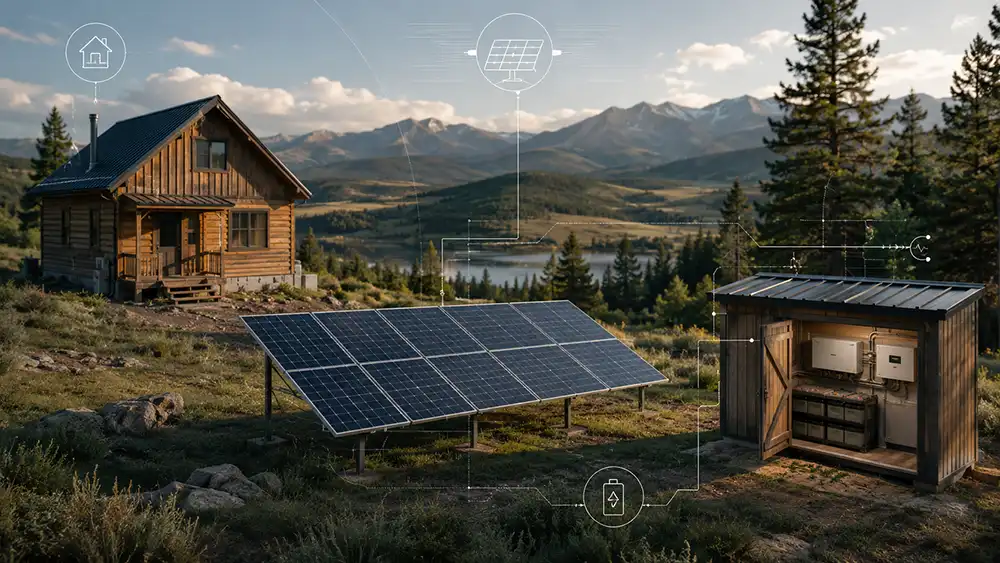
Off grid solar system sizing calculator tools are useful only when they are based on real energy use, realistic sun hours and proper battery storage assumptions. An off-grid solar system is not sized by panel wattage alone. It must be sized around your daily kWh consumption, worst-month solar production, battery backup days, inverter surge loads and total system losses.
This off grid solar system sizing calculator helps estimate the three core parts of a standalone solar power system:
- Solar panel array size
- Battery bank capacity
- Inverter size
Use this guide if you are planning solar power for an off-grid cabin, homestead, RV, tiny house, workshop, garden house or remote backup power system.
The calculator gives a practical starting point, but the final design should always account for local climate, shading, wiring distance, battery chemistry and safety requirements.
Off-Grid Solar System Sizing Calculator
Estimate solar panel size, battery bank capacity and inverter size for an off-grid cabin, RV, homestead or backup power system.
Estimated System Size
Off-Grid Solar System Sizing Calculator
Use the calculator below to estimate the size of your off-grid solar power system.
The calculator is designed to answer three important questions:
- How many watts of solar panels do I need?
- How large should my battery bank be?
- What size inverter do I need for my off-grid system?
For the most accurate result, start by listing every appliance you want to run. Include lights, refrigerator, freezer, water pump, Wi-Fi router, laptop, phone charging, power tools, fans and any kitchen appliances.
What This Off Grid Solar System Sizing Calculator Measures
An off grid solar system sizing calculator should not only calculate solar panel wattage. A complete off-grid design needs to estimate generation, storage and power delivery.
The main sizing factors are:
| Factor | Why It Matters |
|---|---|
| Daily energy use | Determines how much electricity your system must produce per day |
| Peak sun hours | Determines how much solar energy your panels can realistically generate |
| System losses | Accounts for heat, wiring, inverter loss, battery charging loss and dust |
| Backup days | Determines how long the system can run without strong sunlight |
| Battery DoD | Determines usable battery capacity |
| Battery voltage | Affects current, cable size and inverter compatibility |
| Running load | Determines minimum inverter size |
| Surge load | Determines whether motors, pumps and compressors can start safely |
If you already know your daily consumption, you can use the calculator immediately. If not, calculate your daily load first.
Basic Off-Grid Solar Sizing Formula
The core formula for solar panel sizing is:
Solar array watts = Daily watt-hours ÷ Peak sun hours ÷ System efficiency
Example:
A cabin uses 5,000Wh per day.
The location receives 4 peak sun hours per day.
The estimated system efficiency is 75%.
5,000Wh ÷ 4 ÷ 0.75 = 1,667W
In this case, the minimum solar array size is about 1.7kW. With a 20% design margin, a practical recommendation would be around 2.0kW of solar panels.
This is why an off grid solar system sizing calculator should always include peak sun hours and system efficiency. A 2kW solar array in Arizona will not perform the same as a 2kW solar array in a cloudy mountain valley.
Step 1: Calculate Your Daily Energy Use
Before using an off grid solar system sizing calculator, calculate your daily electricity consumption in watt-hours.
Use this formula:
Watt-hours per day = Appliance watts × Hours used per day
Example appliance list:
| Appliance | Watts | Hours Per Day | Daily Energy |
| LED lights | 60W | 5h | 300Wh |
| Refrigerator | 120W average | 10h equivalent | 1,200Wh |
| Laptop | 60W | 4h | 240Wh |
| Wi-Fi router | 12W | 24h | 288Wh |
| Water pump | 800W | 0.5h | 400Wh |
| Phone charging | 30W | 2h | 60Wh |
| Small tools | 500W | 0.5h | 250Wh |
Total:
2,738Wh/day
Round this up to 3,000Wh/day, or 3kWh/day, to create a safer design estimate.
For a more detailed storage calculation, use our off-grid battery bank sizing calculator to estimate amp-hours, kilowatt-hours, usable depth of discharge and backup autonomy.
Step 2: Use Peak Sun Hours, Not Daylight Hours
Peak sun hours are not the same as daylight hours.
A location may have 10 hours of daylight, but only 3 to 5 equivalent full-power solar hours. Peak sun hours convert changing sunlight intensity into a usable design number.
For example:
If your location receives 4 peak sun hours, a 1,000W solar array can theoretically produce:
1,000W × 4 = 4,000Wh
But after losses, real production may be closer to:
4,000Wh × 0.75 = 3,000Wh
For accurate location-based solar estimates, check the NREL PVWatts Calculator. For deeper solar radiation data, you can also use the National Solar Radiation Database.
When designing an off-grid system for year-round use, do not size the system from the best summer month. Use the weakest solar month instead.
Step 3: Add Realistic System Losses
Solar panels rarely produce their rated wattage under real field conditions. Heat, dust, cable resistance, charge controller conversion, battery charging efficiency and inverter losses all reduce usable energy.
Typical off-grid system efficiency assumptions:
| System Condition | Efficiency Assumption |
| Excellent design, clean panels, short cables | 80–85% |
| Typical off-grid cabin system | 70–80% |
| Long cable runs, heat, dust or partial shade | 60–70% |
A good default for an off grid solar system sizing calculator is 75% system efficiency.
Example:
Daily use: 6,000Wh
Peak sun hours: 4
System efficiency: 75%
6,000Wh ÷ 4 ÷ 0.75 = 2,000W
A practical solar array size would be 2.0kW to 2.5kW.
Step 4: Calculate Battery Bank Size
Battery storage is what makes an off-grid solar system usable at night, during storms and during cloudy weather.
The basic battery formula is:
Battery bank capacity = Daily kWh use × Backup days ÷ Battery depth of discharge
Example:
Daily use: 5kWh/day
Backup days: 2
Battery depth of discharge: 80%
5kWh × 2 ÷ 0.80 = 12.5kWh
This means the system needs about 12.5kWh of nominal battery capacity.
To convert battery capacity into amp-hours:
Battery amp-hours = Battery Wh ÷ Battery voltage
For a 48V system:
12,500Wh ÷ 48V = 260Ah
So this example would need approximately 260Ah at 48V.
If you are comparing battery types, read our LiFePO4 vs gel battery comparison before choosing storage. For older systems, our upgrade lead acid to LiFePO4 calculator can help estimate how much lithium capacity is needed to replace AGM, gel or flooded lead-acid batteries.
Step 5: Choose the Right Battery Voltage
Battery voltage affects current, wire size, inverter selection and efficiency.
The most common off-grid system voltages are:
| System Voltage | Best For |
| 12V | Small sheds, vans, tiny DC systems |
| 24V | Small cabins, medium solar systems, moderate inverter loads |
| 48V | Full-time cabins, homesteads, larger inverters and 3kW+ systems |
Higher voltage reduces current.
Example:
A 3,000W inverter on a 12V system:
3,000W ÷ 12V = 250A
A 3,000W inverter on a 48V system:
3,000W ÷ 48V = 62.5A
That difference is huge. Lower current means smaller cables, less voltage drop and better efficiency.
For most serious cabin and homestead systems, 48V is usually the better long-term choice. For a full comparison, see our guide to 12V vs 24V vs 48V solar system design.
Step 6: Size the Inverter
The inverter converts battery power into AC power for appliances. It must be sized for both continuous load and surge load.
Basic formula:
Minimum inverter size = Maximum simultaneous running watts × 1.25
Example:
If your highest simultaneous load is 2,000W:
2,000W × 1.25 = 2,500W
You would choose at least a 2,500W inverter.
However, some appliances need much more power for a few seconds when they start. These include:
- Refrigerators
- Freezers
- Well pumps
- Pressure pumps
- Power tools
- Air compressors
- Washing machines
A refrigerator may run at 150W but surge to 800W or more during startup. A pump may run at 800W but surge to 2,400W.
Use our inverter size calculator for off-grid solar to estimate both continuous inverter capacity and surge capacity.
Step 7: Size the Charge Controller
The charge controller must handle the solar array voltage and current. MPPT charge controllers are common in modern off-grid systems because they allow higher PV array voltage and better energy harvest than basic PWM controllers.
Important charge controller values include:
- PV open-circuit voltage
- Maximum PV input voltage
- Battery charging current
- Cold temperature voltage correction
- Solar array wattage
- Battery bank voltage
If your solar array voltage is too high for the controller, the controller can be damaged. If the current rating is too low, the controller may clip production or overheat.
Use our MPPT charge controller sizing calculator before finalizing your panel string layout.
Step 8: Size Battery Cables and Protection
High-current DC systems need properly sized cables, fuses and breakers. This is especially important for 12V and 24V systems where current can become very high.
Cable sizing depends on:
- Inverter wattage
- Battery voltage
- Cable length
- Acceptable voltage drop
- Maximum current
- Fuse or breaker rating
Example:
A 3,000W inverter at 12V may pull more than 250A before losses. That requires very large cables and proper overcurrent protection.
The same 3,000W inverter at 48V may pull around 63A before losses, making the system easier and safer to wire.
Use our battery cable size calculator to estimate cable gauge and voltage drop for your off-grid battery-to-inverter connection.
Example 1: Small Weekend Cabin
Daily energy use: 2kWh/day
Peak sun hours: 4
System efficiency: 75%
Backup days: 1.5
Battery DoD: 80%
System voltage: 24V
Solar array:
2,000Wh ÷ 4 ÷ 0.75 = 667W
With a design margin, choose around 800W of solar panels.
Battery bank:
2kWh × 1.5 ÷ 0.80 = 3.75kWh
Battery amp-hours at 24V:
3,750Wh ÷ 24V = 156Ah
Recommended battery bank:
24V 150Ah to 200Ah LiFePO4
Inverter recommendation:
A 1,500W to 2,000W pure sine wave inverter is usually enough for lights, a small refrigerator, laptop, router and occasional small tools.
Example 2: Full-Time Off-Grid Cabin
Daily energy use: 6kWh/day
Winter peak sun hours: 3.5
System efficiency: 75%
Backup days: 2.5
Battery DoD: 80%
System voltage: 48V
Solar array:
6,000Wh ÷ 3.5 ÷ 0.75 = 2,286W
With margin, choose around 3,000W of solar panels.
Battery bank:
6kWh × 2.5 ÷ 0.80 = 18.75kWh
Battery amp-hours at 48V:
18,750Wh ÷ 48V = 391Ah
Recommended battery bank:
48V 400Ah LiFePO4, or roughly 20kWh nominal storage
Inverter recommendation:
A 3,000W to 5,000W pure sine wave inverter is usually more appropriate for a full-time cabin with a refrigerator, pump, lights, electronics and occasional power tools.
Example 3: Remote Homestead
Daily energy use: 12kWh/day
Winter peak sun hours: 3
System efficiency: 70%
Backup days: 2
Battery DoD: 80%
System voltage: 48V
Solar array:
12,000Wh ÷ 3 ÷ 0.70 = 5,714W
With margin, choose around 6kW to 7kW of solar panels.
Battery bank:
12kWh × 2 ÷ 0.80 = 30kWh
Battery amp-hours at 48V:
30,000Wh ÷ 48V = 625Ah
Recommended battery bank:
48V 600Ah to 700Ah LiFePO4
Inverter recommendation:
A remote homestead may need a 6,000W to 10,000W inverter, depending on pump loads, kitchen loads, workshop tools and backup generator strategy.
For larger systems, review the U.S. Department of Energy solar-plus-storage basics to understand how solar generation and battery storage work together.
How Much Solar Power Do You Need for an Off-Grid Cabin?
Here are rough starting points:
| Daily Energy Use | Typical Use Case | Solar Array | Battery Bank |
| 1–2kWh/day | Shed, tiny cabin, lights, phone charging | 400W–800W | 2–5kWh |
| 3–5kWh/day | Weekend cabin, fridge, lights, pump | 1.2kW–2.5kW | 5–12kWh |
| 6–10kWh/day | Full-time small cabin | 3kW–5kW | 15–25kWh |
| 10–20kWh/day | Larger off-grid home | 6kW–12kW | 25–50kWh |
| 20kWh+/day | Full homestead with large loads | 12kW+ | 50kWh+ |
These are only starting points. The final result from an off grid solar system sizing calculator depends on location, winter sunlight, appliance efficiency, wiring distance and backup requirements.
Common Off-Grid Solar Sizing Mistakes
Sizing the system from solar panel watts only
A 2,000W solar array does not produce 2,000W all day. Daily production depends on peak sun hours, panel angle, shade, temperature and system losses.
Ignoring the worst solar month
If you use annual average sun hours, your system may look fine on paper but fail in winter. Off-grid systems should be designed around the weakest season if they are used year-round.
Underestimating refrigerators and pumps
Refrigerators, freezers and pumps have startup surges. The inverter must handle these short surge loads without shutting down.
Using electric heating off-grid
Electric heaters, electric water heaters and large resistance loads can make the system extremely expensive. In most off-grid homes, heating is better handled with wood, propane, solar thermal or high-efficiency heat pump systems.
Building a large system at 12V
A 12V system can work for small setups, but large inverters create very high current. High current increases cable cost, voltage drop and safety risk.
Recommended Design Margins
An off-grid system should not be sized with zero margin.
Use these practical design margins:
| Component | Recommended Margin |
| Solar array | Add 15–30% |
| Battery bank | Add 10–25% |
| Inverter continuous rating | Add at least 25% |
| Inverter surge rating | Match startup loads |
| Charge controller | Size for cold-weather VOC |
| Battery cables | Size for current and voltage drop |
A conservative design may cost more at the beginning, but it reduces low-battery shutdowns, generator runtime and equipment stress.
Final Recommendation
An off grid solar system sizing calculator is the right starting point, but the best system design comes from matching the numbers to real-life use.
For a reliable off-grid solar system, follow this order:
- Calculate your daily energy use in watt-hours.
- Use worst-month peak sun hours.
- Apply realistic system losses.
- Size the solar panel array.
- Size the battery bank for backup days and usable DoD.
- Choose the correct battery voltage.
- Size the inverter for continuous and surge loads.
- Size the charge controller for PV voltage and current.
- Size battery cables, fuses and breakers correctly.
- Add safety margin before buying equipment.
A well-designed off-grid solar system is not simply the biggest system you can afford. It is the system that matches your loads, location, battery chemistry, backup strategy and seasonal solar conditions.
Frequently Asked Questions
How do I calculate the size of an off-grid solar system?
Start by calculating your daily energy use in watt-hours. Then divide that number by your local peak sun hours and system efficiency. After that, size the battery bank based on backup days and usable depth of discharge.
How many solar panels do I need for an off-grid cabin?
A small weekend cabin may need 400W to 1,000W of solar panels, while a full-time off-grid cabin often needs 3kW to 6kW or more. The exact number depends on daily energy use, winter sun hours and battery backup requirements.
What is the best battery voltage for an off-grid solar system?
Small systems can use 12V, medium cabin systems often use 24V, and larger off-grid homes usually work better with 48V. Higher voltage reduces current, cable size and voltage drop.
How many batteries do I need for off-grid solar?
Battery quantity depends on daily kWh use, backup days, battery voltage and usable depth of discharge. For example, a 5kWh/day cabin with 2 backup days and 80% DoD needs about 12.5kWh of nominal battery capacity.
Should I size my off-grid solar system for winter?
Yes, if the system will be used year-round. Winter usually has shorter days, lower sun angle and weaker solar production. Designing from annual average sun hours can undersize the system for winter use.
4 thoughts on “Off-Grid Solar System Sizing Calculator: Panels, Battery Bank and Inverter Size”
Comments are closed.