
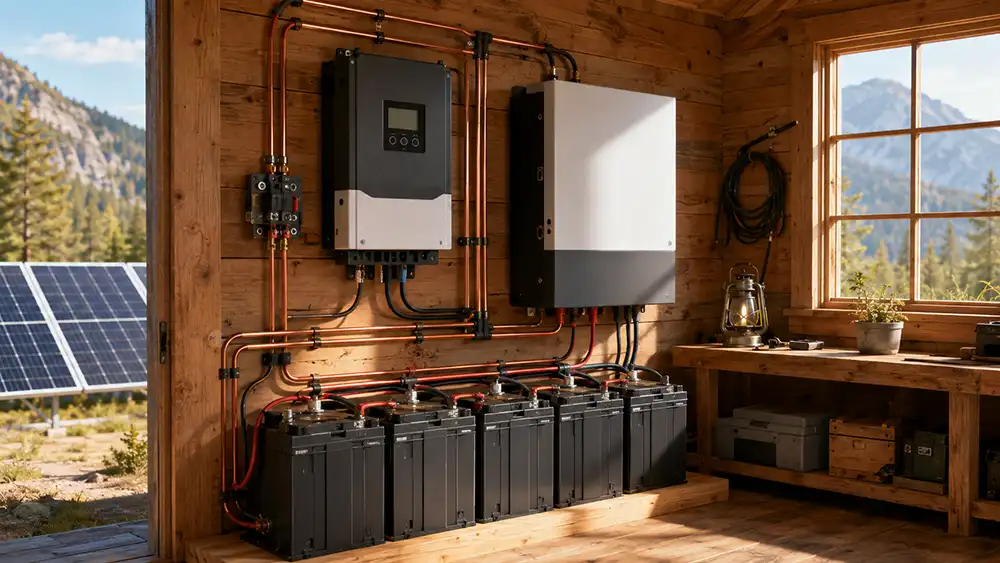
A proper mppt charge controller sizing calculator is essential when designing an off-grid solar system that will actually work under real field conditions. The MPPT controller is not just a small accessory between the solar panels and the battery bank. It decides how much solar power can be harvested, how safely the PV array can be connected, and whether the batteries receive the correct charging current.
Many off-grid system failures begin with a badly sized charge controller. The solar array may look correct on paper, the battery bank may be large enough, and the inverter may be powerful enough. But if the MPPT controller is undersized, over-volted, or mismatched to the battery voltage, the system will clip production, overheat, shut down, or fail prematurely.
This guide explains exactly how to size an MPPT charge controller for 12V, 24V and 48V off-grid solar systems using real engineering logic: PV array wattage, battery voltage, charge current, open-circuit voltage, temperature correction, controller limits, and safety margin.
MPPT Charge Controller Sizing Calculator
Calculate the recommended MPPT charge controller size for an off-grid solar system based on solar array wattage, battery voltage, PV string voltage, cold-weather VOC correction and controller voltage limit.
MPPT Sizing Result
Recommended Controller Class
Enter your system values and calculate.
This calculator provides a design estimate. Always verify the final MPPT charge controller selection with the solar panel datasheet, controller datasheet, battery charging specifications and local electrical code.
MPPT Charge Controller Sizing Calculator: What It Actually Calculates
An mppt charge controller sizing calculator should calculate more than one number. A proper controller selection requires three separate checks:
- Charge current rating
The controller must handle the charging current produced by the solar array. - Maximum PV input voltage
The PV string voltage must never exceed the controller’s maximum input voltage, especially in cold weather. - Battery voltage compatibility
The controller must support the battery bank voltage: 12V, 24V, 36V or 48V, depending on the system.
A mistake in any of these three areas can create a weak or unsafe off-grid system.
Quick Answer: How Do You Size an MPPT Charge Controller?
Use this basic formula:
MPPT current rating = Solar array watts ÷ Battery bank voltage
Then add a safety margin of 20–30%.
Example:
A 2,000W solar array charging a 24V battery bank:
2,000W ÷ 24V = 83.3A
With a 25% margin:
83.3A × 1.25 = 104A
Recommended controller size:
100A to 120A MPPT charge controller
For a 48V system, the same 2,000W array needs much less current:
2,000W ÷ 48V = 41.6A
With margin:
41.6A × 1.25 = 52A
Recommended controller size:
60A MPPT charge controller
This is why 48V systems are more efficient and easier to scale.
Why MPPT Controllers Matter in Off-Grid Solar
MPPT stands for Maximum Power Point Tracking. A solar panel does not produce a fixed voltage and current all day. Its output changes with sunlight, temperature, shading, panel angle and load conditions.
The MPPT controller continuously searches for the voltage and current point where the solar array produces the most power. It then converts that higher PV voltage into the correct charging voltage for the battery bank.
This is the key advantage of MPPT over simple PWM controllers.
A PWM controller essentially pulls the panel voltage down toward battery voltage. An MPPT controller allows the solar array to operate at a higher and more efficient voltage, then converts that energy into usable battery charging current.
For off-grid cabins, homesteads, RVs and remote systems, this matters because every watt counts.
The Three Numbers That Decide MPPT Size
1. Solar Array Wattage
Solar array wattage is the total rated wattage of all connected panels.
Example:
Four 400W panels:
4 × 400W = 1,600W solar array
This number is used to estimate charging current.
2. Battery Bank Voltage
Battery voltage determines how much current the controller must output.
For the same solar array:
- 1,600W ÷ 12V = 133A
- 1,600W ÷ 24V = 66A
- 1,600W ÷ 48V = 33A
This is why large off-grid systems usually use 48V battery banks.
3. PV Open-Circuit Voltage
Open-circuit voltage, or Voc, is the maximum voltage a solar panel can produce when it is not under load.
This matters because MPPT controllers have a maximum PV input voltage, such as:
- 75V
- 100V
- 150V
- 250V
- 450V
If the PV string voltage exceeds this limit, the controller can be damaged.
MPPT Charge Controller Current Formula
The basic current formula is:
Controller current = Total solar array watts ÷ Battery voltage
Then add safety margin:
Recommended controller current = Controller current × 1.25
Example:
Solar array: 3,000W
Battery bank: 48V
3,000W ÷ 48V = 62.5A
With 25% safety margin:
62.5A × 1.25 = 78A
Recommended MPPT controller:
80A
This is the cleanest sizing method for current rating.
MPPT Voltage Formula: PV String Voc
The voltage side is just as important.
Formula:
Total string Voc = Panel Voc × Number of panels in series
Example:
Panel Voc: 41V
Panels in series: 3
41V × 3 = 123V
If the MPPT controller has a 150V PV input limit, this looks safe at first.
But cold weather increases panel voltage. That means the real cold-weather Voc may be higher than the datasheet value at standard test conditions.
A professional design always includes cold temperature correction.
Cold Weather Voltage Correction
Solar panel voltage rises when temperature drops. This is one of the most common mistakes in DIY MPPT sizing.
A PV string that is safe in summer may exceed the controller’s voltage limit on a cold winter morning.
A practical rule:
- Mild climate: add 10% Voc margin
- Cold climate: add 15–20% Voc margin
- Very cold mountain climate: calculate exact temperature coefficient from the panel datasheet
Example:
Panel Voc: 41V
Panels in series: 3
String Voc: 123V
Cold correction at 15%:
123V × 1.15 = 141.45V
This is still under a 150V controller limit, but the margin is small.
If you used four panels in series:
41V × 4 = 164V
With cold correction:
164V × 1.15 = 188.6V
That would exceed a 150V controller and could destroy it.
MPPT Sizing Table for Common Off-Grid Systems
| Solar Array Size | Battery Voltage | Base Current | Recommended MPPT Size |
|---|---|---|---|
| 400W | 12V | 33A | 40A |
| 800W | 12V | 67A | 80A |
| 1,200W | 24V | 50A | 60A |
| 2,000W | 24V | 83A | 100A |
| 3,000W | 48V | 62.5A | 80A |
| 5,000W | 48V | 104A | 120A–150A |
| 8,000W | 48V | 167A | Multiple controllers |
This table gives practical starting points, not final engineering approval. Final design must include PV voltage, cold correction, controller datasheet limits and wiring layout.
Example 1: Small 12V Cabin System
System:
- 600W solar array
- 12V LiFePO4 battery
- Short wire runs
- LED lights, small fridge, USB charging
Charge current:
600W ÷ 12V = 50A
With 25% margin:
50A × 1.25 = 62.5A
Recommended MPPT:
60A to 70A
A 40A controller would likely clip production during good sun. A 60A controller is the more stable choice.
Example 2: 24V Weekend Cabin System
System:
- 1,600W solar array
- 24V battery bank
- Refrigerator, lights, router, pump
- Seasonal cabin use
Charge current:
1,600W ÷ 24V = 66.6A
With 25% margin:
66.6A × 1.25 = 83.2A
Recommended MPPT:
80A to 100A
If the panels are wired in series-parallel, the controller must also be checked against maximum PV input voltage.
Example 3: 48V Full Off-Grid Cabin
System:
- 4,000W solar array
- 48V LiFePO4 battery bank
- 5kW inverter
- Fridge, freezer, pump, tools and internet
Charge current:
4,000W ÷ 48V = 83.3A
With 25% margin:
83.3A × 1.25 = 104A
Recommended MPPT:
100A to 120A, or two smaller MPPT controllers depending on panel layout.
For large systems, splitting the array across multiple MPPT controllers often improves reliability and shade tolerance.
Can You Oversize Solar Panels on an MPPT Controller?
Yes, but only within the manufacturer’s limits.
PV oversizing means installing more panel wattage than the controller’s rated charging output. This can make sense in cloudy climates, winter-heavy systems or off-grid cabins that need more production during weak sun conditions.
For example, a 100A controller on a 48V battery bank may output roughly:
100A × 48V = 4,800W
A designer may connect slightly more PV wattage than this to improve morning, evening and winter production.
However, oversizing does not mean ignoring voltage limits. The PV open-circuit voltage must still remain below the controller’s maximum PV voltage in the coldest expected conditions.
Current clipping is usually acceptable. Over-voltage is not.
MPPT Controller Size vs Solar Panel String Design
MPPT sizing is not only about total panel wattage. String design decides the PV voltage.
Panels in series increase voltage.
Panels in parallel increase current.
Example with 400W panels:
- Voc: 41V
- Vmp: 34V
- Imp: 11.8A
Three panels in series:
- Voc: 123V
- Vmp: 102V
- Current: 11.8A
Two strings of three panels in parallel:
- Voc: 123V
- Vmp: 102V
- Current: 23.6A
- Total power: 2,400W
This layout may work well with a 150V MPPT controller if cold-weather Voc stays below the limit.
MPPT Sizing for LiFePO4 Batteries
LiFePO4 batteries are common in modern off-grid solar systems because they offer high usable capacity, stable voltage and long cycle life.
But they require correct charging settings.
When sizing an MPPT controller for LiFePO4, confirm:
- supported lithium charging profile
- programmable absorption voltage
- programmable float voltage
- low-temperature charge protection
- battery management system compatibility
- correct battery voltage detection
A controller sized correctly for current but configured incorrectly for lithium charging can still damage the battery or reduce lifespan.
Common MPPT Sizing Mistakes
Mistake 1: Choosing by solar panel wattage only
Panel wattage is only one part of the calculation. The controller must also match battery voltage and PV string voltage.
Mistake 2: Ignoring cold-weather Voc
This is the most dangerous mistake. A controller can survive current clipping, but it may not survive over-voltage.
Mistake 3: Using 12V for a large array
A 2,000W solar array on 12V requires very high charge current.
2,000W ÷ 12V = 166A
That usually means multiple controllers or a higher-voltage battery system.
Mistake 4: Undersizing controller current
An undersized controller may clip solar production and run hot. Occasional clipping is normal in oversized PV designs, but constant clipping means the controller is too small.
Mistake 5: Forgetting wire size and breaker ratings
The MPPT controller is part of a larger electrical system. PV wire, battery cable, fuses, breakers and disconnects must all be sized correctly.
When Should You Use Multiple MPPT Controllers?
Multiple MPPT controllers are often better than one large controller when:
- the solar array faces different directions
- part of the array is shaded
- the system is larger than 4–5kW
- roof space forces different string lengths
- you want redundancy
- you want easier expansion later
Example:
Instead of one 150A controller, a full off-grid cabin may use:
- one 80A MPPT for the south-facing array
- one 60A MPPT for the west-facing array
This allows each array section to track its own maximum power point.
MPPT vs PWM: Which One Should You Use?
For serious off-grid solar systems, MPPT is usually the better choice.
PWM may still work for:
- very small 12V systems
- basic shed lighting
- low-cost emergency kits
MPPT is better for:
- cabins
- homesteads
- RV solar systems
- LiFePO4 battery banks
- larger solar arrays
- cold climates
- systems with higher PV string voltage
MPPT controllers cost more, but they allow better panel wiring, higher voltage input and improved energy harvest.
Internal Links for OffGridOrganic
Recommended placement:
Use the off-grid solar system sizing calculator when explaining total array size.
Use the 12V vs 24V vs 48V solar system article when explaining battery voltage.
Use the battery cable size calculator when discussing current, breakers and wiring.
Use the inverter size calculator for off-grid solar when discussing system load planning.
External References to Add
Use these as technical references:
- Victron Energy MPPT Calculator
- Victron Energy Solar Charge Controller Documentation
- NREL PVWatts Calculator
- Blue Sea Systems voltage drop resources
Final Recommendation
An mppt charge controller sizing calculator should always check current rating, PV input voltage, battery voltage and cold-weather voltage rise.
For most off-grid systems:
- Small 12V systems need careful current sizing.
- Medium 24V systems need balanced controller capacity.
- Larger 48V systems are easier to scale and more efficient.
- Cold-weather Voc must always be checked before buying a controller.
- Large arrays often perform better with multiple MPPT controllers.
The safest sizing process is:
- Calculate total solar array watts.
- Divide array watts by battery voltage.
- Add 20–30% current margin.
- Calculate PV string Voc.
- Apply cold-weather voltage correction.
- Confirm controller PV input voltage limit.
- Confirm lithium battery compatibility.
- Size cables, fuses and breakers correctly.
A well-sized MPPT controller does not just protect equipment. It improves solar harvest, stabilizes battery charging and keeps an off-grid system reliable through real seasonal conditions.