
Last updated: August 3, 2026
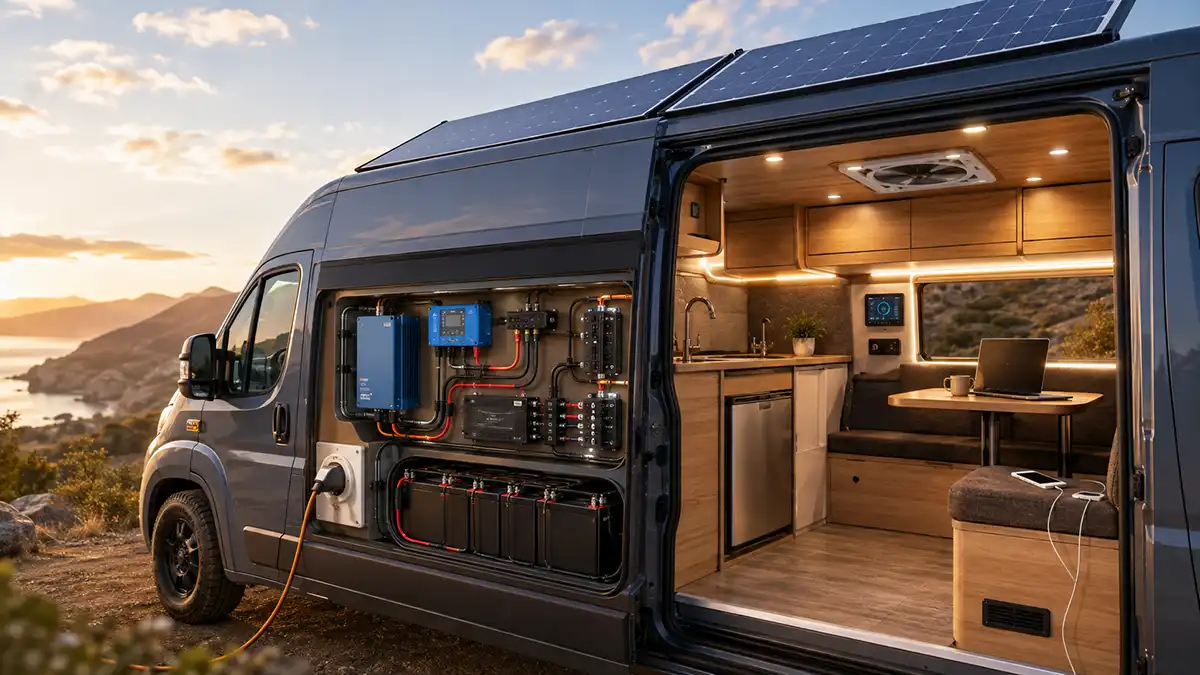
The Camper Van Electrical System Calculator below estimates your daily energy use and recommends a practical battery bank, solar array, inverter, MPPT charge controller, alternator charger and shore charger. It is designed for camper vans, motorhomes, RV conversions, truck campers and other mobile off-grid systems.
A reliable van electrical system starts with the appliances you actually plan to run. Copying a generic 200Ah battery and 400W solar setup may work for one traveler but fail for another. A 12V refrigerator, roof fan and LED lights use far less energy than an induction cooktop, electric water heater, gaming computer or air conditioner.
Use the calculator first, then read the guide to understand how each result is produced. The tool provides a planning estimate rather than a final wiring diagram. Cable size, fuse type, grounding, alternator limits, battery-management requirements and local electrical rules must still be verified for the specific components and vehicle.
Quick Answer: What Size Electrical System Does a Camper Van Need?
A light-use camper van often works with a 100–200Ah LiFePO4 battery, 200–400W of solar and a 500–1,000W inverter. A full-time van with laptops, a larger refrigerator and regular AC appliances may need 200–400Ah of LiFePO4, 400–800W of solar and a 1,500–3,000W inverter.
These are only broad examples. The correct system size depends on daily watt-hours, desired days of autonomy, available sunlight, battery chemistry, charging while driving and which AC appliances will operate at the same time.
Camper Van Electrical System Calculator
Add your appliances and calculate daily energy, battery capacity, solar wattage, inverter size, MPPT output current, DC-DC charging and shore charging.
Daily Appliance Loads
| Appliance | Watts | Hours/day | Qty | Power type | Runs with other AC loads? | Remove |
|---|
Your Camper Van Electrical Results
Calculation summary
How the Camper Van Electrical System Calculator Works
The calculator begins with a load list. Every appliance is assigned a power rating in watts, the number of hours it runs each day and a quantity. The tool converts these values into daily watt-hours and applies inverter losses to AC appliances.
It then adds the safety margin you select and uses that adjusted daily consumption to estimate the battery bank, solar array and charging sources. The inverter is sized separately from daily energy use because an inverter must handle the highest group of AC loads running simultaneously.
Do Not Treat the Result as a Wiring Diagram
The calculator estimates component capacity. It does not know the exact cable routing, ambient temperature, terminal quality, alternator duty cycle, panel open-circuit voltage, local standards or manufacturer-specific fuse requirements. Final installation decisions should be checked against the manuals for every device and, where appropriate, by a qualified installer.
How to Calculate Daily Camper Van Energy Use
Daily energy use is measured in watt-hours. Multiply appliance power by daily runtime and quantity:
A 45W refrigerator that effectively runs for 12 hours per day uses approximately 540Wh. A 65W laptop used for four hours consumes about 260Wh. A 1,500W induction cooktop used for only 20 minutes still uses about 500Wh before inverter losses.
Duty-cycled appliances should use effective runtime rather than 24 hours. A compressor refrigerator may remain switched on all day but the compressor does not necessarily run continuously. Use measured consumption from a power meter whenever possible.
| Typical Load | Example Power | Example Runtime | Approximate Daily Energy |
|---|---|---|---|
| 12V compressor refrigerator | 45W while running | 12 effective hours | 540Wh |
| Roof ventilation fan | 30W | 8 hours | 240Wh |
| LED lighting | 20W total | 5 hours | 100Wh |
| Laptop charger | 65W | 4 hours | 260Wh before losses |
| Induction cooktop | 1,500W | 0.33 hours | 495Wh before losses |
| Water pump | 60W | 0.5 hours | 30Wh |
The examples above are planning values, not product specifications. Use the label, technical sheet or measured energy use of the appliance you will actually install.
How to Size a Camper Van Battery Bank
Battery-bank sizing depends on daily consumption, autonomy days, usable depth of discharge and battery efficiency. The calculator uses different planning assumptions for LiFePO4, AGM and gel batteries.
LiFePO4 batteries generally provide more usable capacity than traditional lead-acid batteries, so the same daily load can often be supported by a smaller nominal amp-hour rating. The exact usable range must follow the battery manufacturer’s limits and BMS settings.
| Battery Type | Planning Usable Fraction | Calculator Efficiency | Planning Note |
|---|---|---|---|
| LiFePO4 | 80% | 95% | High usable capacity; verify low-temperature charging protection and BMS limits. |
| AGM | 50% | 85% | Larger nominal bank required for the same usable energy. |
| Gel | 50% | 85% | Charging voltage and current must match the manufacturer’s profile. |
For a deeper battery-only calculation, compare the result with our battery bank sizing guide. If you are replacing an existing lead-acid bank, use the lead-acid to LiFePO4 calculator.
How Much Solar Does a Camper Van Need?
Solar size depends on daily energy use, useful peak sun hours and total system efficiency. Roof-mounted panels are affected by shading, dirt, temperature, orientation and the fact that a parked van cannot always face the ideal direction.
Use a conservative solar-resource value. A summer-only van traveling through sunny regions may use four to six peak sun hours. A three-season or winter setup may need a much lower planning value. NREL’s PVWatts tool can help estimate solar production by location, although a flat vehicle roof and mobile shading pattern still require additional judgment.
The calculator rounds solar size up to practical 50W increments. Actual panel selection will depend on available roof area, vents, antennas, roof racks and the voltage limits of the MPPT charge controller.
Solar Alone Is Not Always Enough
A van parked in shade or used through winter may not harvest enough solar to replace daily loads. Combining solar with a controlled DC-DC alternator charger and a shore charger usually creates a more resilient system.
What Size Inverter Does a Camper Van Need?
The inverter converts battery DC power into AC power. It should be sized for the AC appliances that may operate at the same time, not the total watt-hours used during the day.
The calculator automatically selects the highest individual AC load when no simultaneous boxes are checked. When several appliances may run together, check each of them in the load table.
Motors, compressors, microwave ovens and some power tools can require a startup surge above their running power. Confirm both continuous and surge ratings in the appliance and inverter manuals. Use a pure sine wave inverter for sensitive electronics and appliances that require clean AC power.
High-Power Inverters Create Very High DC Current
A 2,000W inverter on a 12V system can draw well over 180A after losses. Short, correctly sized battery cables, suitable terminals, busbars and circuit protection become critical. Higher-power systems may be more practical at 24V or 48V because increasing system voltage reduces current for the same power.
How to Size the MPPT Solar Charge Controller
The calculator estimates controller output current from the recommended solar wattage and battery charging voltage, then adds headroom and rounds up to a common controller size.
This output-current estimate is only one part of MPPT selection. You must also verify that the solar array’s maximum open-circuit voltage remains below the controller’s PV-input limit under the coldest expected conditions. Panel series and parallel configuration directly affect voltage and current.
Use our dedicated MPPT charge controller sizing calculator before purchasing a controller.
How to Size a DC-DC Alternator Charger
A DC-DC charger controls energy flow from the vehicle charging system to the house battery. This is particularly important for vehicles with smart alternators and for lithium battery banks that can accept high charging current.
The calculator estimates the charging current needed to replace one day’s adjusted energy use during the driving hours entered:
This does not mean the vehicle alternator can safely provide the calculated current. Check alternator output at idle and operating temperature, existing vehicle loads, manufacturer upfitter guidance, cable length and the battery’s maximum charge current. A smaller charger may be the correct choice when alternator capacity is limited.
How to Size a Camper Van Shore Charger
A shore charger replenishes the house battery from campsite or household AC power. The calculator estimates the current required to restore the usable portion of the recommended battery bank within the recharge time selected.
The result must stay within the battery manufacturer’s accepted charge-current range. Larger chargers reduce recharge time but may require a higher-capacity AC connection, heavier wiring and more ventilation.
An inverter/charger combines the inverter, automatic transfer function and battery charger in one device. Separate components can be easier to replace and may suit smaller systems, while an inverter/charger can simplify a high-power installation.
Should a Camper Van Use 12V, 24V or 48V?
Most conventional camper vans use 12V because vehicle systems and many appliances are designed for it. Higher system voltages reduce current for the same power and can make large inverter systems easier to cable.
| System Voltage | Best Fit | Main Advantage | Main Limitation |
|---|---|---|---|
| 12V | Small and medium camper systems | Wide appliance availability and simple vehicle integration | Very high current at large inverter loads |
| 24V | Medium and high-power conversions | Approximately half the current of a 12V system for the same power | Some 12V loads need a converter |
| 48V | Large all-electric or specialty systems | Much lower current for high-power equipment | More complex integration and fewer native vehicle loads |
When “Auto” is selected, the calculator recommends a planning voltage based on adjusted daily energy use and inverter size. This is a starting point, not a command. Read our 12V vs 24V vs 48V comparison before committing to a system architecture.
Example Camper Van Electrical System Sizes
The following examples show the type of systems the calculator may produce. They are not universal packages because climate, travel pattern and appliance choices can change the result significantly.
| Use Pattern | Daily Energy | LiFePO4 Bank | Solar | Inverter |
|---|---|---|---|---|
| Weekend minimalist | 600–1,000Wh | 100–150Ah at 12V | 200–300W | 300–800W |
| Three-season traveler | 1,200–2,000Wh | 200–300Ah at 12V | 400–600W | 1,000–2,000W |
| Full-time remote worker | 2,000–3,500Wh | 300–500Ah at 12V or equivalent 24V bank | 600–1,000W | 2,000–3,000W |
| High-power all-electric build | 4,000Wh or more | Large 24V or 48V bank | Roof-limited; usually multiple charging sources | 3,000W or more |
High-power electric cooking, water heating and air conditioning can exceed the practical roof-solar and battery capacity of many vans. Reducing loads is often cheaper, lighter and more reliable than continually increasing battery size.
Common Camper Van Electrical System Mistakes
Buying the Battery Before Calculating Loads
A battery size chosen by habit may be too small for the intended appliances or unnecessarily large for a simple build. Calculate daily watt-hours first.
Using Appliance Maximum Power as Daily Energy
Watts and watt-hours are not the same. Watts describe instantaneous power; watt-hours describe energy consumed over time.
Assuming Nameplate Solar Output All Day
A 400W array does not produce 400W continuously. Sun angle, shading, temperature, conversion losses and seasonal conditions reduce daily harvest.
Sizing the Inverter from Daily Watt-Hours
Inverter size depends on simultaneous AC power and startup surge. Battery size depends mainly on total energy use and autonomy.
Ignoring Alternator Limits
A large lithium bank may accept more current than the vehicle charging system can comfortably provide. Use a controlled charger and verify alternator capability.
Choosing Cable Only by Ampacity
Cable must carry current safely and keep voltage drop within an acceptable range. Total circuit length includes both positive and negative conductor paths.
Installing a Fuse That Does Not Protect the Wire
Circuit protection is selected to protect the conductor and must not exceed its safe ampacity. Device manufacturers may specify a lower fuse value.
Forgetting Expansion
Leave reasonable capacity in distribution, busbars, charge controllers and cable routes if future loads are likely. Do not oversize every component blindly; design deliberate expansion points.
Camper Van Electrical Planning Checklist
- List every DC and AC appliance.
- Measure or verify realistic power consumption.
- Estimate summer and winter runtime separately.
- Choose a conservative autonomy target.
- Use location-appropriate peak sun hours.
- Select battery chemistry and usable depth of discharge.
- Check battery BMS current limits.
- Calculate simultaneous AC loads and surge requirements.
- Verify solar-panel roof space before finalizing wattage.
- Check MPPT output current and cold-weather PV voltage.
- Verify alternator and upfitter charging limits.
- Choose a realistic shore-power recharge time.
- Calculate every DC cable for current and voltage drop.
- Install circuit protection sized to protect each conductor.
- Use suitable busbars, disconnects and distribution blocks.
- Follow battery, inverter and charger manuals.
- Provide ventilation and mechanical protection.
- Keep high-current cable runs as short as practical.
- Label circuits and document the final installation.
- Have high-power AC/DC work reviewed when necessary.
Camper Van Electrical System FAQ
How many amp-hours does a camper van need?
A light-use van may need 100–200Ah of LiFePO4 at 12V, while a full-time build may require 200–500Ah or more. The correct size depends on daily watt-hours, autonomy days, battery chemistry and charging availability.
How much solar is enough for a camper van?
Many vans use 200–800W of solar. A reliable calculation divides adjusted daily energy use by conservative peak sun hours and total system efficiency. Roof area and seasonal travel may limit the practical array.
Can a 100Ah battery run a camper refrigerator?
It may run an efficient 12V compressor refrigerator and a few small loads, but runtime depends on actual refrigerator consumption, battery chemistry, temperature and other appliances. Use measured watt-hours rather than relying only on the 100Ah label.
What size inverter is best for a camper van?
Choose an inverter that can support the largest group of AC appliances operating simultaneously plus reasonable headroom. A small electronics-only system may need 500–1,000W, while induction cooking may require 2,000W or more.
Is 12V or 24V better for a camper van?
12V is simpler for most small and medium conversions. A 24V system can reduce current and cable size in higher-power builds, but 12V appliances may require a converter.
Does a camper van need a DC-DC charger?
A controlled DC-DC charger is commonly used when charging a house battery from the vehicle alternator, especially with smart alternators or lithium batteries. The correct current depends on alternator capacity, battery limits and driving time.
Can solar fully power a camper van?
Solar can cover daily loads when the array, sunlight and energy consumption are well matched. Winter, shade and high-power heating or cooking loads often require alternator or shore charging as backup.
How do I calculate camper van battery size from watt-hours?
Divide required nominal battery watt-hours by system voltage to obtain amp-hours. Before doing that, adjust daily energy for autonomy, usable depth of discharge and battery efficiency.
How large should the MPPT controller be?
The controller must handle the expected charge current and remain within its maximum PV input voltage. Verify cold-weather panel open-circuit voltage as well as output current.
Should the fuse match the appliance or the cable?
The primary role of circuit protection is to protect the conductor. A manufacturer may specify a lower fuse value for the equipment, but the fuse must never exceed the safe ampacity of the installed wire.
How accurate is this camper van electrical calculator?
It provides a detailed planning estimate based on the values entered. Accuracy depends on realistic appliance power, runtime, sun hours and charging assumptions. Final component and wiring selection must be checked against product manuals and installation conditions.
Final Recommendation
Begin with load reduction before increasing battery and solar capacity. Efficient refrigeration, LED lighting, direct DC charging and realistic appliance use can make the electrical system smaller, lighter and less expensive.
Run the calculator with at least three scenarios: normal summer use, poor-sun winter use and a high-consumption day. Build around the most demanding realistic scenario while retaining more than one charging source.
1 thought on “Camper Van Electrical System Calculator: Size Solar, Battery & Inverter”
Comments are closed.