
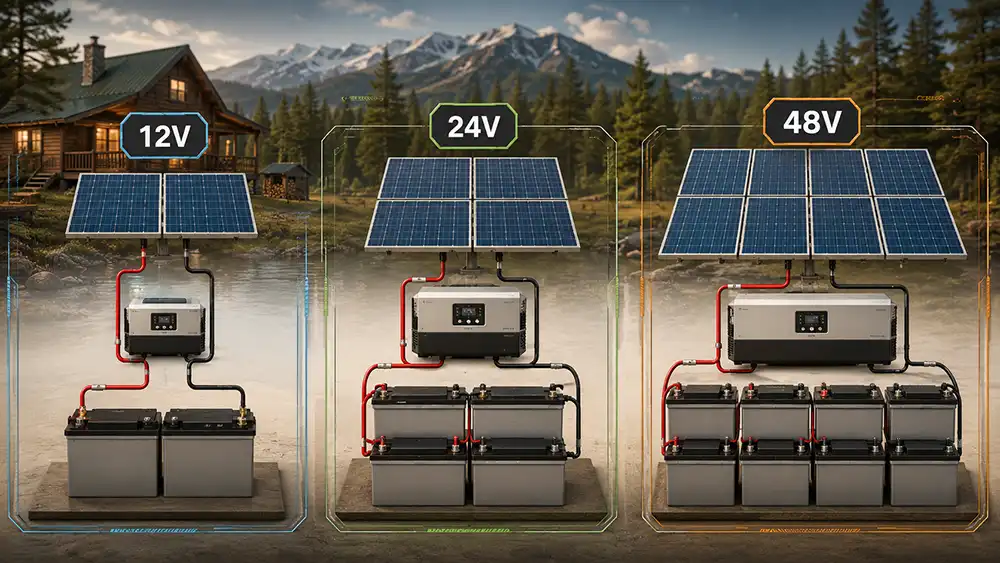
12V vs 24V vs 48V solar system design is one of the most important decisions in an off-grid power setup. The system voltage affects current, cable size, inverter selection, charge controller limits, battery bank layout, voltage drop, safety and long-term expandability.
A small shed with LED lights may work perfectly on 12V. A weekend cabin may be better on 24V. A full-time off-grid cabin, homestead or large solar system usually makes more sense at 48V.
The wrong voltage does not only make the system less efficient. It can also force oversized cables, expensive fuses, high current, inverter limitations and difficult future upgrades.
This guide compares 12V vs 24V vs 48V solar system design from a practical off-grid engineering perspective.
12V vs 24V vs 48V Current Calculator
Enter your inverter or load wattage to compare current draw at 12V, 24V and 48V.
Quick Answer: 12V, 24V or 48V?
Use this table as a starting point:
| System Voltage | Best For | Typical Inverter Size | Main Advantage | Main Limitation |
|---|---|---|---|---|
| 12V | Vans, small sheds, tiny cabins, DC lighting | Up to 1,500W | Simple, common, cheap components | Very high current at larger loads |
| 24V | Weekend cabins, small off-grid homes, medium systems | 1,500W–3,000W | Better efficiency than 12V, still simple | Less ideal for large whole-home systems |
| 48V | Full-time cabins, homesteads, large solar arrays | 3,000W–10,000W+ | Lower current, smaller cables, better scalability | Higher upfront component cost |
As a practical rule:
- Use 12V for very small systems.
- Use 24V for medium cabin systems.
- Use 48V for serious off-grid solar systems with large inverters, pumps, appliances or future expansion.
If you are still calculating your total solar and battery size, start with our off grid solar system sizing calculator before choosing system voltage.
Why System Voltage Matters
The basic electrical relationship is:
Watts = Volts × Amps
So:
Amps = Watts ÷ Volts
This means that for the same power load, a higher-voltage system carries less current.
Example with a 3,000W inverter:
| Battery Voltage | Current Before Losses |
| 12V | 250A |
| 24V | 125A |
| 48V | 62.5A |
This is the core reason 12V vs 24V vs 48V solar system design matters.
A 3,000W inverter on 12V pulls extremely high current. That requires very thick cables, short cable runs, large fuses and careful installation. The same inverter on 48V pulls only one-quarter of the current before losses.
Lower current usually means:
- smaller cable size
- lower voltage drop
- less heat
- easier inverter wiring
- better system efficiency
- easier expansion
- safer high-power design
12V Solar Systems
A 12V solar system is the most common choice for small DC power setups. It is widely used in vans, boats, RVs, small cabins, sheds and portable systems.
Best uses for 12V
A 12V system is suitable for:
- LED lighting
- phone charging
- small routers
- small fans
- small DC fridges
- water pumps with low power draw
- small RV and van systems
- basic weekend shed power
- solar systems below roughly 800W to 1,200W
Advantages of 12V
The biggest advantage of 12V is simplicity. Components are easy to find, many DC appliances are available in 12V, and small systems can be built cheaply.
12V is also convenient if the system directly powers DC loads without a large inverter. For example, a tiny shed with 12V lights, a USB charger and a small DC fan does not need a 48V battery bank.
Limitations of 12V
The main limitation is current.
A 2,000W inverter on 12V pulls:
2,000W ÷ 12V = 166.7A before losses
A 3,000W inverter pulls:
3,000W ÷ 12V = 250A before losses
After inverter losses and surge loads, current can be even higher. This creates serious cable sizing and voltage drop problems.
For this reason, 12V is usually not ideal for large inverters, long cable runs, full-time cabins or systems with pumps, refrigerators and workshop tools running together.
When to choose 12V
Choose 12V if:
- your system is small
- most loads are DC
- inverter size is below 1,500W
- battery-to-inverter cables are very short
- expansion is unlikely
- cost and simplicity matter more than scalability
Do not choose 12V just because it is familiar. If your system may grow, 24V or 48V is usually a better foundation.
24V Solar Systems
A 24V solar system is a strong middle ground. It is more efficient than 12V for medium loads but less expensive and complex than many 48V systems.
Best uses for 24V
A 24V system works well for:
- weekend cabins
- small off-grid houses
- garden houses
- medium RV systems
- small workshops
- solar arrays around 1kW to 3kW
- inverters around 1,500W to 3,000W
Advantages of 24V
Compared with 12V, a 24V system cuts current in half.
Example:
A 2,000W inverter at 12V:
2,000W ÷ 12V = 166.7A
A 2,000W inverter at 24V:
2,000W ÷ 24V = 83.3A
This makes cable sizing easier and reduces voltage drop.
24V also allows more practical inverter sizes for small cabins. It is a good choice when 12V is too limiting but 48V feels unnecessary.
Limitations of 24V
The limitation is scalability. A 24V system can run a cabin, but once inverter loads move toward 4,000W to 5,000W or more, current becomes high again.
A 5,000W inverter at 24V pulls:
5,000W ÷ 24V = 208A before losses
That is still a large DC current. For larger systems, 48V is usually cleaner and easier to wire.
When to choose 24V
Choose 24V if:
- your system is medium-sized
- your inverter is around 1,500W to 3,000W
- your daily energy use is moderate
- you want better efficiency than 12V
- you do not expect a large whole-home expansion
- you want a balanced cabin system without jumping to 48V
A 24V off-grid solar system can be an excellent choice for a weekend cabin, hunting cabin, small workshop or seasonal tiny house.
48V Solar Systems
A 48V solar system is the standard choice for larger off-grid power systems. It is common in full-time cabins, homesteads, larger workshops and whole-home backup systems.
Best uses for 48V
A 48V system is suitable for:
- full-time off-grid cabins
- homesteads
- large solar arrays
- inverter loads above 3,000W
- well pumps
- refrigerators and freezers
- larger tool loads
- systems that may expand later
- battery banks above roughly 10kWh
Advantages of 48V
The biggest advantage is lower current.
Example with a 5,000W inverter:
| Voltage | Current Before Losses |
| 12V | 416.7A |
| 24V | 208.3A |
| 48V | 104.2A |
A 48V system makes high-power loads more practical. It reduces cable size, voltage drop and heat compared with 12V or 24V.
48V also works well with modern server rack LiFePO4 batteries, larger inverter-chargers and scalable off-grid systems.
Limitations of 48V
A 48V system can cost more upfront. Components such as inverters, batteries, DC breakers and charge controllers must be compatible with 48V.
Another limitation is direct DC loads. Many small DC appliances are designed for 12V. If you need 12V DC loads inside a 48V system, you will need a DC-DC converter.
When to choose 48V
Choose 48V if:
- your inverter is 3,000W or larger
- you run pumps, refrigerators, freezers or tools
- your solar array is larger than 2kW to 3kW
- your battery bank is above 10kWh
- you want to expand later
- your system powers a full-time cabin or homestead
For most serious off-grid solar systems, 48V is the better long-term design choice.
Current Comparison: 12V vs 24V vs 48V
Current is the main technical difference between these systems.
| Load | 12V Current | 24V Current | 48V Current |
| 500W | 41.7A | 20.8A | 10.4A |
| 1,000W | 83.3A | 41.7A | 20.8A |
| 2,000W | 166.7A | 83.3A | 41.7A |
| 3,000W | 250A | 125A | 62.5A |
| 5,000W | 416.7A | 208.3A | 104.2A |
| 8,000W | 666.7A | 333.3A | 166.7A |
These numbers are before inverter efficiency losses. Real current will be slightly higher.
This table shows why 12V vs 24V vs 48V solar system voltage is not just a preference. It determines whether your design is practical.
Cable Size and Voltage Drop
Cable size is one of the biggest reasons to avoid low-voltage, high-power systems.
Voltage drop increases with:
- higher current
- longer cable runs
- smaller cable size
- lower system voltage
At 12V, even a small voltage drop can be significant. Losing 0.5V in a 12V system is a larger percentage loss than losing 0.5V in a 48V system.
Example:
- 0.5V drop on 12V = 4.17%
- 0.5V drop on 24V = 2.08%
- 0.5V drop on 48V = 1.04%
This is why 48V systems are easier to design for larger loads.
Before finalizing the system, use a battery cable size calculator to check the cable gauge between the battery bank and inverter. Cable size should be based on current, cable length, acceptable voltage drop and fuse rating.
Inverter Selection
Inverter availability is another major factor.
12V inverter range
12V inverters are common, but large 12V inverters create high current. A 3,000W 12V inverter can work, but it requires very careful wiring.
Best range:
300W to 1,500W
24V inverter range
24V inverters are a good middle ground for cabin systems.
Best range:
1,500W to 3,000W
48V inverter range
48V inverters are ideal for larger off-grid systems.
Best range:
3,000W to 10,000W+
If your loads include pumps, refrigerators, freezers or power tools, use an inverter size calculator for off-grid solar to estimate continuous wattage and surge wattage.
Battery Bank Design
System voltage also affects how batteries are connected.
12V battery bank
A 12V battery bank may use:
- one 12V battery
- multiple 12V batteries in parallel
Parallel connections increase amp-hour capacity while keeping voltage the same.
Example:
Two 12V 100Ah batteries in parallel:
12V 200Ah
24V battery bank
A 24V battery bank may use:
- one 24V battery
- two 12V batteries in series
- multiple 24V batteries in parallel
Two 12V 100Ah batteries in series:
24V 100Ah
The voltage doubles, but amp-hours stay the same.
48V battery bank
A 48V battery bank may use:
- one 48V battery
- four 12V batteries in series
- server rack LiFePO4 batteries
- multiple 48V batteries in parallel
Four 12V 100Ah batteries in series:
48V 100Ah
The energy is:
48V × 100Ah = 4,800Wh
That is the same energy as four 12V 100Ah batteries, but at higher voltage and lower current.
For a deeper storage calculation, use the off-grid battery bank sizing calculator to estimate kWh, amp-hours, backup days and usable depth of discharge.
Charge Controller Considerations
The charge controller must match both the solar array and battery bank voltage.
MPPT charge controllers are common in off-grid systems because they allow higher PV string voltage and can step down voltage to charge the battery bank.
Important charge controller values:
- maximum PV input voltage
- maximum charging current
- supported battery voltage
- PV open-circuit voltage
- cold-weather VOC correction
- solar array wattage limit
A 48V battery bank often works well with higher-voltage solar strings, but the charge controller must be sized correctly.
Before buying a controller, use an MPPT charge controller sizing calculator to check PV voltage, array current and controller limits.
Solar Array Size and System Voltage
The solar panel array does not have to match the battery bank voltage directly when using an MPPT controller. For example, you can have a higher-voltage PV string charging a 24V or 48V battery bank if the controller supports it.
However, larger solar arrays generally pair better with higher battery voltage.
Practical guide:
| Solar Array Size | Recommended System Voltage |
| 100W–800W | 12V |
| 800W–2,000W | 12V or 24V |
| 2,000W–4,000W | 24V or 48V |
| 4,000W+ | 48V |
This is not a strict rule, but it is a useful design starting point.
If you have not sized your solar array yet, use the off grid solar system sizing calculator first.
Example 1: Small 12V Shed System
Use case:
- LED lights
- phone charging
- small fan
- occasional tool battery charging
Daily use:
0.5kWh to 1kWh/day
Recommended design:
- 12V battery bank
- 200W to 600W solar array
- 500W to 1,000W inverter
- short DC cable runs
Why 12V works:
The system is small, current is manageable, and many loads can run directly on 12V DC.
Example 2: 24V Weekend Cabin System
Use case:
- lights
- refrigerator
- water pump
- router
- laptop
- small kitchen appliances
Daily use:
2kWh to 5kWh/day
Recommended design:
- 24V battery bank
- 1kW to 2.5kW solar array
- 2,000W to 3,000W inverter
- MPPT charge controller
Why 24V works:
The system is too large for comfortable 12V design, but it may not need a full 48V setup.
Example 3: 48V Full-Time Off-Grid Cabin
Use case:
- refrigerator
- freezer
- water pump
- lights
- internet
- laptops
- tools
- washing machine
- larger inverter loads
Daily use:
6kWh to 12kWh/day
Recommended design:
- 48V battery bank
- 3kW to 6kW solar array
- 5,000W inverter
- server rack LiFePO4 batteries
- properly sized DC breakers and cables
Why 48V works:
The system has enough load and storage capacity to justify lower current, better scalability and cleaner wiring.
Example 4: 48V Homestead System
Use case:
- multiple refrigerators/freezers
- well pump
- workshop tools
- washing machine
- communication equipment
- larger household loads
Daily use:
12kWh to 25kWh/day
Recommended design:
- 48V battery bank
- 6kW to 12kW solar array
- 8,000W to 12,000W inverter or stacked inverter system
- backup generator integration
- large LiFePO4 storage bank
Why 48V is necessary:
At this scale, 12V and 24V systems become impractical because current becomes too high.
12V vs 48V Solar System: The Practical Difference
Many beginners compare 12V vs 48V only by battery cost. That misses the real difference.
A 12V system is cheaper and simpler at small scale. But as power increases, the cost of large cables, fuses, busbars and high-current equipment can remove that advantage.
A 48V system may cost more at the beginning, but it becomes more practical as the system grows.
Choose 12V if the system will stay small.
Choose 48V if the system will power a real cabin, large inverter or homestead.
Is 24V Still Worth It?
Yes. 24V is still useful for many medium off-grid systems.
A 24V system is often the best choice when:
- 12V is too small
- 48V feels oversized
- the inverter is around 2,000W
- the solar array is around 1kW to 2.5kW
- the cabin is seasonal or weekend-use
- battery capacity is moderate
However, if there is a strong chance of expanding later, 48V is usually the safer long-term choice.
Best Voltage by Use Case
| Use Case | Best Voltage |
| Small shed lighting | 12V |
| Van or small RV | 12V |
| Tiny cabin with DC loads | 12V |
| Weekend cabin with fridge | 24V |
| Small workshop | 24V |
| Seasonal off-grid cabin | 24V or 48V |
| Full-time cabin | 48V |
| Homestead | 48V |
| Large inverter system | 48V |
| System above 5kW inverter | 48V |
Common Mistakes
Choosing 12V for a large inverter
A large 12V inverter creates very high current. This can lead to thick cables, voltage drop, heat and poor efficiency.
Choosing voltage before calculating loads
System voltage should be chosen after estimating daily energy use, inverter size and battery capacity.
Ignoring future expansion
If you build a 12V system and later need 5,000W of inverter power, you may need to replace the inverter, batteries, charge controller and wiring.
Mixing batteries incorrectly
Series and parallel battery wiring must be done carefully. Batteries should match in voltage, chemistry, capacity, age and state of health.
Forgetting DC-DC converters
If you choose 48V but need 12V DC appliances, plan for a high-quality DC-DC converter.
Decision Framework
Use this simple decision process:
Choose 12V if:
- daily energy use is below 1–2kWh
- inverter is below 1,500W
- cable runs are short
- loads are mostly DC
- system will not expand much
Choose 24V if:
- daily energy use is around 2–5kWh
- inverter is around 1,500W–3,000W
- system is for a weekend cabin or small workshop
- you want lower current than 12V
- expansion needs are moderate
Choose 48V if:
- daily energy use is above 5kWh
- inverter is 3,000W or larger
- system powers pumps, fridges, freezers or tools
- battery bank is above 10kWh
- system may expand later
- this is a full-time off-grid cabin or homestead
Final Recommendation
The best choice in a 12V vs 24V vs 48V solar system comparison depends on system size.
For very small systems, 12V is simple and affordable.
For medium cabin systems, 24V is often a practical middle ground.
For serious off-grid power, 48V is usually the best long-term choice.
The larger the inverter, battery bank and solar array become, the more important higher voltage becomes.
Before buying equipment, calculate:
- Daily energy use
- Solar array size
- Battery bank capacity
- Inverter continuous and surge load
- Cable length and current
- Charge controller limits
- Future expansion needs
If the system is small and will stay small, 12V can work well.
If the system is medium-sized, 24V may be enough.
If the system powers a real cabin or homestead, choose 48V from the beginning.
Frequently Asked Questions
Is 12V, 24V or 48V better for off-grid solar?
12V is best for very small systems, 24V is good for medium cabin systems, and 48V is usually best for full-time off-grid cabins, homesteads and larger inverter systems.
Why is 48V better for large solar systems?
48V systems carry less current for the same wattage. Lower current reduces cable size, voltage drop, heat and wiring difficulty, especially with large inverters.
Can I run a 3000W inverter on 12V?
Yes, but it is usually not ideal. A 3000W inverter on 12V can pull around 250A before losses, which requires very large cables, short cable runs and proper overcurrent protection.
When should I choose a 24V solar system?
Choose 24V for medium systems such as weekend cabins, small workshops or seasonal off-grid homes with inverter loads around 1500W to 3000W.
Do solar panels have to match battery voltage?
Not always. With an MPPT charge controller, the solar array voltage can be higher than the battery bank voltage, as long as the controller supports the PV input voltage and battery voltage.
3 thoughts on “12V vs 24V vs 48V Solar System: Which Is Best for Off-Grid Power?”
Comments are closed.