
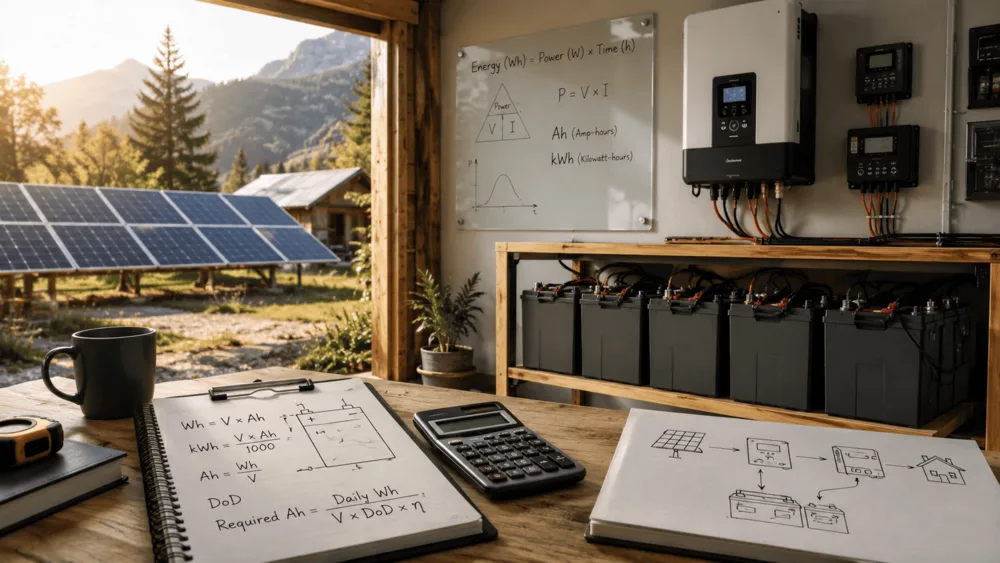
Off-Grid Battery Bank Sizing Is the Difference Between Resilience and Waste
An off-grid solar system fails for two opposite reasons: the battery bank is too small, or it is unnecessarily oversized.
Battery Bank Sizing Calculator
Determine your exact storage requirements instantly based on your daily loads.
Required Bank Capacity
LiFePO4 batteries allow an efficient 80% Depth of Discharge. This smaller footprint preserves cell life and requires less physical space.
An undersized battery bank causes:
- Nighttime blackouts
- Deep discharges that shorten battery life
- Inverter low-voltage shutdowns
- Generator dependence
- Weak refrigerator, pump, or freezer reliability
- Chronic undercharging during cloudy weather
An oversized battery bank causes:
- Excess capital cost
- Batteries that rarely reach full charge
- Longer absorption charging requirements for lead-acid
- Higher replacement cost
- More cable, fuse, rack, and enclosure expense
- Lower return on investment
Correct sizing is not guesswork. It is a sequence of electrical calculations:
- Calculate daily energy use in watt-hours.
- Multiply by autonomy days.
- Correct for depth of discharge.
- Correct for inverter efficiency and system losses.
- Convert required storage into amp-hours at the chosen system voltage.
- Select the battery chemistry and configuration.
Core formula:
Wh = V × Ah
Watt-hours equal voltage multiplied by amp-hours.
1. Step 1: Auditing Your Daily Energy Consumption
Why Watt-Hours Matter More Than Watts
Watts describe instantaneous power. Watt-hours describe energy over time.
A 100 W light running for 1 hour uses 100 Wh.
A 100 W light running for 8 hours uses 800 Wh.
Daily energy formula:
Daily Wh = Appliance Watts × Hours Used per Day
For off-grid systems, every load must be converted into daily watt-hours before battery sizing begins.
Daily Load Audit Table
| Appliance / Load | Rated Power | Hours per Day | Daily Energy |
| LED lights | 40 W | 5 h | 200 Wh |
| Refrigerator | 80 W average | 10 h compressor runtime | 800 Wh |
| Laptop | 60 W | 4 h | 240 Wh |
| Wi-Fi router | 10 W | 24 h | 240 Wh |
| Water pump | 500 W | 0.3 h | 150 Wh |
| Phone charging | 20 W | 2 h | 40 Wh |
| DC ventilation fan | 25 W | 8 h | 200 Wh |
| Small freezer | 90 W average | 8 h compressor runtime | 720 Wh |
Total daily energy use:
200 + 800 + 240 + 240 + 150 + 40 + 200 + 720 = 2,590 Wh/day
Rounded design load: 2.6 kWh/day
How to Treat Intermittent Loads
Some appliances do not run continuously. Refrigerators, freezers, pumps, and pressure systems cycle on and off. Use estimated runtime, not full 24-hour operation.
Example refrigerator:
- Nameplate power: 120 W
- Compressor runtime: 8 hours/day
- Daily energy: 120 W × 8 h = 960 Wh/day
Better method:
- Use a plug-in energy meter for 3–7 days.
- Measure real Wh/day.
- Average the result.
- Add seasonal correction for summer heat or winter heating loads.
AC Loads vs DC Loads
Off-grid systems often include both:
- DC loads: lights, fans, pumps, USB chargers, DC fridge
- AC loads: standard appliances powered through an inverter
DC loads avoid inverter losses. AC loads require conversion from battery DC to household AC.
If most loads are DC, the system can be smaller.
If most loads are AC, inverter efficiency must be included.
Recommended Load Safety Margin
After calculating the daily energy total, add a practical margin:
| System Type | Recommended Margin |
| Small cabin, weekend use | 10–15% |
| Full-time off-grid home | 20–30% |
| Critical refrigeration / medical / livestock loads | 30–50% |
| Unknown future load growth | 25–40% |
For the example:
- Measured daily use: 2.6 kWh/day
- Margin: 25%
- Design daily load: 2.6 × 1.25 = 3.25 kWh/day
Design rule: Size the battery bank for realistic daily use, not optimistic minimum use.
2. Step 2: The Autonomy Factor
What Autonomy Days Mean
Autonomy days are the number of days the battery bank must support the loads without meaningful solar charging.
Common design values:
| Application | Autonomy Days |
| Weekend cabin with backup generator | 1 day |
| Mild climate off-grid system | 1–2 days |
| Full-time homestead | 2–3 days |
| Cloudy winter climate | 3–5 days |
| Critical telecom, medical, or livestock loads | 4–7 days |
Autonomy formula:
Required usable storage = Daily Wh × Autonomy Days
Example:
- Design daily load: 3.25 kWh/day
- Autonomy target: 2 days
- Required usable storage: 3.25 × 2 = 6.5 kWh usable
This is not the nominal battery size yet. It is only the usable energy the system must deliver.
Why More Autonomy Is Not Always Better
Adding autonomy increases battery cost quickly. A 5-day battery bank may be technically impressive, but it may not be economically optimal.
A resilient design may use:
- 2 days of battery autonomy
- Oversized winter solar array
- Generator backup
- Load-shedding plan
- DC critical circuits
- Manual backup heating or refrigeration strategy
For many homesteads, 2–3 autonomy days is the best balance between reliability and budget.
Seasonal Autonomy Planning
Winter sizing is stricter than summer sizing because:
- Solar days are shorter
- Sun angle is lower
- Clouds are more frequent in many regions
- PV modules may be shaded by trees or snow
- Heating, lighting, and ventilation loads may increase
- Lead-acid batteries lose capacity in cold conditions
A system that works in July may fail in December. Battery sizing should be based on the worst practical season, not the best month.
3. Step 3: Depth of Discharge and Inverter Efficiency Compensation
Why 1,000 Wh of Battery Does Not Mean 1,000 Wh of Usable Power
A battery’s nameplate capacity is nominal. Usable capacity depends on:
- Depth of discharge
- Battery chemistry
- Temperature
- Discharge rate
- Inverter efficiency
- Cable losses
- Battery age
- BMS cutoff or low-voltage disconnect settings
Usable battery energy:
Usable Wh = Nominal Wh × Allowed DoD × Inverter Efficiency
For battery sizing, reverse the formula:
Required nominal battery capacity:
Nominal Wh = Required usable Wh ÷ (Allowed DoD × Inverter Efficiency)
Depth of Discharge Explained
Depth of discharge, or DoD, is the percentage of battery capacity that is used before recharging.
A 10 kWh battery discharged by 5 kWh has reached:
DoD = 5 kWh ÷ 10 kWh = 50%
DoD directly affects battery lifespan.
Lead-acid batteries are strongly affected by deep discharge. Regularly discharging AGM or Gel batteries to 80–100% DoD can drastically reduce cycle life. For long service life, many off-grid lead-acid banks are designed around 50% maximum DoD.
LiFePO4 batteries tolerate deeper cycling much better. Many quality LiFePO4 systems are designed around 80–90% usable DoD, depending on manufacturer limits, BMS settings, temperature, and desired service life.
Inverter Efficiency
Most quality off-grid inverters operate around 90–95% efficiency under suitable load. Low loads, poor inverter sizing, standby consumption, and cheap modified sine wave units can reduce effective efficiency.
For sizing:
| Inverter Type | Practical Efficiency Assumption |
| High-quality pure sine inverter | 92–95% |
| Average inverter | 88–92% |
| Cheap or poorly loaded inverter | 80–88% |
| DC-only system | 95–99% distribution efficiency |
Conservative design value for mixed AC loads: 90% inverter efficiency
Example: LiFePO4 Battery Bank
Required usable storage:
- 6.5 kWh usable
Assumptions:
- LiFePO4 allowed DoD: 80%
- Inverter efficiency: 90%
Calculation:
Nominal Wh = 6,500 Wh ÷ (0.80 × 0.90)
Nominal Wh = 6,500 ÷ 0.72 = 9,028 Wh
Required nominal battery bank: about 9.0 kWh
Example: AGM / Gel Lead-Acid Battery Bank
Required usable storage:
- 6.5 kWh usable
Assumptions:
- Lead-acid allowed DoD: 50%
- Inverter efficiency: 90%
Calculation:
Nominal Wh = 6,500 Wh ÷ (0.50 × 0.90)
Nominal Wh = 6,500 ÷ 0.45 = 14,444 Wh
Required nominal battery bank: about 14.4 kWh
This is why a lead-acid bank often needs much more nameplate capacity than LiFePO4 for the same usable energy.
Peukert’s Law: Why Lead-Acid Capacity Drops Under High Load
Lead-acid batteries do not deliver their full rated capacity at all discharge rates. Most deep-cycle lead-acid batteries are rated at a 20-hour rate, often called C20.
Example:
- 12 V 100 Ah lead-acid battery at C20
- Rated discharge: 100 Ah over 20 hours
- Current: 5 A
If the same battery is discharged much faster, the available capacity drops. This behavior is described by Peukert’s law.
Peukert principle:
The faster a lead-acid battery is discharged, the less total capacity it can deliver.
LiFePO4 batteries are much less affected by Peukert losses at typical off-grid discharge rates. This is one reason lithium systems often feel stronger under inverter loads, pumps, compressors, and short high-current events.
4. Step 4: System Voltage Selection
Why System Voltage Matters
Battery bank voltage determines current.
Current formula:
Amps = Watts ÷ Volts
For a 2,000 W inverter load:
| Battery Voltage | Current Draw |
| 12 V | 166.7 A |
| 24 V | 83.3 A |
| 48 V | 41.7 A |
Higher voltage reduces current. Lower current means:
- Smaller cable cross-section
- Lower voltage drop
- Lower heat loss
- Easier inverter operation
- Better scalability
- Cleaner protection design
12V Systems
Best for:
- Small cabins
- Vans and RVs
- Boats
- Lighting systems
- Small DC loads
- Inverters under 1,000–1,500 W
Limitations:
- Very high current at larger loads
- Thick cables required
- Higher voltage drop
- Less ideal for full-time homesteads
Recommended battery size range:
- Up to 2–3 kWh nominal
- Occasionally up to 5 kWh if loads are modest
24V Systems
Best for:
- Medium cabins
- Small homesteads
- Workshops with moderate loads
- Inverters around 1,500–3,000 W
- Systems with pumps, fridges, lights, and electronics
Advantages:
- Half the current of 12V
- Easier cable sizing
- Good DIY balance
- Wide inverter and charge controller availability
Recommended battery size range:
- 3–10 kWh nominal
48V Systems
Best for:
- Full-time off-grid homes
- Larger cabins
- High inverter loads
- Electric tools
- Deep well pumps
- Larger refrigeration systems
- Battery banks above 8–10 kWh
Advantages:
- Much lower current
- Better for 3,000–8,000 W inverters
- Cleaner wiring for large systems
- More efficient high-power operation
- Better compatibility with modern rack batteries
Recommended battery size range:
- 8 kWh and above
Voltage Selection Matrix
| System Size | Daily Energy Use | Inverter Size | Recommended Voltage |
| Very small cabin | <1 kWh/day | <1,000 W | 12V |
| Weekend cabin | 1–2 kWh/day | 1,000–2,000 W | 12V or 24V |
| Serious cabin | 2–5 kWh/day | 2,000–3,000 W | 24V |
| Full-time homestead | 5–10 kWh/day | 3,000–6,000 W | 48V |
| Large off-grid home | >10 kWh/day | >6,000 W | 48V |
Design rule: Once inverter power exceeds about 3,000 W or battery capacity exceeds about 10 kWh, 48V is usually the cleaner engineering choice.
Converting Required kWh to Amp-Hours
Once the required nominal battery capacity is known, convert watt-hours to amp-hours.
Ah = Wh ÷ V
Example LiFePO4 bank:
- Required nominal capacity: 9,028 Wh
- System voltage: 48 V
Calculation:
Ah = 9,028 Wh ÷ 48 V = 188 Ah
Practical selection:
- 48V 200Ah LiFePO4 bank
- Nominal energy: 48 V × 200 Ah = 9,600 Wh
- Nominal capacity: 9.6 kWh
Example lead-acid bank:
- Required nominal capacity: 14,444 Wh
- System voltage: 48 V
Calculation:
Ah = 14,444 Wh ÷ 48 V = 301 Ah
Practical selection:
- 48V 300Ah AGM/Gel bank
- Nominal energy: 48 V × 300 Ah = 14,400 Wh
- Usable at 50% DoD and 90% inverter efficiency: 14,400 × 0.50 × 0.90 = 6,480 Wh usable
Technical Specification Matrix: AGM/Gel vs LiFePO4
| Parameter | AGM / Gel Lead-Acid | LiFePO4 |
| Recommended design DoD | 50% for long life | 80–90% depending on BMS and manufacturer |
| Practical round-trip efficiency | 75–85% | 92–98% |
| Typical cycle life | 400–1,000 cycles at moderate DoD | 3,000–6,000+ cycles at 80% DoD |
| Peukert effect | Significant | Low in normal off-grid use |
| High-current performance | Voltage sag under heavy load | Stronger voltage stability |
| Cold charging | Can charge below 0°C with reduced performance | Charging below 0°C usually prohibited without heating/BMS protection |
| Maintenance | Low for sealed AGM/Gel; higher for flooded lead-acid | Very low |
| Weight per usable kWh | High | Much lower |
| Ventilation | Recommended; critical for flooded lead-acid | Minimal under normal operation |
| Best use case | Low-cost, occasional-use systems | Full-time off-grid, daily cycling |
| Average battery-only cost per usable kWh | Often moderate upfront, higher over lifespan because only ~50% is usable | Higher upfront, often lower lifetime cost |
| Installed cost per usable kWh | Highly market-dependent | Highly market-dependent |
| Main weakness | Shorter cycle life, partial-state-of-charge damage, heavy weight | Higher upfront cost, cold-charge limitations |
Battery Chemistry Selection
When AGM or Gel Makes Sense
AGM or Gel can still work when:
- The system is small.
- Use is occasional.
- Budget is very tight.
- Temperatures are cold and lithium battery heating is not available.
- Replacement cost is acceptable.
- Loads are modest.
- The owner understands charging discipline.
Best examples:
- Weekend cabins
- Seasonal sheds
- Small lighting systems
- Backup systems used rarely
- Low-load communication cabins
When LiFePO4 Is the Better Choice
LiFePO4 is usually better when:
- The system cycles daily.
- The site is full-time off-grid.
- High inverter loads are expected.
- Weight and space matter.
- Long service life matters.
- Solar charging varies.
- Deeper usable capacity is valuable.
- Maintenance must be minimal.
Best examples:
- Full-time cabins
- Homesteads
- Off-grid offices
- Solar workshops
- Refrigeration systems
- Larger 24V and 48V systems
Worked Example: Full Battery Bank Calculation
Load Profile
| Load | Daily Energy |
| Refrigerator | 900 Wh |
| Freezer | 700 Wh |
| Lights | 250 Wh |
| Laptop and electronics | 500 Wh |
| Router and monitoring | 250 Wh |
| Water pump | 200 Wh |
| Ventilation | 300 Wh |
| Miscellaneous reserve | 400 Wh |
Total:
Daily use = 3,500 Wh/day = 3.5 kWh/day
Add 20% design margin:
Design daily load = 3.5 × 1.20 = 4.2 kWh/day
Autonomy target:
4.2 kWh/day × 2 days = 8.4 kWh usable
LiFePO4 Calculation
Assumptions:
- DoD: 80%
- Inverter efficiency: 92%
- System voltage: 48V
Nominal Wh = 8,400 ÷ (0.80 × 0.92)
Nominal Wh = 8,400 ÷ 0.736 = 11,413 Wh
Convert to Ah:
Ah = 11,413 ÷ 48 = 238 Ah
Practical selection:
- 48V 250Ah LiFePO4
- Nominal capacity: 12.0 kWh
- Usable AC energy: 12.0 × 0.80 × 0.92 = 8.83 kWh
AGM/Gel Calculation
Assumptions:
- DoD: 50%
- Inverter efficiency: 90%
- System voltage: 48V
Nominal Wh = 8,400 ÷ (0.50 × 0.90)
Nominal Wh = 8,400 ÷ 0.45 = 18,667 Wh
Convert to Ah:
Ah = 18,667 ÷ 48 = 389 Ah
Practical selection:
- 48V 400Ah AGM/Gel
- Nominal capacity: 19.2 kWh
- Usable AC energy: 19.2 × 0.50 × 0.90 = 8.64 kWh
The lead-acid system needs a much larger nominal battery bank to deliver similar usable energy.
Cable and Current Check
Battery sizing is not complete until current is checked.
Example:
- Inverter: 5,000 W
- Battery voltage: 48V
Current = 5,000 W ÷ 48 V = 104 A
At 24V:
Current = 5,000 W ÷ 24 V = 208 A
At 12V:
Current = 5,000 W ÷ 12 V = 417 A
A 5,000 W inverter on 12V is usually poor engineering because the current is extremely high. It requires large cables, large fuses, short cable runs, and excellent terminations.
Charging Current Check
A battery bank must also match the solar charge controller and PV array.
Approximate charging current:
Charge current = Solar array watts ÷ Battery charging voltage
Example:
- PV array: 2,000 W
- 48V battery charging voltage: about 56V for many lithium systems
Charge current = 2,000 ÷ 56 = 35.7 A
For lead-acid, charging time and absorption stage are critical. A large lead-acid bank with too little solar may never reach full charge, causing sulfation and early failure.
For LiFePO4, charging is more efficient, but the BMS, charge voltage, low-temperature protection, and charge current limits must be respected.
Common Battery Sizing Mistakes
Avoid these errors:
- Sizing from inverter watts instead of daily Wh
- Ignoring cloudy-day autonomy
- Treating nominal capacity as usable capacity
- Using 100% DoD in calculations
- Forgetting inverter efficiency
- Building large 12V systems with high current
- Mixing old and new batteries
- Mixing different capacities or chemistries
- Ignoring cold-temperature charging limits
- Using automotive starter batteries for deep-cycle storage
- Oversizing lead-acid banks without enough solar charging power
- Designing without fuses, disconnects, and proper cable sizing
Final Verdict: Resilience Comes From Accurate Math
A reliable off-grid battery bank is not sized by guessing the number of batteries. It is sized by energy math.
The correct sequence is:
- Audit daily loads in watt-hours.
- Add a realistic safety margin.
- Multiply by autonomy days.
- Correct for depth of discharge.
- Correct for inverter efficiency.
- Convert watt-hours to amp-hours at the selected system voltage.
- Choose a battery chemistry that matches cycling frequency, climate, budget, and maintenance tolerance.
For occasional-use cabins, AGM or Gel batteries can still be acceptable if the bank is sized conservatively and not deeply discharged. For full-time off-grid living, LiFePO4 is usually the stronger engineering choice because it provides deeper usable capacity, higher efficiency, longer cycle life, lower weight, and better performance under inverter loads.
The most resilient system is not always the largest. It is the system where daily energy demand, autonomy, battery chemistry, solar charging capacity, inverter size, and system voltage are mathematically aligned.
3 thoughts on “Off-Grid Battery Bank Sizing: How to Calculate Your Exact Amp-Hour and Kilowatt-Hour Needs”
Comments are closed.