
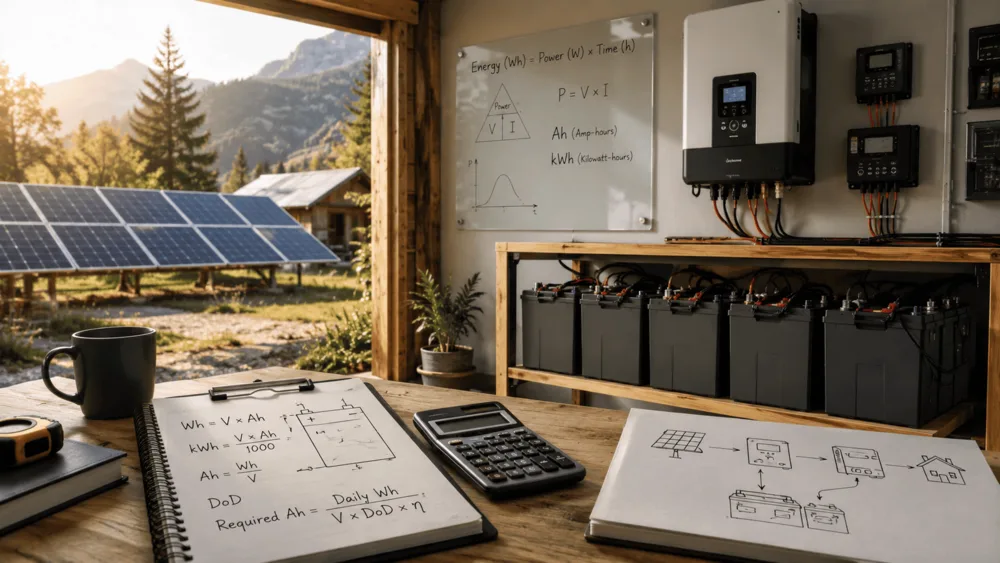
A battery runtime calculator tells you how many hours a battery bank can power your loads before it needs a recharge. Whether you run a fridge and lights on a single 100 Ah battery or a whole cabin on a 10 kWh bank, the maths is the same: usable energy divided by the load. The detail that trips people up is how much of the battery you can actually use, and how much the inverter wastes on the way.
This guide gives you the complete battery runtime calculator method. You will learn the core formula, how depth of discharge changes the answer for lithium (LiFePO4) and lead-acid, how to account for inverter losses and cold weather, and how to turn runtime into days of autonomy for solar sizing. Three worked examples follow, from a tiny fridge setup to a full off-grid cabin.
Quick answer: the battery runtime formula
The simplest battery runtime calculator formula is:
Runtime (hours) = Battery capacity (Wh) × usable fraction × inverter efficiency ÷ Load (W)
- Battery capacity in Wh = Ah × nominal voltage (for example 100 Ah × 12.8 V = 1,280 Wh).
- Multiply by the usable fraction (depth of discharge): about 0.8–0.9 for LiFePO4, 0.5 for lead-acid.
- Multiply by inverter efficiency (0.85–0.95) if you run AC loads.
- Divide by the load in watts to get hours.
Battery runtime calculator
Planning estimate. A simple Peukert correction is applied for flooded, AGM and gel batteries. Battery age, temperature and state of charge change the result.
Step 1: Convert battery capacity to watt-hours
Battery labels show amp-hours (Ah), but a battery runtime calculator needs watt-hours (Wh) so you can compare it with a load in watts. Multiply Ah by the nominal voltage. A 12 V lead-acid battery uses 12 V, a LiFePO4 12 V battery is usually 12.8 V, and a 24 V or 48 V bank uses its own nominal voltage. Batteries in parallel add Ah, batteries in series add voltage, and in both cases total Wh is the sum of all batteries.
| Battery bank | Nominal voltage | Capacity | Total energy (Wh) |
|---|---|---|---|
| 1 × 100 Ah LiFePO4 | 12.8 V | 100 Ah | 1,280 Wh |
| 2 × 100 Ah LiFePO4 (parallel) | 12.8 V | 200 Ah | 2,560 Wh |
| 4 × 100 Ah LiFePO4 (2S2P) | 25.6 V | 200 Ah | 5,120 Wh |
| 1 × 100 Ah AGM | 12 V | 100 Ah | 1,200 Wh |
| 4 × 100 Ah LiFePO4 (4S) | 51.2 V | 100 Ah | 5,120 Wh |
Step 2: Apply depth of discharge and usable capacity
You should never plan on draining a battery to zero. Depth of discharge (DoD) is the share of the nominal capacity you can safely use. LiFePO4 batteries tolerate 80–100 % DoD and many manufacturers rate 6,000 cycles at 80 %. Lead-acid and AGM batteries last far longer when kept above 50 % state of charge, so plan on using only half of the rated capacity. This single factor often doubles the runtime difference between two banks of equal size.
| Battery type | Typical usable DoD | Usable energy from 1,280 Wh nominal |
|---|---|---|
| LiFePO4 | 80–90 % | 1,024–1,152 Wh |
| AGM / sealed lead-acid | 50 % | 640 Wh |
| Flooded lead-acid | 50 % | 640 Wh |
| Gel | 50–60 % | 640–768 Wh |
If you are choosing between chemistries, our comparison of LiFePO4 vs gel batteries shows how DoD, cycle life and cost interact.
Step 3: Account for inverter losses and temperature
AC loads run through an inverter that converts battery DC into mains AC. A good pure sine inverter is about 90–95 % efficient at mid load, so a 100 W AC load really draws about 105–110 W from the battery, plus the inverter idle draw. DC loads connected straight to the battery avoid this loss, which is why 12 V fridges and LED lights are popular off-grid.
Temperature also matters. Lead-acid batteries lose a quarter or more of their capacity near freezing, and LiFePO4 cells must not be charged below 0 °C without a heating pad or low-temperature protection. In a cold cabin, assume 20–30 % less usable energy unless the battery stays in a warm space.
Worked example 1: fridge, lights and a laptop on one 100 Ah LiFePO4 battery
| Load | Power | Hours per day | Energy per day |
|---|---|---|---|
| Efficient 12 V fridge (average) | 45 W | 24 h (duty cycle) | about 500 Wh |
| LED lights | 20 W | 5 h | 100 Wh |
| Laptop | 60 W | 4 h | 240 Wh |
- Daily load energy: 500 + 100 + 240 = 840 Wh.
- Battery usable energy: 1,280 Wh × 0.9 = 1,152 Wh.
- AC share about 340 Wh through an inverter at 90 %: add roughly 38 Wh, giving about 880 Wh needed.
- Runtime ≈ 1,152 ÷ 880 ≈ 1.3 days, or about 31 hours.
So a single 100 Ah LiFePO4 battery runs this small setup for about a day, and needs solar or a charger to continue.
Worked example 2: constant 200 W load on a 5 kWh bank
A pump, router and freezer together draw an average of 200 W. The bank is four 100 Ah LiFePO4 batteries at 51.2 V, which stores 5,120 Wh. With 90 % usable capacity and a 92 % efficient inverter, the usable energy is 5,120 × 0.9 × 0.92 ≈ 4,240 Wh. Runtime = 4,240 ÷ 200 ≈ 21 hours.
Worked example 3: off-grid cabin with 3 kWh per day
A cabin uses 3,000 Wh per day. A 10 kWh LiFePO4 bank (10,000 Wh) with 90 % DoD and 92 % inverter efficiency gives 10,000 × 0.9 × 0.92 ≈ 8,280 Wh usable. Runtime ≈ 8,280 ÷ 3,000 ≈ 2.8 days with zero solar input. That is the days of autonomy figure used in solar system sizing.
From runtime to days of autonomy and solar sizing
Days of autonomy is the number of days the bank can power your loads with no charging at all, such as during a week of cloudy winter weather. Two to three days is a common target for cabins, and critical systems may need more. Your solar array must also recharge the bank between those cloudy spells. Combine this battery runtime calculator result with the off-grid solar system sizing calculator to size panels, and read our battery bank sizing guide for the full method.
We also have a practical case study on how long a 100 Ah LiFePO4 battery will really run a fridge, which pairs well with this battery runtime calculator.
How to extend battery runtime
- Reduce the biggest loads first: fridge, water heating and electric cooking.
- Switch to DC appliances to skip inverter losses.
- Use LED lighting and efficient laptops instead of desktop computers.
- Turn off the inverter when no AC load is needed to avoid idle draw.
- Keep batteries in a warm, insulated space during winter.
- Add battery capacity or parallel strings only after reducing the load.
- Monitor with a shunt-based battery monitor rather than guessing from voltage.
Common battery runtime calculator mistakes
- Using nominal Ah as if it were all usable.
- Forgetting inverter efficiency and idle consumption.
- Ignoring surge loads that cut runtime sharply when motors start.
- Assuming rated capacity at low temperatures.
- Mixing batteries of different age, size or chemistry in one bank.
Related guides
Frequently Asked Questions
How do I calculate battery runtime?
Multiply battery Ah by voltage to get Wh, multiply by usable depth of discharge and inverter efficiency, then divide by the load in watts. The result is the runtime in hours.
How long will a 100Ah battery last?
A 12.8 V 100 Ah LiFePO4 battery stores 1,280 Wh, about 1,150 Wh usable. A 100 W load would run for roughly 11 hours, while a 20 W load could run for more than two days.
Does a bigger inverter drain the battery faster?
Only through idle consumption. A larger inverter often draws more standby power, so size it to your real loads, not the biggest number available.
What depth of discharge should I plan for?
Plan for 80–90 % with LiFePO4 and about 50 % with lead-acid or AGM. Lower DoD extends cycle life.
Sources and further reading
- U.S. Department of Energy: inverters and grid services basics
- NREL PVWatts Calculator for sizing the recharging solar array
Use this battery runtime calculator method as a planning tool, then confirm the final figures with your battery manufacturer datasheet. Wiring and protection must always follow local electrical codes.
2 thoughts on “Battery Runtime Calculator: How Long Will Your Off-Grid Battery Bank Last?”
Comments are closed.