
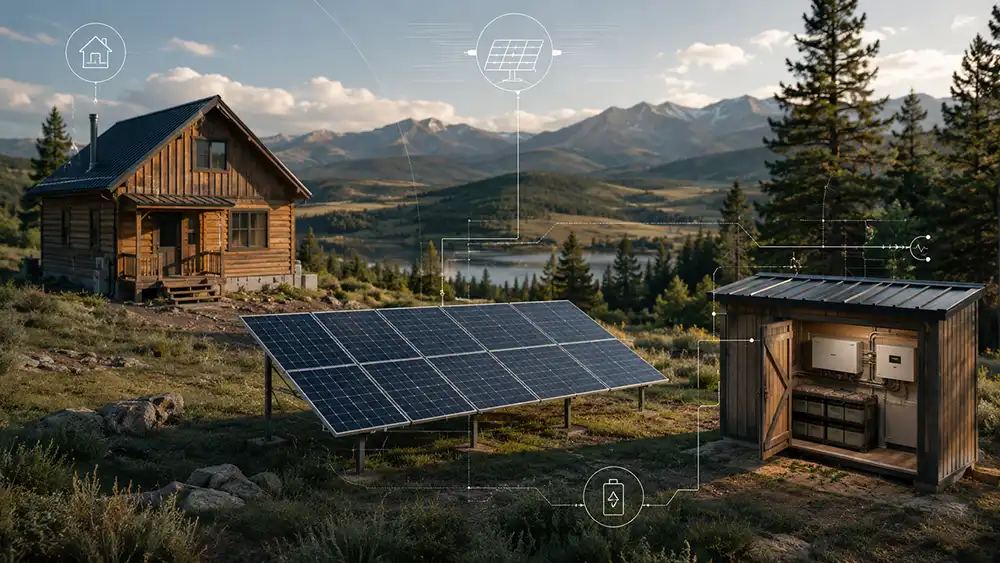
Off grid refrigerator power consumption is usually the biggest single electric load in a small solar cabin. A fridge runs all day and night, it has a big starting surge, and its real energy use depends on climate, door openings and how it is installed. Get this one appliance right and the rest of your solar system becomes much easier to size.
This guide explains the real off grid refrigerator power consumption of the four main fridge types, how to measure your own with a plug-in meter, how placement and habits cut energy, and how to size solar and batteries for a fridge-freezer. It ends with a buying checklist.
Quick answer: how much power does an off-grid fridge use?
| Fridge type | Typical daily energy | Typical size | Notes |
|---|---|---|---|
| Standard A+++ fridge-freezer (230 V) | 0.6–1.0 kWh | 250–350 L | Needs a good pure sine inverter |
| 12 V / 24 V DC compressor fridge | 0.3–0.6 kWh | 40–100 L | No inverter losses, small solar array |
| Chest freezer converted to fridge | 0.15–0.4 kWh | 150–300 L | Very efficient, requires an external thermostat |
| Absorption fridge (gas / electric) | Gas, or 1.5–3 kWh electric | 40–150 L | Common in vans, poor on solar alone |
Treat these as planning ranges. Your real off grid refrigerator power consumption is higher in a hot room, with frequent door opening or an old unit, and lower in a cool pantry with an efficient model.
Off-grid fridge power calculator
Rule of thumb from this guide: every extra 5 °C of room temperature adds roughly 10–15% to consumption. A plug-in energy meter reading is always more accurate.
Compressor, DC, absorption and chest freezer fridges compared
Standard compressor fridge-freezer
A modern mains fridge-freezer with a high energy rating is a good low-cost choice. Its efficiency is excellent, but it runs on AC, so the inverter adds losses and idle draw, and the compressor start surge can reach four to six times its running power. Make sure the inverter surge rating can handle it. Our inverter size calculator guide shows how.
12 V or 24 V DC compressor fridge
DC fridges use the same compressor technology as mains models but run directly from the battery. There is no inverter loss, the start-up current is low and they work well on a small solar system. Prices are higher per litre but total system cost is often lower. Many models have good insulation and a built-in low-voltage cutout.
Chest freezer converted to a fridge
Cold air stays in a chest freezer when you open the lid, so a chest freezer with an external thermostat set to fridge temperature uses very little energy. It is the cheapest way to cut off grid refrigerator power consumption, but you give up the shelf access of an upright fridge and need a proper thermostat controller.
Absorption fridge
Absorption fridges use a heat source instead of a compressor. They can run silently on gas, which makes them popular in caravans, but they are less efficient, need good ventilation and a level installation, and drawing their heater from solar is wasteful. For a solar cabin they are usually the worst choice unless gas is your priority.
Real daily kWh by climate and use
The same fridge uses more energy in a hot kitchen than in a cool pantry. As a rough guide, each extra 5 °C of ambient temperature adds around 10–15 % to a compressor fridge consumption, and frequent door openings can add another 10–20 %. A fridge in a 30 °C room can use about 1.5 times the energy it uses in a 20 °C room.
Measure your own fridge with an energy meter
- Plug the fridge into a plug-in energy meter (or use a DC energy meter on the 12 V circuit).
- Leave it running for at least 24 hours, ideally 48, with normal use and the door closed as usual.
- Read the kWh figure and divide by the hours measured, then multiply by 24 for daily energy.
- Note the room temperature and how often the door was opened.
- Repeat in hot weather if you can; the summer figure is the one to design for.
A meter measurement beats any label value because it includes your climate, your habits and the age of the unit.
Placement, insulation and habits that cut consumption
- Put the fridge in the coolest part of the cabin, away from the stove and direct sun.
- Leave the gap the manufacturer recommends at the back and sides so the condenser can shed heat.
- Keep the fridge reasonably full; thermal mass stabilises temperature. Fill gaps with water bottles.
- Clean the condenser coils or grille once or twice a year.
- Defrost when ice builds up more than a few millimetres thick.
- Set the thermostat to 4–5 °C rather than colder.
- Let hot food cool before it goes in.
- Open the door as little as possible and plan what you need before opening.
Sizing solar and battery for a fridge-freezer
Take the daily energy from your meter test or the table above. Example: a 12 V DC fridge using 0.5 kWh per day (500 Wh).
- Battery: for two days of autonomy, 500 × 2 = 1,000 Wh. With 90 % usable capacity, 1,000 ÷ 0.9 ≈ 1,100 Wh, about 90 Ah of 12.8 V LiFePO4. Use our battery runtime calculator for other loads.
- Solar: with 4 peak sun hours and 75 % system efficiency, 500 ÷ 4 ÷ 0.75 ≈ 167 W, so a 200 W panel is a good fit. Winter in northern climates may need 2–3 times this.
- Inverter (only if AC): choose one with surge capacity at least five times the fridge running watts.
For the whole cabin, run the numbers in our off-grid solar system sizing calculator and add the fridge as one line item.
Buying checklist for an off-grid fridge
- High energy rating, or a published daily kWh figure measured at 25–32 °C.
- Insulation thickness and a thick door seal.
- Low-voltage cutout that matches your battery chemistry.
- Quiet compressor and good ventilation clearances.
- Soft-start or low inrush current for easy inverter sizing.
- Top-opening or drawer layout if you want to reduce cold air loss.
- Service and spare parts availability in your area.
Related guides
Frequently Asked Questions
How much power does an off-grid fridge use per day?
A typical efficient compressor fridge uses 0.3–1.0 kWh per day depending on size, climate and use. Measure yours with an energy meter for an exact figure.
Is a 12V fridge better than an AC fridge for solar?
A DC fridge avoids inverter losses and has a low start current, so it works better on a small solar and battery system. A mains fridge is cheaper per litre but needs a larger inverter.
Can I run a chest freezer as a fridge?
Yes, with an external thermostat that holds 3–5 °C. It uses far less energy than an upright fridge because cold air stays in when you open the lid.
Do absorption fridges work on solar?
They can, but their electric heater draws a lot of power. They are best run on gas, and on solar they are rarely a sensible choice.
Sources and further reading
Measure first, choose the right type and manage placement and habits, and off grid refrigerator power consumption becomes a number you can plan around rather than a surprise.
1 thought on “Off Grid Refrigerator Power Consumption: Real kWh and Best Options for Solar”
Comments are closed.