
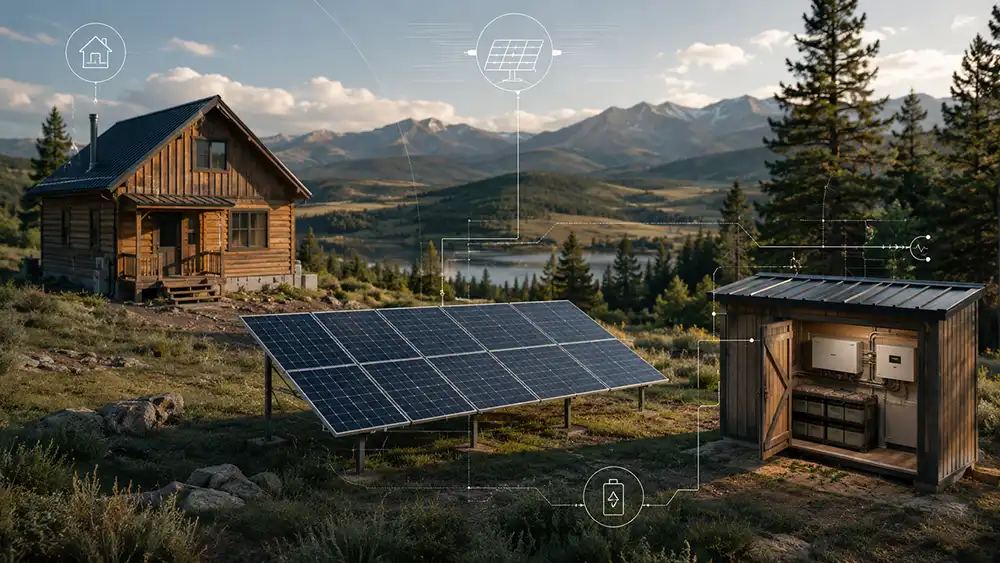
The solar panel tilt angle decides how much energy your array harvests, and for an off-grid system the winter figure matters most. In December the sun is low, days are short and your batteries are at their most stressed. A steeper tilt that faces the low winter sun can raise winter production by a quarter or more compared with a flat mount, which can mean the difference between a generator-free winter and a cold, dark one.
This guide explains how to choose the solar panel tilt angle for your latitude, how to compare a fixed mount with seasonal adjustment, what a steep tilt does for snow and shading, and how roof and ground mounts limit your options. A simple worked method follows so you can pick your own angle.
Quick answer: the best solar panel tilt angle for winter
- Winter-optimised fixed tilt: latitude + 10° to 15° (for example 60–65° at 50° N).
- Year-round fixed tilt: roughly latitude × 0.8, or latitude minus 5° to 10° for summer-heavy loads.
- Summer tilt: latitude − 10° to 15°.
- Face true south in the northern hemisphere (true north in the southern).
- Adjust twice a year (spring and autumn) to gain a few percent annual energy and much more in winter.
Solar panel tilt angle calculator
Rules of thumb from this guide (winter: latitude + 10–15°, year-round: latitude × 0.8, summer: latitude − 10–15°). Shading and roof pitch may force a different angle.
Why tilt matters more in winter for off-grid systems
Grid-tied systems are usually tilted to maximise annual energy. Off-grid systems are different, because the bottleneck is the worst month, not the average one. In winter, the sun can sit only 15–20° above the horizon at higher latitudes. A flat or shallow panel intercepts the light at a glancing angle and loses most of it. Tilting the panel steeply points it closer to the sun and increases the energy per square metre dramatically.
Your design month is therefore December or January in the northern hemisphere (June or July in the south). Size the panels and batteries for that month using the tilt you will actually install. Our off-grid solar system sizing calculator lets you enter winter peak sun hours.
Fixed tilt rule of thumb: latitude plus 10 to 15 degrees
If you only set the angle once, the usual rule for winter-first design is latitude plus 10 to 15 degrees. That tilts the panel so that its surface is closer to perpendicular to the low winter sun. If your loads are similar all year, use roughly latitude × 0.8 for a year-round compromise. If summer demand dominates (irrigation pumps, cooling), tilt flatter.
| Latitude | Summer tilt | Annual compromise | Winter tilt |
|---|---|---|---|
| 35° | 20–25° | 28° | 45–50° |
| 40° | 25–30° | 32° | 50–55° |
| 45° | 30–35° | 36° | 55–60° |
| 50° | 35–40° | 40° | 60–65° |
| 55° | 40–45° | 44° | 65–70° |
| 60° | 45–50° | 48° | 70° |
These are planning angles. Real optimum depends on your climate: very cloudy winters favour flatter angles because more of the light is diffuse, while snowy, clear-sky regions favour steep angles.
Seasonal adjustment vs fixed mount: what you gain
Changing the tilt a few times a year increases energy collected, mostly in winter and summer. Studies and simulation tools consistently show that adjusting twice a year adds roughly 3–5 % to annual energy, and four times a year about 5–8 %. For an off-grid system the percentage in winter is larger and is what lets you downsize the battery bank and generator use.
| Strategy | Typical annual gain vs fixed annual tilt | Winter gain | Effort |
|---|---|---|---|
| Fixed annual tilt | Baseline | Baseline | None |
| Fixed winter tilt | Slightly lower annually | Highest winter value | None |
| Two adjustments per year | About +3–5 % | Strong | Twice a year |
| Four adjustments per year | About +5–8 % | Strong | Quarterly |
| Single-axis tracking | About +25–30 % | Good | Needs moving parts |
You can estimate production for any tilt, location and month with the free NREL PVWatts Calculator or the PVGIS tool of the European Commission.
Snow shedding and shading from a steep tilt
A steep solar panel tilt angle helps in two ways in winter: the module catches the low sun better and snow slides off faster. Panels tilted 45–60° shed snow far more readily than those at 15°. Leave a clear space under the lower edge so snow can slide off and does not bury the bottom row, and keep the lowest edge at least 0.5 m above the expected snow depth.
There is a catch: steeper arrays cast longer shadows. When rows are tilted high, they need more spacing between them or they shade each other in winter. A common rule is to space rows by about 3–4 times the height of the panel top above the ground at high latitudes. Also check shading from trees, hills and your own cabin, which is usually worse in winter than in summer.
Ground mount vs roof mount tilt limits
- Roof mount: the panels follow the roof pitch unless you use tilt-up frames. A roof pitch below your ideal winter tilt can be raised with brackets, but wind loads and roof loading increase.
- Ground mount: free choice of tilt and orientation, easier snow clearing and easy seasonal adjustment. Needs space and secure footings.
- Wall mount: steep tilt (about 90°) works well at high latitudes in winter, especially with snow reflection.
- Pole mount: allows tilt adjustment and a fixed-angle option for small arrays.
Whatever you choose, follow the mounting manufacturer wind and snow load ratings and local building codes. A steep tilt catches more wind and increases mounting loads.
Worked example: choosing a tilt for a cabin at 50° N
- Latitude: 50° N. Design month: December.
- Winter tilt: 50 + 12 = 62°. Summer tilt: 50 − 12 = 38°.
- Choose an adjustable ground mount that can be set to 62° from November to February and 38° from April to August, and 50° in spring and autumn.
- Estimate production for each tilt with PVWatts and size the array for the December figure.
- Add 20–30 % margin for dirt, snow cover and cloudy spells.
For a deeper look at how many panels you need after you pick an angle, see our guide to solar panels in series vs parallel and the MPPT charge controller sizing calculator.
Mounting tips for adjustable racks
- Use a rack with marked angle positions so adjustment takes minutes, not an hour.
- Choose stainless or galvanised hardware that will not corrode with repeated adjustment.
- Leave a service gap behind the array for cable slack when the tilt changes.
- Use flexible PV cable and strain relief at the panel ends.
- Write the winter and summer angle on the rack with a permanent marker.
- Always keep the lowest panel edge clear of snow and vegetation.
Related guides
Frequently Asked Questions
What is the best solar panel tilt angle for winter?
For off-grid winter production, use your latitude plus 10 to 15 degrees, facing true south in the northern hemisphere. For example, 60–65° at 50° N.
Is it worth adjusting solar panels seasonally?
Yes for off-grid systems. Two adjustments a year add a few percent annually and much more in winter, the month that limits your system.
Does a steeper tilt help with snow?
Yes. Steep panels shed snow faster and catch more low sun, but they need more row spacing and a stronger mount.
Does tilt matter if the sky is cloudy?
Less. In very cloudy climates most light is diffuse, so the optimum tilt is flatter and the gain from seasonal adjustment is smaller.
Sources and further reading
Pick a solar panel tilt angle for your worst month, check shading and snow, and consider two seasonal adjustments a year. The result is a smaller battery bank and fewer cold, dark winter evenings.
1 thought on “Solar Panel Tilt Angle: Best Angle for Winter Production Off-Grid”
Comments are closed.