
An inverter size calculator answers one question: how many watts must your inverter deliver so every appliance you own can run, including the moment a fridge compressor or well pump starts? Pick an inverter that is too small and it trips off whenever a motor starts. Pick one that is far too large and you pay for capacity you never use, plus a higher idle drain on your batteries all day long.
This guide shows the exact method behind any good inverter size calculator. You list your loads, separate continuous watts from surge watts, apply a realistic diversity factor, add a margin for efficiency, and check the result against your battery voltage. A fully worked 2 kW cabin example follows, so you can copy the steps with your own numbers.
Quick answer: how do you size an off-grid inverter?
- Add up the running watts of every appliance that could be on at the same time.
- Find the single largest surge (starting) load, such as a fridge, pump or power tool.
- Inverter continuous rating = simultaneous running watts × 1.25 safety margin.
- Check that the inverter surge rating covers running watts plus the largest starting load.
- Match the inverter input voltage (12 V, 24 V or 48 V) to your battery bank.
Inverter size calculator
Enter the running watts of everything that can be on at the same time, plus the running watts of the biggest load with a start-up surge.
Assumes the inverter surge rating is about twice its continuous rating. Check the datasheet of the model you buy and follow local electrical rules.
Step 1: Pure sine vs modified sine – what your loads need
Before you run any inverter size calculator, decide on the waveform. A pure sine wave inverter produces power like the grid and runs everything cleanly. A modified sine inverter is cheaper but can cause buzzing, heat and shortened life in motors, and many electronics, laser printers, CPAP machines and battery chargers will not work properly on it.
For an off-grid home or cabin we recommend pure sine for any system that powers refrigeration, pumps, tools or electronics. Only choose modified sine for simple resistive loads such as incandescent lights or a basic heater, and even then the price gap is small today.
Step 2: Continuous watts vs surge watts
Every inverter has two ratings. The continuous rating is the power it can supply for hours. The surge (peak) rating is the short burst, often only a few seconds, that it can deliver while a motor spins up. An induction motor such as a fridge compressor or a submersible pump can draw three to seven times its running power for a moment at start.
| Appliance | Typical running watts | Typical surge multiplier | Surge watts |
|---|---|---|---|
| LED lighting (10 bulbs) | 60 | 1× | 60 |
| Laptop and router | 90 | 1× | 90 |
| Chest freezer / fridge | 120 | 4–6× | 480–720 |
| Well pump (½ hp) | 750 | 3–4× | 2,250–3,000 |
| Washing machine | 500 | 2–3× | 1,000–1,500 |
| Power tool (circular saw) | 1,200 | 2–3× | 2,400–3,600 |
| Microwave (1,000 W output) | 1,500 | 1× | 1,500 |
These figures are typical planning values. Always check the nameplate of your own appliances, because efficiency and motor type change the real numbers. Where a label shows amps, multiply by the mains voltage to get watts.
Step 3: List your loads and apply a diversity factor
Write down every load, its running watts and how many of them can realistically be on at once. Not everything runs together. The share of your total connected load that actually runs at the same moment is the diversity factor. For a small cabin it is often 0.5 to 0.7, while a small household with a family at home in the evening can approach 0.8.
- List each appliance and its running watts.
- Mark which loads are inductive (motors, compressors, pumps) and note their surge.
- Decide which loads can run together and which you will never use at the same time.
- Multiply connected watts by the diversity factor to get the expected simultaneous load.
Be honest with yourself here. If you never want to think about which appliance is on, use a higher factor. If you are willing to run the washing machine only when the microwave is off, a lower factor saves real money on inverter size.
Step 4: Add efficiency and idle consumption
An inverter wastes some energy as heat. Most quality pure sine models reach about 90–95 % efficiency at mid load, and less at very light load. They also draw a fixed idle (no-load) power just by being switched on, often 10–40 W for a 2 kW unit. Over 24 hours, a 25 W idle draw uses 600 Wh, which is a real chunk of a small system.
Use the efficiency number from the datasheet when you convert AC loads to battery energy: battery Wh = AC Wh ÷ efficiency. Many modern inverters offer a low-power or search mode that cuts idle draw when nothing is running, which is useful in a cabin that sits idle most of the day.
Worked example: sizing a 2 kW cabin inverter
Our cabin owner wants to run lights, a laptop, a fridge, a water pump and occasional power tools. Here is the full inverter size calculator method with real numbers.
| Load | Running watts | Surge watts | Runs together? |
|---|---|---|---|
| LED lights | 60 | 60 | Yes |
| Laptop and router | 90 | 90 | Yes |
| Fridge | 120 | 600 | Yes |
| Water pump | 750 | 2,250 | Sometimes |
| Circular saw | 1,200 | 2,400 | Rarely, alone |
- Simultaneous running load (lights, laptop, fridge, pump): 60 + 90 + 120 + 750 = 1,020 W.
- Apply a 1.25 margin: 1,020 × 1.25 ≈ 1,275 W continuous.
- Largest surge: the pump at 2,250 W while everything else already runs (270 W). Peak need ≈ 2,520 W.
- The saw case: 1,200 W running plus 270 W already on gives about 1,470 W continuous and roughly 2,670 W surge.
- Choose a pure sine inverter rated at least 1,500 W continuous with a surge rating above 3,000 W. A 2,000 W continuous / 4,000 W surge model gives comfortable headroom.
So a 2 kW pure sine inverter is the right size for this cabin. A 3 kW model would work but cost more and waste more energy at idle, and a 1 kW model would trip on pump start.
Match the inverter to your battery voltage
High-power inverters draw very large currents at 12 V. A 2,000 W load at 12 V pulls more than 160 A from the battery, which demands thick cable and big fuses. The same load at 24 V draws about 80 A, and at 48 V about 40 A. As a rule of thumb, stay at 12 V up to about 1 kW, use 24 V for 1–3 kW, and move to 48 V above 3 kW. Our guide to 12V vs 24V vs 48V off-grid systems explains the trade-offs in detail, and the battery cable size calculator shows the cable you need.
How many batteries does the inverter need?
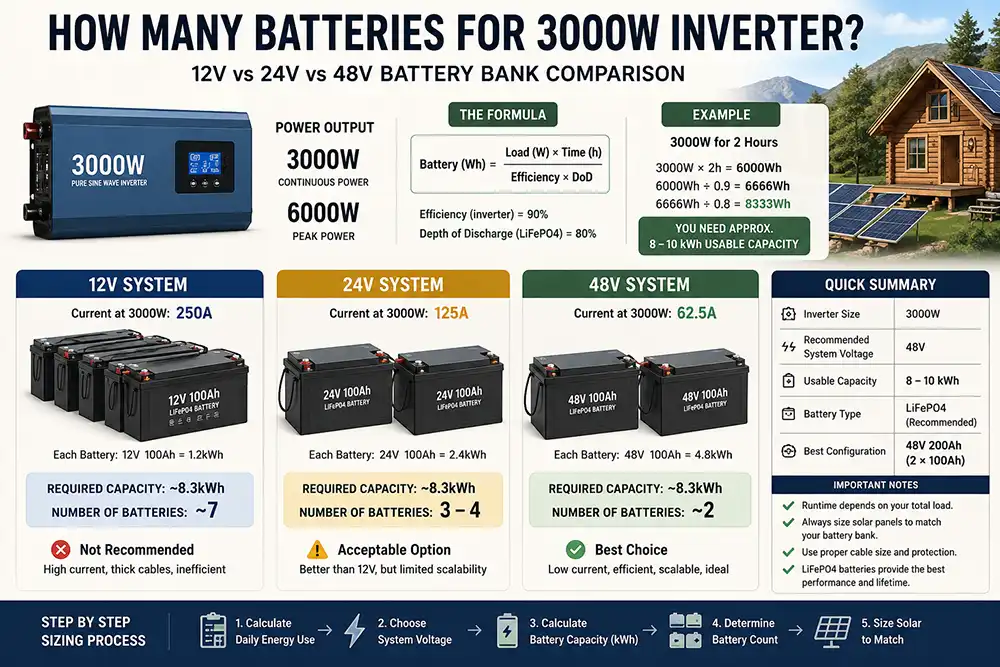
Once you know the inverter size, check that the battery bank can supply its current. A 3 kW inverter at 24 V can pull 125 A or more at full load, so the battery must support that discharge rate. Read our walkthrough on how many batteries you need for a 3000W inverter, then size the full system with the off-grid solar system sizing calculator.
Common inverter sizing mistakes
- Ignoring surge: a 1,000 W inverter cannot start a 750 W pump that needs 2,500 W for a second.
- Adding every appliance together and buying a huge inverter that idles at a high draw.
- Choosing modified sine for motors and sensitive electronics.
- Forgetting inverter efficiency and idle power when sizing the battery and solar array.
- Using cable and fuses that are too small for the DC current at 12 V.
- Running the inverter at 100 % for long periods; leave 20–25 % headroom.
Related guides
Frequently Asked Questions
What size inverter do I need for an off-grid cabin?
Most small cabins run well on a 1,500–2,000 W pure sine inverter. Add the running watts of loads that run together, multiply by 1.25, then confirm the surge rating covers your biggest motor start.
Can I oversize an inverter?
Yes, but oversizing has a cost. A larger inverter draws more idle power, costs more and may run at poor efficiency at light load. A margin of 20–25 % above your expected peak is usually enough.
Do I need a pure sine wave inverter?
If you run a fridge, pump, tools or electronics, yes. Pure sine is quieter and gentler on motors, and some devices will not operate on modified sine at all.
How much surge power do fridges and well pumps need?
A fridge compressor typically needs four to six times its running watts for a moment, and a well pump three to four times. Check the nameplate or the locked rotor current on the pump motor for the exact figure.
Sources and further reading
- U.S. Department of Energy: estimating appliance and home electronic energy use
- NREL PVWatts Calculator
Use this inverter size calculator method with your own appliance list, then double-check the final figures against the datasheets of the inverter you plan to buy. When in doubt, have a qualified electrician review your system before installation.
1 thought on “Inverter Size Calculator for Off-Grid Solar: Continuous Watts, Surge and Efficiency”
Comments are closed.