
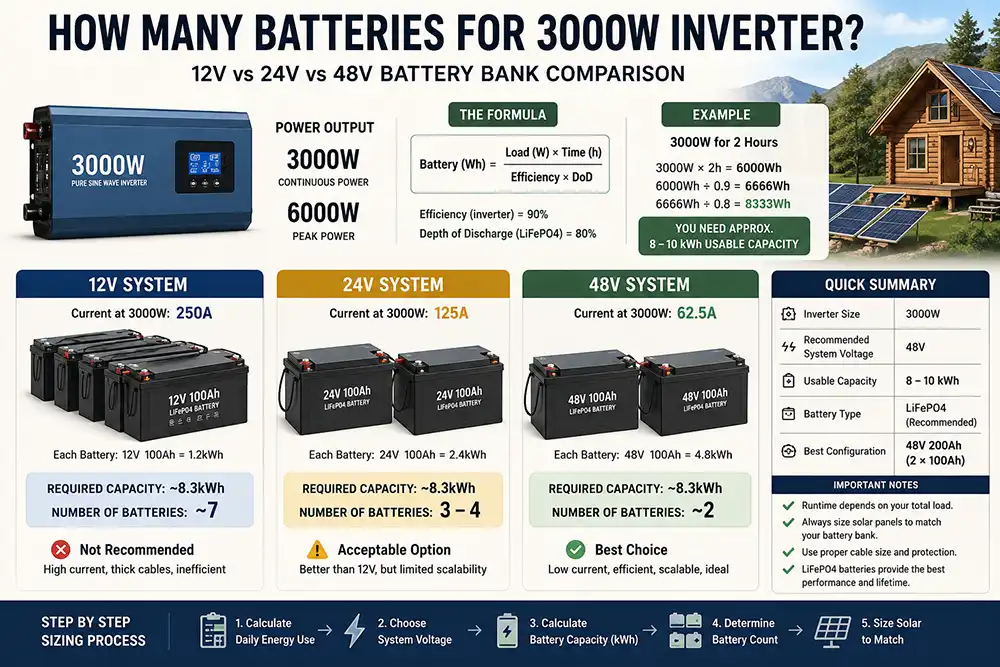
A 3000W inverter does not require a fixed number of batteries. The correct battery bank depends on how much power your appliances actually use, how long you want to run them, the battery voltage and capacity, battery chemistry, inverter efficiency, and the maximum current the batteries can safely deliver.
For example, two systems can both use a 3000W inverter while requiring completely different battery banks. A cabin that occasionally runs a 2,000W power tool for 15 minutes has very different storage requirements from a backup system supplying a continuous 2,000W load for four hours.
This guide explains how to calculate the battery capacity for a 3000W inverter using energy demand rather than a fixed battery count.
Quick Answer
If a 3000W inverter operates at its full rated output for one hour, the connected loads consume approximately:
3,000W × 1 hour = 3,000Wh
The battery must supply more than 3,000Wh because some energy is lost during DC-to-AC conversion.
Assuming 90% inverter efficiency:
3,000Wh ÷ 0.90 = 3,333Wh
The battery bank therefore needs to deliver approximately 3.33kWh of usable energy to support a continuous 3000W load for one hour.
That does not mean a 3.33kWh nominal battery is necessarily sufficient. Available capacity also depends on the battery’s recommended depth of discharge and its ability to supply the required current.
Battery Capacity Calculator
Use the calculator to estimate the battery capacity required for your system.
Inputs
- Actual AC load in watts
- Desired runtime in hours
- System voltage
- Battery chemistry
- Inverter efficiency
- Usable depth of discharge
- Individual battery capacity
Results
- Required usable energy
- Recommended nominal battery capacity
- Required amp-hours
- Approximate battery quantity
- Estimated DC current at the selected voltage
The result is a planning estimate. Battery manufacturer limits, BMS current ratings, cable sizing, fuse protection, temperature and inverter surge requirements must also be checked before installation.
Step 1: Calculate Your Actual Load
The inverter rating and the appliance load are not the same thing.
A 3000W inverter is capable of supplying up to approximately 3000W continuously if the manufacturer specifies that continuous rating. It does not constantly consume 3000W from the battery.
If your appliances are drawing only 800W, battery sizing should primarily be based on that 800W load.
The basic energy formula is:
Energy (Wh) = Power (W) × Runtime (hours)
For example, an 800W load operating for three hours requires:
800W × 3h = 2,400Wh
A 2,500W load operating for only 20 minutes requires:
2,500W × 0.333h ≈ 833Wh
Despite using a much higher instantaneous load, the second example requires considerably less stored energy.
This is why battery banks should be sized around both power and time.
Step 2: Account for Inverter Losses
An inverter consumes some energy while converting DC battery power into AC power.
If the inverter operates at 90% efficiency, the battery energy required can be estimated with:
Battery energy = AC energy ÷ inverter efficiency
For a 3000W load operating for one hour:
3,000Wh ÷ 0.90 = 3,333Wh
For the same load operating for two hours:
6,000Wh ÷ 0.90 = 6,667Wh
These figures represent energy that must be delivered by the battery. They are not yet the recommended nominal battery-bank capacity.
Step 3: Account for Usable Battery Capacity
Most batteries should not be sized on the assumption that 100% of their nominal capacity will be available every cycle.
The appropriate usable depth of discharge depends on the battery chemistry, manufacturer and intended cycle life.
The general calculation is:
Nominal battery capacity = Required battery energy ÷ usable fraction
For illustration, suppose the battery bank must supply 3.33kWh and you design around 90% usable capacity:
3.33kWh ÷ 0.90 ≈ 3.70kWh
The resulting planning target would therefore be approximately 3.7kWh nominal capacity.
Always use the battery manufacturer’s specifications rather than assuming a universal depth-of-discharge value.
Step 4: Convert kWh to Amp-Hours
Battery capacity is frequently advertised in amp-hours rather than kilowatt-hours.
A simplified conversion is:
Ah = Wh ÷ system voltage
A nominal 3.7kWh battery bank corresponds approximately to:
| System Voltage | Approximate Capacity |
|---|---|
| 12V | 308Ah |
| 24V | 154Ah |
| 48V | 77Ah |
These numbers describe equivalent energy capacity. They do not mean that every configuration is equally appropriate for a 3000W inverter.
Current becomes extremely important at higher inverter loads.
Step 5: Check the DC Current
A 3000W inverter operating near full output can demand substantial current from the battery bank.
A simplified estimate is:
DC current ≈ inverter output ÷ system voltage ÷ inverter efficiency
Assuming 90% efficiency:
| System Voltage | Approximate Current at 3000W |
|---|---|
| 12V | 278A |
| 24V | 139A |
| 48V | 69A |
This is one reason higher-voltage battery systems are commonly considered for larger inverter installations.
At 12V, approximately 278A is a substantial continuous current. The battery bank, BMS, busbars, disconnects, fuses and cables would all need to be designed for the required current and applicable safety margins.
A battery can contain enough stored energy while still being unable to safely supply the required power.
Energy Capacity vs Power Capability
This distinction is essential when choosing batteries for a 3000W inverter.
Energy capacity determines approximately how long the system can operate.
It is usually expressed in:
- Wh
- kWh
- Ah
Power capability determines whether the battery can safely support the inverter load.
It depends on factors including:
- maximum continuous discharge current
- BMS current limit
- battery configuration
- temperature
- cable and connection limits
- inverter surge requirements
Both conditions must be satisfied.
Example 1: 1000W Load for 4 Hours
Suppose a 3000W inverter normally supplies a 1000W combined load.
Desired runtime: 4 hours
Inverter efficiency: 90%
AC energy:
1,000W × 4h = 4,000Wh
Required battery energy:
4,000Wh ÷ 0.90 = 4,444Wh
Assuming a design target of 90% usable battery capacity:
4,444Wh ÷ 0.90 ≈ 4,938Wh
A reasonable planning target is therefore approximately 5kWh nominal battery capacity.
Notice that the calculation is based on the actual 1000W load, not simply the 3000W label on the inverter.
Example 2: Full 3000W Load for 30 Minutes
Desired runtime:
0.5 hours
Energy consumed:
3,000W × 0.5h = 1,500Wh
Accounting for 90% inverter efficiency:
1,500Wh ÷ 0.90 = 1,667Wh
At 90% usable capacity:
1,667Wh ÷ 0.90 ≈ 1,852Wh
The energy calculation therefore suggests approximately 1.85kWh nominal capacity.
However, capacity alone is not enough.
The selected battery bank must also be capable of delivering the high continuous current required by the inverter.
Example 3: Full 3000W Load for 2 Hours
Energy consumed:
3,000W × 2h = 6,000Wh
Accounting for 90% inverter efficiency:
6,000Wh ÷ 0.90 = 6,667Wh
At 90% usable capacity:
6,667Wh ÷ 0.90 ≈ 7,407Wh
The planning target is therefore approximately 7.4kWh nominal capacity.
This demonstrates how dramatically runtime changes the required battery bank even though the inverter remains exactly the same.
How Many 100Ah Batteries Do You Need?
There is no useful answer without specifying battery voltage and chemistry.
For example, a nominal:
12.8V 100Ah battery
stores approximately:
12.8V × 100Ah = 1,280Wh
or:
1.28kWh
A nominal:
25.6V 100Ah battery
stores approximately:
2.56kWh
A nominal:
51.2V 100Ah battery
stores approximately:
5.12kWh
This is why statements such as “a 3000W inverter needs four batteries” are incomplete.
Battery count alone does not describe battery-bank capacity.
Always compare batteries using both voltage and amp-hours, or convert them to watt-hours/kilowatt-hours.
Is 12V, 24V or 48V Better for a 3000W Inverter?
A 3000W inverter can exist in different system-voltage configurations, but the electrical demands change substantially.
At lower voltage, the same power requires more current.
For a dedicated 3000W off-grid installation, 24V or 48V can reduce DC current compared with 12V. A 48V architecture becomes particularly attractive as battery capacity, inverter power, cable length or future expansion increases.
However, system voltage should not be selected from inverter wattage alone.
Other considerations include:
- existing DC appliances
- battery configuration
- solar charge controller
- alternator charging
- cable distances
- equipment availability
- expansion plans
- manufacturer requirements
For a broader comparison, see our 12V vs 24V vs 48V Off-Grid Solar System Guide.
Don’t Forget Inverter Surge Power
Some appliances briefly require substantially more power when starting.
Examples can include:
- refrigerators
- freezers
- pumps
- compressors
- air conditioners
- some power tools
Your inverter may advertise both continuous and surge ratings.
The battery bank and BMS must be capable of supporting the resulting short-duration DC demand without triggering protection or excessive voltage sag.
Always check the starting requirements of the actual appliances and the inverter manufacturer’s specifications.
Common Battery-Sizing Mistakes
Choosing batteries from inverter wattage alone
A 3000W inverter does not automatically mean you continuously use 3000W.
Calculate actual loads and runtime first.
Looking only at amp-hours
A 100Ah battery at 12V stores roughly half the nominal energy of a 100Ah battery at 24V.
Compare watt-hours or kilowatt-hours.
Ignoring BMS limits
A LiFePO4 battery may have sufficient energy capacity but an inadequate BMS continuous-current rating for the inverter.
Ignoring inverter losses
Energy taken from the battery will be greater than AC energy delivered to appliances.
Ignoring surge loads
Motors and compressors can require high starting power.
Designing around 100% usable capacity
Use the battery manufacturer’s recommended operating limits when sizing the bank.
Practical Sizing Process
For a 3000W inverter system, use this sequence:
- List the appliances that may operate simultaneously.
- Calculate the realistic maximum continuous load.
- Estimate how many hours each load will operate.
- Calculate required watt-hours.
- Account for inverter efficiency.
- Apply the appropriate usable-capacity limit for the selected battery.
- Convert the result into kWh and Ah.
- Choose a system voltage appropriate for the installation.
- Verify battery and BMS continuous-current limits.
- Check inverter surge requirements.
- Verify cable, fuse, disconnect and busbar requirements against manufacturer specifications and applicable electrical rules.
Only after these calculations should you decide how many physical batteries are required.
Frequently Asked Questions
Can one battery run a 3000W inverter?
Potentially, but the word “battery” does not specify enough information.
A battery would need sufficient energy capacity, voltage and continuous discharge capability. Its BMS and manufacturer specifications would also need to permit the required current.
Can a 100Ah battery run a 3000W inverter?
Amp-hours alone cannot answer this question. You also need the battery voltage, chemistry, BMS/discharge limit, inverter efficiency, actual load and desired runtime.
Does a 3000W inverter always draw 3000W?
No. The inverter supplies the power demanded by connected appliances, plus its own conversion losses and idle consumption.
A 500W appliance does not normally cause a 3000W inverter to deliver 3000W.
How long will a battery run a 3000W inverter?
Runtime depends primarily on usable battery energy and actual load.
A useful approximation is:
Runtime ≈ usable battery Wh × inverter efficiency ÷ AC load W
Real-world runtime can differ because of battery characteristics, temperature, inverter behavior, voltage sag and other system losses.
Is 48V better than 12V for a 3000W inverter?
A higher system voltage substantially reduces DC current for the same power, which can be advantageous in higher-power installations. However, the correct voltage depends on the complete electrical system rather than inverter wattage alone.
Final Answer
There is no universal number of batteries required for a 3000W inverter.
Start with:
Actual load × desired runtime
Then account for inverter losses and the battery’s usable capacity. Finally, verify that the battery bank can safely deliver the required continuous and surge current.
For example, operating a full 3000W load for one hour requires approximately 3.33kWh of usable battery energy at 90% inverter efficiency. If the design allows 90% of nominal battery capacity to be used, that corresponds to approximately 3.7kWh of nominal storage.
But energy capacity is only half of the calculation.
The battery bank, BMS and associated electrical equipment must also safely support the inverter’s current demand.
For a complete system calculation including solar array, battery storage and inverter sizing, use the Off-Grid Solar System Sizing Calculator.
1 thought on “How Many Batteries for 3000W Inverter? (Complete Sizing Guide)”
Comments are closed.