
Introduction
Battery storage is the heart of an off-grid solar power system. Solar panels only generate energy when sunlight is available, but a homestead still needs electricity at night, during cloudy weather, and during high-demand moments when multiple appliances run at the same time. The battery bank decides how much of your solar production you can actually use, how long your system can operate without sun, and how often you will need to replace expensive components.
For years, Gel batteries were one of the preferred sealed lead-acid options for cabins, boats, RVs, telecom sites, and remote solar systems. They improved on flooded lead-acid batteries by using a sealed valve-regulated design with immobilized electrolyte, reducing maintenance and leakage risk.
LiFePO4 batteries, also known as Lithium Iron Phosphate or LFP batteries, have now become the modern standard for serious off-grid solar storage. They cost more upfront, but they provide far more usable capacity, higher charging efficiency, much longer cycle life, and better performance under daily cycling.
This guide compares LiFePO4 vs. Gel batteries from an off-grid engineering perspective. The goal is not to crown the newest technology automatically. The goal is to determine which battery gives the best long-term return on investment for a homestead, cabin, farm, or independent solar power system.
LiFePO4 vs. Gel Battery for Off-Grid Solar
1. Core Technology: How They Work
Gel Batteries
Gel batteries are a type of sealed valve-regulated lead-acid battery, usually called VRLA. Internally, they still use traditional lead-acid chemistry:
- Positive plate: lead dioxide
- Negative plate: sponge lead
- Electrolyte: sulfuric acid
- Discharge product: lead sulfate and water
The difference is the electrolyte. In a Gel battery, the sulfuric acid is mixed with fumed silica, turning the liquid electrolyte into a thick gel-like material. This immobilized electrolyte reduces the risk of acid spills, allows the battery to operate without routine watering, and makes the battery more resistant to vibration than a flooded lead-acid battery.
Gel batteries are not truly “gas-free.” They are sealed under normal operating conditions, but they are valve-regulated. During charging, oxygen generated near the positive plate can migrate through the internal gel structure and recombine at the negative plate, forming water again. This gas recombination cycle is what allows Gel batteries to be marketed as maintenance-free.
If the battery is overcharged, charged too quickly, overheated, or exposed to a charger with the wrong voltage profile, internal pressure can rise. The safety valve can open and release gas. Once a VRLA battery vents, lost water cannot be replaced. That makes correct charging voltage and temperature compensation critical.
LiFePO4 Batteries
LiFePO4 batteries are a type of lithium-ion battery using lithium iron phosphate as the cathode material. A typical cell has:
- Cathode: lithium iron phosphate
- Anode: graphite
- Electrolyte: lithium salt in organic solvent
- Nominal cell voltage: about 3.2V
- Typical 12V battery pack: four cells in series, producing 12.8V nominal
The key engineering advantage of LiFePO4 is its olivine crystal structure. The phosphate bonds in the cathode are very stable and strongly hold oxygen within the material. This makes LiFePO4 far less prone to thermal runaway than higher-energy lithium chemistries such as NMC, which stands for nickel manganese cobalt.
NMC batteries have higher energy density, which is why they are common in electric vehicles and compact electronics. LiFePO4 sacrifices some energy density in exchange for better thermal stability, longer cycle life, and improved abuse tolerance. For a stationary off-grid solar battery bank, that trade-off is usually ideal.
A LiFePO4 battery must be controlled by a Battery Management System, or BMS. The BMS monitors cell voltage, temperature, current, and pack status. It protects the battery from overcharge, over-discharge, short circuits, overcurrent, overheating, and charging below safe temperatures. In a quality drop-in LiFePO4 solar battery, the BMS is built into the battery case.
2. Depth of Discharge & Usable Capacity: The 50% Rule
Depth of Discharge, or DoD, measures how much of a battery’s rated capacity is used.
A 100Ah battery discharged by 50Ah has reached 50% DoD. The remaining state of charge is 50%.
This number matters because rated capacity and usable capacity are not the same thing.
Gel Battery Usable Capacity
Gel batteries should usually be limited to around 50% DoD for routine off-grid cycling. They can be discharged deeper in emergencies, but repeated deep discharge shortens their life dramatically.
A Gel battery bank rated at 400Ah should be treated as roughly 200Ah usable if you want reasonable service life.
This is the hidden cost of Gel batteries. The battery may look cheaper per rated amp-hour, but only about half of that rating should be used every day.
Example:
- 12V 200Ah Gel battery bank
- Rated capacity: 200Ah
- Recommended daily usable capacity at 50% DoD: 100Ah
- Energy at 12V: 2.4kWh rated
- Practical daily usable energy: about 1.2kWh before inverter losses
For homestead solar, this means the Gel battery bank must be oversized. If your cabin needs 200Ah of usable storage, you should buy around 400Ah of Gel battery capacity.
LiFePO4 Usable Capacity
LiFePO4 batteries can safely use much more of their rated capacity. Most quality LiFePO4 batteries can handle 80% DoD as a normal daily operating target, and many can be discharged close to 100% DoD when necessary.
For best long-term life, 80% DoD is a practical engineering target. It gives most of the battery’s capacity while reducing stress.
Example:
- 12V 200Ah LiFePO4 battery bank
- Rated capacity: 200Ah
- Practical usable capacity at 80% DoD: 160Ah
- Emergency usable capacity near 100% DoD: close to 200Ah, depending on BMS limits
- Energy at 12.8V: 2.56kWh rated
- Practical daily usable energy at 80% DoD: about 2.05kWh before inverter losses
Quick Calculation: 200Ah of Usable Storage
If you need 200Ah of usable battery capacity:
Gel battery sizing:
- Target usable capacity: 200Ah
- Recommended DoD: 50%
- Required rated capacity: 200Ah ÷ 0.50 = 400Ah
LiFePO4 battery sizing:
- Target usable capacity: 200Ah
- Recommended DoD: 80%
- Required rated capacity: 200Ah ÷ 0.80 = 250Ah
- If using the full emergency capacity: 200Ah rated can provide close to 200Ah usable
So, to get roughly the same daily usable energy, you may need a 400Ah Gel bank or only a 250Ah LiFePO4 bank. That difference affects cost, weight, cable sizing, enclosure space, charge time, and replacement frequency.
3. Lifespan and Cycle Life: The Real ROI
Cycle life is the number of charge-discharge cycles a battery can deliver before its capacity falls to a defined end-of-life threshold, usually around 70% to 80% of original capacity.
For off-grid solar, cycle life is more important than calendar life. A backup battery that sits full most of the year ages very differently from a homestead battery that cycles every day.
Gel Battery Cycle Life
A good deep-cycle Gel battery typically delivers:
| Depth of Discharge | Typical Gel Battery Cycle Life |
|---|---|
| 30% DoD | 1,200–1,800 cycles |
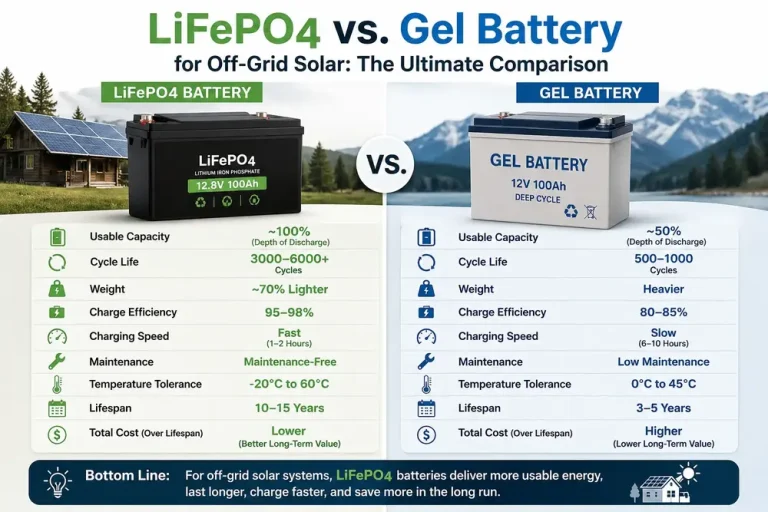
| 50% DoD | 500–1,000 cycles |
| 80% DoD | 300–600 cycles |
The exact number depends on plate design, temperature, charge voltage, discharge rate, and how often the battery sits partially discharged.
For daily cycling:
- 500 cycles = about 1.4 years
- 750 cycles = about 2.1 years
- 1,000 cycles = about 2.7 years
In real homestead use, a Gel bank may last 2–4 years if it is lightly cycled, kept cool, charged properly, and rarely discharged below 50%. In a hard daily-cycle system with high inverter loads and partial state-of-charge operation, lifespan can be shorter.
LiFePO4 Cycle Life
A quality LiFePO4 battery typically delivers:
| Depth of Discharge | Typical LiFePO4 Cycle Life |
| 60% DoD | 5,000–8,000+ cycles |
| 80% DoD | 3,000–5,000+ cycles |
| 100% DoD | 2,000–4,000 cycles, depending on cell quality and operating conditions |
For daily cycling:
- 3,000 cycles = about 8.2 years
- 4,000 cycles = about 11 years
- 5,000 cycles = about 13.7 years
- 6,000 cycles = about 16.4 years
This is why LiFePO4 usually wins the real ROI calculation. It is not only that LiFePO4 lasts longer. It lasts longer while allowing deeper discharge, faster charging, better efficiency, and less oversizing.
A Gel bank may need to be replaced three to five times over the same operating period in which a LiFePO4 bank is still in service.
4. Charging Efficiency and Speed
Charging behavior is one of the biggest practical differences between Gel and LiFePO4 batteries in off-grid solar systems.
A solar battery is not just a storage tank. It is also a load on your solar array. If the battery charges slowly or wastes energy as heat and chemical losses, you need more panels, more generator runtime, or more patience.
Peukert’s Law and Gel Batteries
Lead-acid batteries are affected by Peukert’s Law. The higher the discharge current, the lower the effective available capacity.
A Gel battery rated at 200Ah is usually rated at a 20-hour discharge rate. That means the rating assumes a slow discharge of about 10A over 20 hours.
If you run a large inverter load, such as:
- Well pump
- Microwave
- Power tools
- Kettle
- Induction cooktop
- Washing machine
- Refrigerator startup surge
the battery may deliver less usable capacity than its label suggests.
This happens because lead-acid chemistry cannot move ions and reactants fast enough under high load. Voltage drops sooner, internal losses rise, and the inverter may hit its low-voltage cutoff before the battery’s theoretical capacity is fully used.
LiFePO4 batteries have a much lower Peukert effect. Their voltage stays flatter through discharge, and they maintain usable capacity better under high current.
Internal Resistance and Charging Efficiency
Gel batteries have higher internal resistance than LiFePO4 batteries. They also require a multi-stage charging profile:
- Bulk stage
- Absorption stage
- Float stage
The bulk stage is reasonably fast, but the absorption stage is slow. As the battery approaches full charge, the current must taper down to prevent overcharging and gas venting. This is why a Gel battery may reach 80% state of charge relatively quickly, then take several more hours to reach full charge.
In off-grid solar, this matters. The sun may not stay strong long enough to complete absorption every day. If a Gel battery repeatedly fails to reach full charge, sulfation accelerates and capacity declines.
Typical practical charging efficiency:
| Battery Type | Practical Charging Efficiency |
| Gel lead-acid | about 80–85% |
| LiFePO4 | about 96–99%, often modeled around 98% |
A 15% to 20% loss in a Gel bank means a meaningful portion of your solar production never becomes usable stored energy. With LiFePO4, almost all incoming solar energy is stored, assuming the charge controller and inverter system are configured correctly.
Why LiFePO4 Charges Faster
LiFePO4 batteries can accept higher charging current and do not require the same long absorption phase as Gel batteries.
A typical Gel bank is often charged around C/10 to C/5 for long life. A 400Ah Gel bank may be charged at 40A to 80A depending on the battery manufacturer and system design.
A LiFePO4 bank can often accept 0.5C charging, and some systems can accept close to 1C if the cells, BMS, cables, fuses, and charger are designed for it. A 250Ah LiFePO4 bank may accept 100A to 125A comfortably, with some models accepting more.
This can make LiFePO4 up to four times faster in real off-grid charging scenarios, especially when solar hours are limited. The exact speed depends on:
- Solar array size
- Charge controller output
- BMS current limit
- Battery temperature
- Cable size
- System voltage
- Charger settings
For a homestead relying on winter sun or generator backup, faster charging is not just convenient. It can reduce generator fuel use, lower system stress, and make daily energy recovery more reliable.
5. Temperature Resilience & Environmental Factors
Temperature can completely change the battery decision. A battery that performs well in a mild indoor utility room may struggle in an unheated shed, desert cabin, or mountain homestead.
Cold Climate Performance
Gel batteries can generally be discharged and charged below freezing, as long as the battery is not frozen and the charging voltage is temperature-compensated. Their available capacity drops in cold weather, but the chemistry is more tolerant of cold charging than LiFePO4.
A fully charged lead-acid battery has a lower freezing point than a discharged one because the electrolyte has a higher acid concentration when charged. A discharged Gel battery in freezing conditions is at greater risk of damage.
Cold effects on Gel batteries:
- Slower chemical reaction
- Higher internal resistance
- Lower usable capacity
- More voltage sag under inverter loads
- Longer charging time
- Higher risk if stored discharged in freezing temperatures
LiFePO4 batteries behave differently. They can usually discharge below 0°C, although available power may be reduced. The critical limitation is charging. Standard LiFePO4 cells should not be charged below freezing because lithium plating can occur on the anode. Lithium plating can permanently reduce capacity and create safety risks.
For cold climates, LiFePO4 is still viable, but the system needs one of these solutions:
- Battery installed inside a heated space
- Insulated battery enclosure
- Built-in low-temperature BMS cutoff
- Self-heating LiFePO4 battery
- Small thermostatically controlled heating pad
- Charge controller configured to stop charging below 0°C
If the off-grid cabin is unheated for weeks at a time and solar charging continues in sub-freezing weather, a non-heated LiFePO4 battery is the wrong choice.
Hot Climate Performance
Heat is brutal on Gel batteries. High temperature accelerates grid corrosion, dry-out, water loss, and internal degradation. A common engineering rule for sealed lead-acid batteries is that life is roughly cut in half for every 8°C to 10°C rise above 25°C.
Example:
- Expected life at 25°C: 4 years
- Continuous operation around 33°C: roughly 2 years
- Continuous operation around 41°C: potentially about 1 year
This is a major issue for batteries installed in sheds, garages, RV compartments, shipping containers, or outdoor cabinets exposed to summer heat.
LiFePO4 batteries also age faster in heat, especially when stored at high state of charge. They are not immune to thermal aging. However, they do not suffer water loss like lead-acid batteries, and their cycle life advantage usually remains significant if kept within manufacturer temperature limits.
Best practice for both types:
- Keep batteries shaded
- Avoid sealed metal boxes in direct sun
- Provide ventilation
- Keep batteries away from inverters and charge controllers that generate heat
- Use temperature sensors where possible
- Avoid floating LiFePO4 batteries at high voltage for long periods in hot weather
6. Weight, Space, and Installation Flexibility
Battery weight and footprint are not minor details in a homestead system. They affect battery room design, wall mounting, floor loading, enclosure size, transport, maintenance access, and future expansion.
Energy Density Comparison
Typical practical energy density:
| Battery Type | Approximate Pack-Level Energy Density |
| Gel lead-acid | 30–50 Wh/kg |
| LiFePO4 | 90–160 Wh/kg |
LiFePO4 commonly provides about two to three times the usable energy per unit of weight. When usable capacity is considered, the difference becomes even larger because Gel batteries are normally limited to 50% DoD.
Example: 200Ah usable at 12V.
Gel battery bank:
- Required rated capacity: about 400Ah
- Approximate rated energy: 4.8kWh
- Practical usable energy: about 2.4kWh
- Typical weight: roughly 240–300 lb depending on battery format
LiFePO4 battery bank:
- Required rated capacity at 80% DoD: about 250Ah
- Approximate rated energy: 3.2kWh at 12.8V
- Practical usable energy: about 2.56kWh
- Typical weight: roughly 60–90 lb depending on model
For a small cabin, RV, tiny home, mobile workshop, or remote site where batteries must be carried by hand, LiFePO4 is much easier to install.
Installation Flexibility and Safety
Gel batteries are sealed and maintenance-free under normal operation, but they are still lead-acid batteries. They should be installed with ventilation because fault conditions can cause venting. They also require careful charging voltage control. Overcharging a Gel battery can create gas pockets in the gel, dry out the electrolyte, and permanently damage the battery.
LiFePO4 batteries do not off-gas during normal operation. They can often be installed in more flexible orientations, depending on the manufacturer. They are cleaner, lighter, and easier to package in compact power rooms.
The trade-off is electronics dependency. A LiFePO4 battery bank must have a properly functioning BMS. The BMS is not optional. It performs several critical roles:
- Prevents cell overvoltage during charging
- Prevents cell undervoltage during discharge
- Stops charging below safe temperature
- Disconnects loads during overcurrent or short-circuit events
- Balances cells so one cell does not drift too high or too low
- Protects the pack from unsafe operating conditions
For DIY solar builders using raw LiFePO4 cells, the BMS must be correctly sized for inverter surge current, charge current, and system voltage. For drop-in batteries, the internal BMS should be checked against the inverter’s maximum draw and the charge controller’s maximum output.
7. Financial Breakdown: Upfront Cost vs. Lifetime Value
Gel batteries usually have the lower purchase price. That is their strongest advantage.
For a small backup system, that lower initial cost may be enough to justify Gel. For a daily-cycle off-grid homestead, upfront price is the wrong metric. The better metric is lifetime cost per usable kilowatt-hour.
Why Rated Capacity Cost Is Misleading
Assume two battery banks provide roughly the same daily usable storage.
Gel option:
- Rated capacity required: 400Ah at 12V
- Usable capacity at 50% DoD: 200Ah
- Usable energy: about 2.4kWh
- Cycle life at 50% DoD: around 750 cycles
- Charging efficiency: about 85%
LiFePO4 option:
- Rated capacity required: 250Ah at 12.8V
- Usable capacity at 80% DoD: 200Ah
- Usable energy: about 2.56kWh
- Cycle life at 80% DoD: around 4,000 cycles
- Charging efficiency: about 98%
The Gel bank looks cheaper at the start, but it provides far fewer lifetime cycles.
Cost Per Lifetime kWh Example
Use simple normalized pricing:
- Gel battery cost: $180 per rated kWh
- LiFePO4 battery cost: $350 per rated kWh
Gel lifetime delivered energy per rated kWh:
- 50% DoD × 750 cycles × 85% efficiency
- 0.50 × 750 × 0.85 = 318.75kWh delivered per rated kWh
Gel lifetime cost per delivered kWh:
- $180 ÷ 318.75 = about $0.56 per kWh
LiFePO4 lifetime delivered energy per rated kWh:
- 80% DoD × 4,000 cycles × 98% efficiency
- 0.80 × 4,000 × 0.98 = 3,136kWh delivered per rated kWh
LiFePO4 lifetime cost per delivered kWh:
- $350 ÷ 3,136 = about $0.11 per kWh
Even with a much higher upfront price per rated kWh, LiFePO4 can be around five times cheaper over its working life.
10-Year Daily Cycling Scenario
Assume one full equivalent cycle per day for 10 years.
Total cycles required:
- 365 cycles/year × 10 years = 3,650 cycles
Gel battery bank:
- Typical useful cycle life at 50% DoD: 500–1,000 cycles
- Replacement events over 10 years: roughly 4 to 7 battery banks depending on actual life
- Performance declines as the bank ages
- More solar energy is lost during charging
- Higher risk of premature failure from heat, sulfation, or chronic undercharging
LiFePO4 battery bank:
- Typical useful cycle life at 80% DoD: 3,000–5,000+ cycles
- One battery bank can often cover the full 10-year period
- Higher usable capacity from the same nameplate rating
- Less wasted solar production
- Better high-load inverter performance
For a daily-use off-grid home, LiFePO4 is usually the cheaper battery even when the purchase price is higher.
Final Verdict: Which One Should You Choose?
Buy LiFePO4 If You Want the Best Long-Term Off-Grid Battery
LiFePO4 is the better choice for most serious off-grid solar systems, especially when the battery will cycle daily.
Choose LiFePO4 if:
- You live off-grid full-time
- Your system cycles every day
- You want a 10–15 year battery strategy
- You have limited battery room space
- Weight matters
- You run inverter loads such as pumps, refrigerators, tools, or kitchen appliances
- You want faster solar charging
- You use generator backup and want shorter generator runtime
- You want maximum usable capacity from each amp-hour purchased
- You want the lowest long-term cost per kWh
- Your battery can be protected from freezing during charging
For a homestead, the default recommendation is LiFePO4 with a quality BMS, correct charge settings, proper fusing, properly sized cables, and a battery location protected from temperature extremes.
Choose Gel Only in Specific Situations
Gel batteries can still make sense, but mainly in limited-use or budget-constrained systems.
Gel may be reasonable if:
- The system is backup-only, not daily cycling
- The battery will spend most of its life on float charge
- Upfront cost is the main constraint
- The system is small and low-power
- The site is extremely cold and cannot provide battery heating
- You already have a charger designed specifically for Gel batteries
- You understand the 50% DoD limit and size the bank accordingly
Gel is not the best choice for a modern full-time off-grid homestead with daily solar cycling. The usable capacity is lower, charging is slower, efficiency is worse, and replacement intervals are much shorter.
The Practical Engineering Answer
For daily off-grid solar use, LiFePO4 wins on usable capacity, cycle life, efficiency, charge speed, weight, space, and lifetime cost.
Gel wins mainly on lower initial purchase price and cold-charge tolerance.
If the battery bank is part of a long-term independent energy system, LiFePO4 is usually the smarter investment. If the system is rarely used, very small, or installed in an unheated freezing environment with no way to protect lithium batteries during charging, Gel can still be a practical compromise.
Can LiFePO4 batteries be used with the same charger as Gel batteries?
Technically yes, but it is not recommended. LiFePO4 batteries have different charging profiles (voltage levels) compared to Gel batteries. A charger set for Gel batteries may not charge your LiFePO4 battery to full capacity or might trigger the Battery Management System (BMS) to cut off charging prematurely. For optimal performance and longevity, ensure your charge controller has a specific “LiFePO4” or “Lithium” charging profile.
Do LiFePO4 batteries work in cold weather?
The main limitation for LiFePO4 batteries is charging temperature. Charging them below freezing (0°C / 32°F) can cause permanent damage to the cell structure. If you are operating an off-grid system in a cold climate, you should store your batteries in an insulated enclosure or choose LiFePO4 models equipped with a built-in heating element (self-heating). Gel batteries are generally more tolerant of cold temperatures but lose capacity faster in the cold.
What needs to be changed if I upgrade from Gel to LiFePO4?
If you are replacing your existing Gel batteries with LiFePO4, you will likely need to adjust the settings on your charge controller (MPPT/PWM) and inverter to the “Lithium” setting. If your current equipment is older or lacks adjustable settings, you may need to upgrade your charge controller to one that supports lithium chemistry.
How much longer do LiFePO4 batteries last compared to Gel batteries?
Gel batteries typically offer 300–500 cycles at a 50% Depth of Discharge (DoD). In contrast, LiFePO4 batteries can often handle 3,000–5,000 cycles even at an 80% or 90% DoD. This makes LiFePO4 a significantly more cost-effective choice in the long run (5–10 years) due to a much lower “cost per cycle.”
Which is safer: LiFePO4 or Gel batteries?
Gel batteries are stable due to their lead-acid chemistry and are very forgiving of user error. However, LiFePO4 batteries come with an integrated BMS (Battery Management System), which prevents overcharging, over-discharging, and short-circuiting by shutting the system down if a fault occurs. When using a high-quality battery with a robust BMS, LiFePO4 is considered extremely safe for residential and off-grid use.
2 thoughts on “LiFePO4 vs. Gel Battery for Off-Grid Solar: The Ultimate Comparison”