
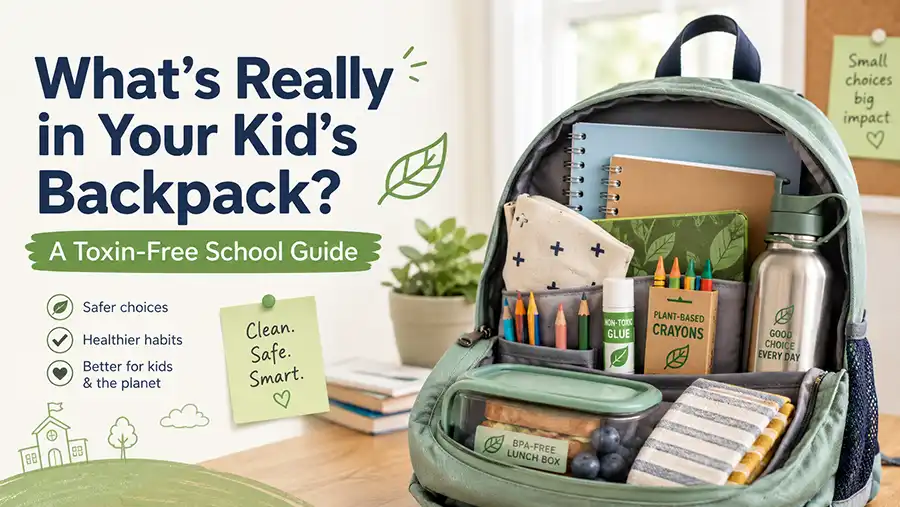
A toxin-free school guide should help parents make calmer, better-informed choices—not suggest that every colorful backpack or plastic lunch box is dangerous. Children’s products sold by reputable retailers are subject to safety rules, but materials, coatings, fragrances, and product quality still vary. The most useful strategy is to focus on items that touch food, skin, and hands every day, buy age-appropriate products from traceable brands, and replace anything that is peeling, cracked, strongly odorous, or recalled.
Quick answer: Use this toxin-free school guide to start with a washable, appropriately sized backpack; a stainless-steel or clearly identified food-grade lunch container; a durable water bottle; fragrance-free personal-care products; and art supplies labeled for the child’s age. Look for clear material disclosures and recognized safety certifications, check recalls, wash new food-contact items before use, and do not pay extra for vague claims such as “all natural,” “green,” or “chemical-free.”
What “Toxin-Free” Really Means
Nothing in a backpack is literally chemical-free: water, cotton, stainless steel, and the human body are all made of chemicals. “Toxin-free” is an informal shopping phrase, not a universal certification. A more accurate goal is to reduce avoidable exposure to substances of concern while choosing products that are functional, durable, and compliant with applicable safety standards.
Risk depends on the substance, dose, route of exposure, and frequency. A material sealed inside a product is different from a peeling surface that a young child repeatedly handles or mouths. This guide therefore prioritizes realistic exposure pathways: food and drink contact, hand-to-mouth behavior, skin contact, inhalation of sprays or fragrances, and damaged product surfaces.
The 10-Minute Backpack Audit
- Empty every compartment. Remove old food, leaking pens, wipes, sanitizer, and mystery items.
- Check for a recall. Search the brand, model, and product number in the official recall database for your country. In the United States, use the CPSC recall search.
- Inspect wear. Look for peeling coatings, exposed foam, cracked plastic, flaking paint, rust, loose magnets, or broken metal parts.
- Smell the product. A strong odor does not prove toxicity, but it is a sensible reason to air out a new item, review its materials, or choose another product if the smell persists.
- Read the labels. Note the manufacturer, age grading, care instructions, materials, and safety marks.
- Check food-contact items. Replace deeply scratched, warped, or cracked lunch containers and bottles that can no longer be cleaned properly.
- Review liquids and sprays. Confirm that glue, markers, sanitizer, sunscreen, and cleaning products are closed, labeled, age-appropriate, and not leaking.
- Wash what can be washed. Clean the lunch bag, bottle, food containers, and frequently touched backpack surfaces according to the manufacturer’s directions.
Toxin-Free School Guide: What to Check Item by Item
| Item | Priority check | Lower-concern choice | Replace when |
|---|---|---|---|
| Backpack | Traceable brand, washable surface, no peeling coating | Durable fabric with clear material information | Coating flakes, seams expose foam, or hardware breaks |
| Lunch box | Food-contact material and cleaning instructions | Stainless steel, glass with protective sleeve, or identified food-grade plastic | Cracked, warped, deeply scratched, or retains odor |
| Water bottle | Known material, leakproof design, cleanable lid | Stainless steel or food-grade plastic from a reputable maker | Interior lining peels, plastic cracks, or mold cannot be removed |
| Pencil case | Strong odor, soft vinyl, peeling decoration | Washable fabric, silicone, metal, or clearly disclosed material | Surface becomes sticky or flakes |
| Markers and crayons | Age label and recognized art-material statement | Products carrying an appropriate conformity or toxicological-review label | Unlabeled, recalled, dried out, or damaged |
| Glue | Intended use, age grading, cap security | Water-based school glue labeled for children | Leaking, unlabeled, or transferred into another container |
| Rain gear | Material disclosure and condition | Durable, well-fitting gear from a compliant children’s brand | Coating peels or the product develops persistent odor or stickiness |
| Sanitizer | Active ingredient, secure cap, supervision needs | Product in its original container, used as directed | Recalled, leaking, or packaged like food or drink |
1. How to Choose a PVC-Free Backpack
Backpacks can contain woven fabric, foam, plastic coatings, printed decorations, metal hardware, and flexible vinyl. In the United States, a backpack designed or decorated for children 12 and under may qualify as a children’s product under Consumer Product Safety Commission guidance. Children’s products are subject to requirements that include limits for lead in accessible components.
Some parents prefer a PVC-free backpack because flexible polyvinyl chloride may require plasticizers and because avoiding PVC can simplify end-of-life disposal. However, “PVC-free” alone does not prove that every alternative material is safer or more sustainable. Ask what the product is made from rather than relying on a single front-label claim.
- Choose a manufacturer that identifies the shell, lining, coating, and trim materials.
- Prefer a durable bag that can be wiped or washed, since long service life reduces waste.
- Avoid untraceable products with no manufacturer, importer, model, or care information.
- Inspect painted zipper pulls, charms, and printed decorations for damage.
- Skip unnecessary dangling accessories for younger children, especially pieces small enough to become choking hazards.
- Make sure the backpack fits. Chemical concerns should not distract from weight, strap comfort, visibility, and trip hazards.
2. Safer Lunch Boxes and Food Containers
Food-contact items deserve priority because their contents are eaten or drunk. Good choices include stainless steel, glass with an impact-resistant sleeve where school rules permit it, silicone intended for food contact, and food-grade plastics from reputable manufacturers. “Plastic-free” is optional; a well-made plastic container used within its temperature limits can be more practical than a heavy or breakable alternative.
What about BPA-free plastic?
“BPA-free” answers only one question: whether bisphenol A was used. It does not identify every other component or guarantee that a container is suitable for heat. Follow the manufacturer’s microwave, dishwasher, freezer, and replacement instructions. Never heat a container that is not labeled for that purpose, and replace plastic that is cracked, cloudy, warped, or deeply scratched.
A practical lunch-container checklist
- Look for the manufacturer and a clear food-contact use statement.
- Choose simple containers with removable seals and lids that can be fully cleaned.
- Wash before first use and after each school day.
- Do not reuse single-use packaging as a permanent lunch container unless the maker says it is designed for reuse.
- Keep hot foods in containers specifically rated for hot food.
- Use an insulated bag and appropriate cold pack for perishable food.
Packaging choices are only part of a resilient household food system. Our guide to food preservation without electricity explains lower-energy approaches to storage, fermentation, drying, and root-cellar use.
3. BPA-Free Water Bottles for Kids
A child’s bottle should be durable, easy to clean, and made from an identified food-contact material. Stainless steel avoids many concerns associated with plastic and is long-lasting, but painted exteriors and interior linings should remain intact. Food-grade plastic is lighter and can also be a reasonable choice when used as directed.
- Select a lid that comes apart far enough to clean hidden seals and straws.
- Label the bottle so it is less likely to be lost and repeatedly replaced.
- Wash it daily and allow all parts to dry completely.
- Do not pour boiling liquid into a bottle unless it is designed for that use.
- Replace a bottle if the interior peels, the plastic cracks, or persistent mold remains around the lid.
4. Non-Toxic Pencils, Markers, Crayons, and Paint
“Non-toxic” on art supplies should not be interpreted as “safe to eat” or suitable for every age. Buy supplies intended for children and use the age label. In the United States, look for products that conform to ASTM D-4236; the statement indicates that the art material has been reviewed for potential chronic hazards and appropriately labeled. The ACMI AP seal is another voluntary label commonly seen on art materials evaluated for intended use.
- Choose reputable, labeled brands rather than loose crayons, paints, or markers with no packaging.
- Use water-based, washable products when they meet the activity’s needs.
- Do not send solvent-based permanent markers unless the school specifically requires and supervises them.
- Teach children not to chew pencils, marker caps, erasers, or paintbrushes.
- Wash hands after art activities and before eating.
- Replace art products subject to a safety recall.
5. Glue, Tape, Erasers, and Pencil Cases
For ordinary classroom crafts, a water-based glue labeled for children is usually sufficient. Keep it in the original container so directions and warnings remain available. Avoid decanting glue or cleaner into beverage bottles, and do not mix products to create homemade formulas.
Soft vinyl pencil cases may have a noticeable odor and can wear into a sticky or peeling surface. A washable fabric, metal, or silicone case with clear material information is a straightforward alternative. Natural rubber erasers can work well but may be unsuitable for a child with a latex allergy; “natural” is not automatically safer for every person.
6. Hand Sanitizer, Wipes, and Fragranced Products
Soap and water are the preferred routine for visibly dirty hands. Where school policy calls for hand sanitizer, keep it in the original container, follow the label, and supervise younger children. The FDA warns that swallowing even a small amount of alcohol-based sanitizer can cause alcohol poisoning in children. Products packaged to resemble food or drinks create additional risk.
Fragrance can irritate some children or trigger symptoms in people with asthma, migraine, or fragrance sensitivity. A fragrance-free product is different from an “unscented” product, which may contain masking fragrance. For wipes, sunscreen, lotion, or sanitizer, use only what the child actually needs and follow school rules. More products do not automatically mean more protection.
For household cleaners used to wash lunch bags and containers, the EPA Safer Choice label can help U.S. consumers identify products whose ingredients have been reviewed against program criteria. It does not mean a product is harmless or safe to swallow; label directions still matter.
7. Raincoats, Jackets, and Waterproof Gear
Rainwear may use coated fabrics, membranes, surface water-repellent treatments, plastic snaps, prints, and reflective trim. A single marketing claim cannot describe the entire product. Choose correctly sized gear from a traceable children’s brand, follow care instructions, and replace pieces whose coating is flaking or sticky.
If you want to reduce fluorinated treatments, look for a precise statement such as “made without intentionally added PFAS” rather than an undefined “eco” label. Remember that terminology and regulations vary by country, and absence claims are only as reliable as the company’s documentation.
Labels and Claims: What They Do—and Do Not—Tell You
| Claim or label | Useful meaning | Important limitation |
|---|---|---|
| PVC-free | The item is represented as not using polyvinyl chloride | Does not assess every substitute, dye, coating, or metal part |
| BPA-free | BPA is not intentionally used or detected under the maker’s stated criteria | Does not mean plastic-free or heat-safe |
| Phthalate-free | Addresses a named group of plasticizers | Ask which phthalates and what testing or standard supports the claim |
| Natural | No consistent universal safety meaning for school supplies | Natural substances can still irritate, trigger allergies, or be unsafe |
| Fragrance-free | Generally indicates no fragrance materials were added | Read the ingredient label; definitions can vary |
| ASTM D-4236 | Art material has undergone chronic-hazard review and labeling | It is not permission to ingest or misuse the product |
| EPA Safer Choice | Cleaning-product ingredients meet program criteria | Applies to participating products, not all school supplies |
| CE marking | Manufacturer declares conformity with applicable EU requirements | Not a universal “non-toxic” certification and not relevant to every product category |
Red Flags That Matter More Than Marketing
- No identifiable manufacturer, importer, or contact information.
- No age grade or instructions on an item intended for young children.
- A product under active recall.
- Peeling paint, flaking coating, cracked food-contact plastic, or exposed filling.
- Liquid products transferred into food or beverage containers.
- Sanitizer or cleaner packaged to resemble candy, juice, or another edible product.
- Loose magnets, batteries, charms, or small parts accessible to a young child.
- Persistent mold in a bottle cap, straw, seal, or lunch-bag seam.
- Extraordinary health promises without a named standard or verifiable test.
Do You Need to Replace Everything?
No. Throwing away functional supplies can increase cost and waste without meaningfully reducing exposure. Prioritize replacement when an item is recalled, damaged, difficult to clean, poorly labeled, unsuitable for the child’s age, or used incorrectly. Otherwise, continued use plus good hygiene may be the more sustainable choice.
A toxin-free school guide does not require replacing everything. If the budget is limited, spend first on food and drink contact, then on products used directly on skin or sprayed into the air. A plain, durable item from a reputable manufacturer is often a better choice than an expensive product covered in unverified wellness claims.
A Budget-Friendly Safer School Supply Plan
- Keep safe items you already own. Clean and inspect before replacing.
- Check recalls for free. Do this before buying secondhand as well as after purchase.
- Prioritize food contact. One durable bottle and lunch container matter more than matching accessories.
- Choose fewer multipurpose supplies. A small set of washable markers is easier to monitor than a large mixed kit.
- Buy refillable or replaceable-part designs. Bottles with available seals and lunch boxes with replacement lids last longer.
- Label possessions. Preventing loss reduces repeat purchases and waste.
- Ask the school. Confirm material restrictions, allergy policies, and required products before shopping.
Frequently Asked Questions About Toxin-Free School Supplies
Are all plastic school supplies toxic?
No. “Plastic” describes a broad family of materials, and risk depends on the specific material, additives, product quality, intended use, condition, and exposure. Choose compliant products from traceable manufacturers and use them according to instructions.
Is stainless steel always better than plastic?
Not always. Stainless steel is durable and useful for food and drink, but it can be heavier, dent, or include coatings and seals made from other materials. The best product is one that is suitable for the child, remains intact, and can be cleaned properly.
Should a new backpack with a strong smell be returned?
Odor alone cannot identify a chemical or establish risk. Air the item outdoors or in a ventilated area and follow washing instructions. If the odor persists, causes symptoms, or accompanies sticky or peeling material, stop using it and contact the retailer or manufacturer.
Are “natural” crayons and glues safer?
Not automatically. Look for age-appropriate labeling and a recognized art-material safety statement. Natural ingredients can still cause allergies or be unsafe if swallowed.
How often should lunch boxes and bottles be replaced?
There is no universal calendar deadline. Replace them when they are recalled, cracked, warped, peeling, permanently contaminated, or no longer able to be cleaned and sealed correctly.
How can I verify a non-toxic claim?
Ask which substance is excluded, what standard applies, who performed the testing, and whether a current report or certificate is available for the exact product. A precise, verifiable statement is more useful than a broad green claim.
Final Backpack Checklist
- Recall search completed
- Manufacturer and materials identified
- No peeling, cracking, stickiness, or loose small parts
- Food and drink containers intact and easy to clean
- Art supplies age-appropriate and properly labeled
- Glue, sanitizer, and other liquids sealed in original containers
- Fragrance-free options chosen where sensitivity is a concern
- Backpack fits comfortably and includes no unnecessary hazards
- Child knows not to chew supplies or share bottles
- Care and replacement instructions saved
A practical toxin-free school guide is about priorities, not perfection. The goal is not a perfectly “pure” backpack. It is a small set of durable, transparent, age-appropriate supplies used as intended. Begin with recalls and damaged products, prioritize what touches food and skin, and treat vague marketing claims with healthy skepticism.
Sources and Further Reading
- U.S. Consumer Product Safety Commission: Children’s Products
- CPSC: Total Lead Content Requirements
- CPSC: Phthalates FAQ
- CPSC: Recalls and Product Safety Warnings
- U.S. EPA: Safer Choice Program
This article provides general consumer information and is not medical advice. Product rules and labels differ by country. If a child develops symptoms after using a product, stop exposure and seek advice from an appropriate medical professional or poison center.