
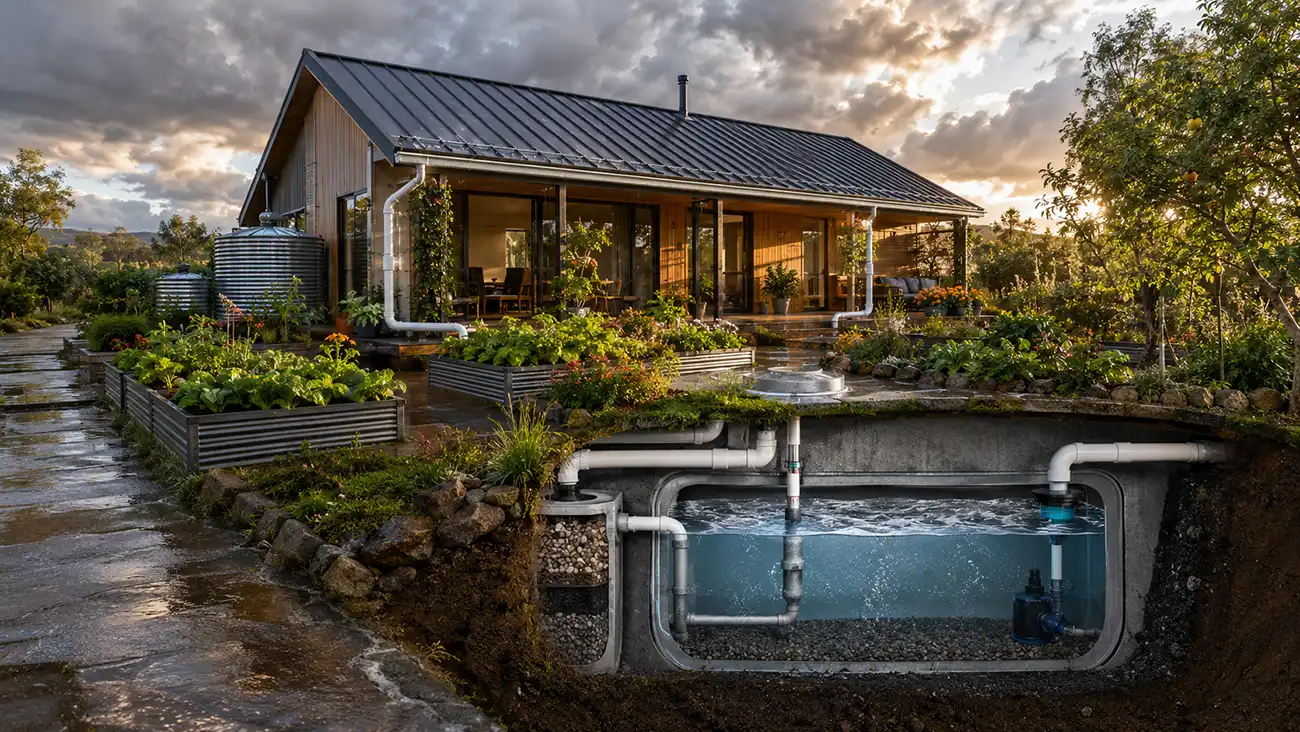
Rainwater Harvesting System Size Calculator: Find the Right Tank for Your Home
Choosing the correct rainwater harvesting system size can save thousands of gallons of water every year while preventing oversized tanks and unnecessary costs. Our free Rainwater Harvesting System Size Calculator estimates how much rainwater you can collect based on your roof size, local rainfall, household water usage, and collection efficiency.
Whether you’re building an off-grid cabin, reducing your water bills, or creating a sustainable homestead, this guide will help you determine the ideal rainwater tank size and design an efficient collection system.
Quick Answer
Most homes require a rainwater tank between 1,500 and 5,000 gallons (5,700–19,000 liters).
- Small cabin → 500–1,000 gallons
- Small family → 1,500–3,000 gallons
- Large family → 3,000–5,000 gallons
- Off-grid home → 5,000+ gallons
Your ideal size depends on roof area, annual rainfall, water consumption, and climate.
Rainwater Harvesting System Size Calculator
Estimate how much rainwater your roof can collect, your household’s annual demand, the storage needed for a dry period, and a practical rainwater tank size.
Your Rainwater Harvesting Results
Calculation breakdown
This calculator provides a planning estimate rather than an engineered system design. Actual tank sizing should also consider monthly rainfall distribution, available installation space, overflow routing, filtration, pump capacity, freezing conditions, local building rules, and water-quality requirements.
💧 Did You Know?
A roof measuring just 1,000 square feet can collect approximately 600 gallons of water from only 1 inch of rainfall.
How Does Rainwater Harvesting Work?
A rainwater harvesting system captures rain from your roof and stores it for later use. Instead of allowing water to flow into storm drains, gutters direct rainfall into a storage tank where it can be filtered and reused.
The amount of water you can collect depends primarily on four factors:
- Roof size
- Annual rainfall
- Collection efficiency
- Water consumption
Understanding these variables is essential when selecting the correct tank size.
What Size Rainwater Tank Do You Need?
The ideal tank size isn’t simply the largest one you can afford. An oversized tank may never fill completely, while an undersized tank can run dry during periods without rainfall.
The goal is to balance rainfall patterns with household water demand.
| Household | Typical Tank Size |
|---|---|
| Garden irrigation | 500–1,000 gallons |
| 1–2 people | 1,500 gallons |
| 3–4 people | 2,500–3,500 gallons |
| Large family | 4,000–5,000 gallons |
| Off-grid home | 5,000+ gallons |
Rainwater Tank Size Comparison
| Tank Size | Best For | Storage Capacity |
|---|---|---|
| 500 gal | Small gardens | Good |
| 1,000 gal | Cabins | Better |
| 2,500 gal | Family homes | Excellent |
| 5,000 gal | Off-grid living | Outstanding |
| 10,000 gal | Large homesteads | Maximum resilience |
⚠️ Common Mistake
Many homeowners buy the largest tank they can afford without calculating their actual water usage. In many climates, a correctly sized 2,500-gallon tank performs better than an oversized 10,000-gallon tank because it fills more consistently throughout the year.
Rainwater Harvesting Calculator Formula
The amount of rainwater you can collect depends on four key variables:
- Roof Catchment Area
- Annual Rainfall
- Runoff Coefficient (Collection Efficiency)
- Water Consumption
Rainwater Collection Formula
Collected Water = Roof Area × Annual Rainfall × 0.623 × Collection Efficiency
The constant 0.623 converts inches of rainfall falling on one square foot into gallons of water.
Example:
- Roof Area: 2,000 sq ft
- Rainfall: 35 inches/year
- Efficiency: 90%
2,000 × 35 × 0.623 × 0.90 = 39,249 gallons per year
This equals more than 148,000 liters of harvestable rainwater annually.
How Much Water Can Your Roof Collect?
| Roof Area | 1 inch Rain | 20 in/year | 40 in/year |
|---|---|---|---|
| 500 sq ft | 311 gal | 6,226 gal | 12,452 gal |
| 1,000 sq ft | 623 gal | 12,452 gal | 24,904 gal |
| 1,500 sq ft | 935 gal | 18,678 gal | 37,356 gal |
| 2,000 sq ft | 1,246 gal | 24,904 gal | 49,808 gal |
| 3,000 sq ft | 1,869 gal | 37,356 gal | 74,712 gal |
💡 Did You Know?
A typical suburban home with a 2,000-square-foot roof located in a region receiving 40 inches of rainfall can collect nearly 50,000 gallons every year.
Recommended Tank Size by Household
| Household Size | Daily Usage | Suggested Tank |
|---|---|---|
| 1 person | 30–60 gal | 1,000 gal |
| 2 people | 60–120 gal | 1,500 gal |
| 4 people | 120–250 gal | 2,500–5,000 gal |
| 6+ people | 250+ gal | 5,000–10,000 gal |
These estimates assume rainwater is used for toilets, irrigation, laundry, and outdoor cleaning. Homes relying entirely on rainwater for drinking and cooking may require larger storage volumes.
Collection Efficiency by Roof Material
Not every roof collects rainwater equally. Roof material influences water quality, debris accumulation, and runoff efficiency.
| Roof Material | Efficiency | Recommended? |
|---|---|---|
| Metal Roofing | 95% | ⭐⭐⭐⭐⭐ |
| Clay Tiles | 90% | ⭐⭐⭐⭐☆ |
| Concrete Tiles | 88% | ⭐⭐⭐⭐☆ |
| Slate | 92% | ⭐⭐⭐⭐⭐ |
| Asphalt Shingles | 85% | ⭐⭐⭐☆☆ |
| Green Roof | 40% | ★☆☆☆☆ |
⚠️ Common Mistake
Many people calculate tank size using roof area alone. They forget that collection efficiency varies depending on roofing material, first-flush systems, leaf guards, evaporation losses and overflow events.
Above-Ground vs Underground Rainwater Tanks
| Above Ground | Underground | |
|---|---|---|
| Installation Cost | Low | High |
| Maintenance | Easy | Moderate |
| Water Temperature | Higher | Stable |
| Appearance | Visible | Hidden |
| Freeze Protection | Lower | Excellent |
Above-ground tanks are ideal for most homeowners due to their lower installation costs and easier maintenance. Underground tanks become more practical for larger systems or properties where aesthetics and temperature stability are priorities.
Rainwater Tank Materials Compared
| Material | Lifespan | Pros | Cons |
|---|---|---|---|
| Plastic (Poly) | 20–30 Years | Affordable | UV degradation |
| Steel | 30–40 Years | Strong | Rust risk |
| Concrete | 50+ Years | Very durable | Expensive |
| Fiberglass | 40 Years | Corrosion resistant | Higher cost |
Infographic: How Rainwater Travels Through Your System
Suggested illustration:
- Roof
- Gutters
- Leaf Guard
- First Flush Diverter
- Filter
- Storage Tank
- Pump
- Garden / House Supply
Checklist Before Buying a Rainwater Tank
- ☐ Measure roof area
- ☐ Check annual rainfall
- ☐ Calculate household water usage
- ☐ Choose tank material
- ☐ Decide above or underground installation
- ☐ Install leaf guards
- ☐ Install first flush diverter
- ☐ Plan overflow drainage
- ☐ Consider future expansion
- ☐ Clean gutters regularly