
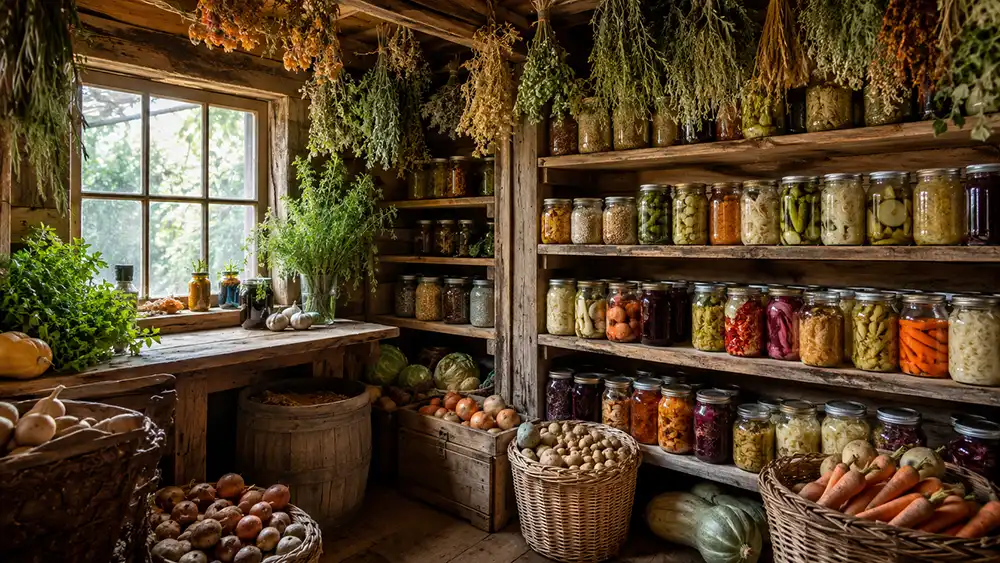
Food Preservation Without Electricity
Food preservation without electricity is not about going backward. It is about using temperature, moisture, salt, acidity, airflow and time with enough precision to keep food safe and useful when refrigeration is not available.
For off-grid cabins, homesteads, garden harvests and emergency food systems, this skill is essential. A freezer can fail. A solar battery bank can run low in winter. But a well-designed root cellar, a shelf of fermented vegetables, dried herbs, properly canned food and a simple cold storage plan can keep a household resilient for months.
This guide explains how to preserve food without electricity using practical, low-energy methods: root cellaring, clamps and trenches, fermentation, drying, pickling, canning, smoking, salting and evaporative cooling.
The goal is not to romanticize old methods. The goal is to build a reliable food preservation system that matches the crop, the climate, the available storage space and the level of food safety required.
Quick Answer: How Do You Preserve Food Without Electricity?
The best methods for food preservation without electricity are:
- Root cellaring for potatoes, carrots, beets, cabbage and apples
- Clamps and trenches for root crops in cool climates
- Fermentation for cabbage, cucumbers, peppers and mixed vegetables
- Solar dehydration for fruits, herbs, mushrooms and some vegetables
- Canning for shelf-stable foods when done with tested recipes
- Pickling for acidified vegetables and fruits
- Salting, curing and smoking for specific foods
- Evaporative cooling for short-term fresh storage in dry climates
No single method works for every food. A good off-grid pantry uses several preservation methods together.
Why Food Preservation Without Refrigeration Works
Food spoils because microorganisms, enzymes, oxygen, moisture, temperature and pests break it down.
Traditional preservation methods work by controlling one or more of these factors.
Root cellars slow spoilage with cold temperature and humidity control.
Drying removes moisture.
Fermentation creates acidity and beneficial microbial activity.
Canning uses heat and sealed jars.
Pickling uses acidity.
Salting and curing reduce available moisture.
Cold storage, drying, acidity and oxygen control are all different tools. The best method depends on the food.
The Off-Grid Preservation Rule: Match the Food to the Method
A common mistake is trying to preserve everything the same way.
Potatoes do not want the same conditions as onions.
Carrots do not store like dry beans.
Cabbage can be root cellared, fermented or canned, but each method gives a different result.
Herbs are usually better dried than root cellared.
Tomatoes are often better canned, dried or fermented than stored fresh.
A strong off-grid food preservation system starts by sorting the harvest into categories.
Best Food Preservation Methods Without Electricity
| Method | Best For | Storage Style | Skill Level |
|---|---|---|---|
| Root cellar | Potatoes, carrots, beets, cabbage, apples | Cool/cold storage | Medium |
| Clamp or trench | Root crops | Outdoor earth storage | Medium |
| Fermentation | Cabbage, cucumbers, peppers, mixed vegetables | Acidified jars/crocks | Medium |
| Solar drying | Fruits, herbs, mushrooms, tomatoes | Dry pantry storage | Easy-medium |
| Canning | Fruits, tomatoes, pickles, low-acid foods with pressure canning | Shelf-stable jars | High |
| Pickling | Cucumbers, onions, peppers, fruits | Acidified jars | Medium |
| Salting/curing | Meat, fish, some vegetables | Dry/cool storage | High |
| Evaporative cooling | Short-term fresh produce | Cool microclimate | Easy |
This table should not be used as a safety shortcut. Canning, curing and some pickling methods require tested procedures.
Root Cellar Food Storage
A root cellar is one of the most valuable systems for food preservation without refrigeration.
It uses the earth’s natural insulation to create a cool, humid, stable environment. This is ideal for many root crops and winter vegetables.
A proper root cellar can store:
- Potatoes
- Carrots
- Beets
- Turnips
- Rutabagas
- Cabbage
- Apples
- Pears
- Winter squash, in a separate warmer/drier zone
The key is not just “cold.” The key is matching temperature and humidity to the crop.
Root Cellar Temperature and Humidity
Different vegetables require different storage conditions.
A practical root cellar plan should include three storage zones:
| Storage Zone | Temperature | Humidity | Best Foods |
|---|---|---|---|
| Cold and moist | 32–40°F / 0–4°C | 90–95% RH | Carrots, beets, cabbage, rutabagas |
| Cold and dry | 32–40°F / 0–4°C | 60–70% RH | Apples, pears, some dry crops |
| Cool and dry | 50–60°F / 10–15°C | 50–70% RH | Winter squash, onions, garlic |
This matters because a storage crop can fail even in a “cool” room if humidity is wrong.
Carrots shrivel in dry air.
Onions rot in high humidity.
Potatoes sprout in warm conditions.
Winter squash can decay in a damp cold cellar.
For a deeper article, create a separate page for root cellar temperature and humidity and link it from this section.
How to Store Potatoes Without Electricity
Potatoes store best in a dark, cool, humid but ventilated place.
Ideal conditions:
- Cool temperature
- High humidity
- Total darkness
- Good airflow
- No freezing
- No direct contact with apples
Light causes greening.
Warmth causes sprouting.
Too much moisture without airflow causes rot.
Too much dryness causes shriveling.
A root cellar, buried box, insulated storage bin or traditional clamp can work if temperature stays stable.
A strong supporting article for this cluster should be: how to store potatoes without electricity.
How to Store Carrots in Sand
Carrots need cold, moist conditions. Without enough humidity, they lose water and become rubbery.
One traditional method is storing carrots in damp sand.
Basic method:
- Harvest carrots before hard freezing.
- Remove the greens.
- Do not store damaged or diseased roots.
- Place a layer of damp sand in a box.
- Add carrots without letting them touch.
- Cover with more damp sand.
- Keep the box in a cold, moist storage area.
The sand should be damp, not wet.
This method helps maintain humidity around the roots and slows moisture loss.
A separate article titled how to store carrots in sand would be a strong long-tail support page.
Traditional Root Clamps and Trenches
A root clamp is an outdoor storage mound built from root crops, straw and soil.
It is useful when you do not have a full root cellar.
Root clamps work best for:
- Potatoes
- Beets
- Carrots
- Turnips
- Rutabagas
The principle is simple: insulation plus ventilation.
A clamp must keep crops cold without freezing and moist without suffocating.
Poorly built clamps fail from three causes:
- freezing
- overheating
- trapped moisture and rot
Fermentation Without Electricity
Fermentation is one of the most powerful traditional methods for food preservation without electricity.
It is especially useful for:
- Cabbage
- Cucumbers
- Carrots
- Peppers
- Radishes
- Garlic
- Mixed garden vegetables
Fermentation works because salt and controlled conditions encourage lactic acid bacteria. These bacteria create acidity, which helps preserve the food and develop flavor.
Common examples include:
- Sauerkraut
- Kimchi
- Fermented pickles
- Fermented carrots
- Pepper mash
Fermentation is low-energy, low-cost and excellent for small homesteads.
But it still requires cleanliness, correct salt ratios, good containers and careful observation.
Does Fermented Food Need Refrigeration?
This depends on the stage and the food.
Active fermentation happens at room temperature, usually for days or weeks depending on the recipe and temperature.
After fermentation reaches the desired acidity and flavor, cool storage slows further fermentation.
Without refrigeration, fermented foods can be stored in:
- root cellars
- cool pantries
- spring houses
- cold rooms
- buried crocks in suitable climates
The warmer the storage area, the faster the flavor and texture will continue to change.
For this reason, fermenting vegetables without refrigeration is possible, but cool storage is still very useful after the active fermentation stage.
Solar Food Dehydration
Drying preserves food by removing moisture.
A solar food dehydrator DIY setup can work well for:
- herbs
- apples
- pears
- plums
- tomatoes
- mushrooms
- peppers
- onions
- greens
Drying is excellent for foods that do not need to remain fresh in texture.
The main goal is to remove enough moisture to prevent spoilage while protecting the food from insects, dust and condensation.
A good solar dehydrator needs:
- dark heat-absorbing surface
- airflow
- insect screen
- food-safe trays
- protection from rain
- enough heat without cooking the food
Drying is simple, but storage matters. Dried food should be kept in airtight containers away from moisture, heat and light.
Canning Without Electricity
Canning can be part of off-grid food preservation, but it must be treated carefully.
The key issue is not whether the heat source is electric. The key issue is whether the correct temperature, pressure and processing time are achieved.
Water bath canning is used for high-acid foods.
Pressure canning is required for low-acid foods such as many vegetables, meats, poultry, fish and beans.
A propane stove, wood cookstove or outdoor burner may provide heat, but the method still needs to follow tested canning procedures.
Do not improvise canning times.
Do not “dry can” foods as if it were the same as tested canning.
Do not can low-acid foods in a water bath.
Canning is powerful, but it is also the preservation method where safety rules matter most.
Pickling and Acid Preservation
Pickling preserves food through acidity.
There are two main types:
- fermented pickles
- vinegar pickles
Fermented pickles develop acidity through lactic acid fermentation.
Vinegar pickles rely on added acid.
Pickling works well for:
- cucumbers
- onions
- peppers
- beets
- green beans
- some fruits
The important rule is simple: use tested proportions.
Changing the vinegar, water, salt or food ratio can create unsafe acidity levels.
Pickling is not just flavoring. It is a preservation system based on acid control.
Salting, Curing and Smoking
Salting, curing and smoking are traditional preservation methods, but they require more skill than root cellaring or drying.
They can be used for:
- fish
- meat
- some vegetables
- cheese in certain systems
These methods reduce moisture, inhibit spoilage and add antimicrobial conditions.
However, they must be done carefully.
Improper curing or smoking can create serious food safety risks.
For a beginner off-grid pantry, start with root cellaring, drying and fermentation before relying on meat curing as a primary preservation method.
Evaporative Cooling and Zeer Pots
Evaporative cooling can help extend the life of fresh produce without electricity.
A common example is a pot-in-pot cooler, sometimes called a zeer pot.
It uses:
- two unglazed clay pots
- wet sand between the pots
- airflow
- evaporation
- shade
As water evaporates, it cools the inner container.
This works best in hot, dry climates with good airflow.
It is not a replacement for a root cellar or safe canning, but it can help store fresh vegetables, herbs and fruit for short periods.
In humid climates, evaporative cooling is much less effective.
What to Preserve by Method
| Food | Best No-Electric Method | Notes |
|---|---|---|
| Potatoes | Root cellar, clamp | Keep dark, cool and ventilated |
| Carrots | Damp sand, root cellar | Needs cold and high humidity |
| Beets | Root cellar, sand storage | Remove greens before storage |
| Cabbage | Root cellar, fermentation | Good for sauerkraut and kimchi |
| Apples | Cool storage, drying, canning | Store away from some root crops |
| Tomatoes | Canning, drying, fermentation | Fresh storage is short-term |
| Herbs | Drying | Store airtight after drying |
| Onions | Cool, dry storage | Needs low humidity and airflow |
| Garlic | Cool, dry storage | Cure before storage |
| Winter squash | Cool, dry storage | Do not store in damp cold cellar |
| Cucumbers | Fermentation, pickling | Fresh storage is short |
| Beans | Drying, pressure canning | Dry fully before pantry storage |
This table is useful because it prevents the biggest storage mistake: treating all harvest crops the same.
Building an Off-Grid Food Preservation System
A resilient pantry does not depend on one method.
A practical homestead system uses layers:
Layer 1: Fresh short-term storage
Use shaded pantries, evaporative cooling, spring houses or cool rooms.
Best for:
- greens
- herbs
- fresh fruit
- daily-use vegetables
Layer 2: Root cellar storage
Use for dense crops that naturally store well.
Best for:
- potatoes
- carrots
- beets
- cabbage
- apples
- rutabagas
Layer 3: Fermentation
Use for vegetables that can be safely acidified through fermentation.
Best for:
- cabbage
- cucumbers
- peppers
- radishes
- carrots
Layer 4: Dry storage
Use for foods that can lose moisture without losing usefulness.
Best for:
- herbs
- mushrooms
- apples
- tomatoes
- peppers
- onions
Layer 5: Shelf-stable canning
Use tested canning recipes for long-term pantry storage.
Best for:
- sauces
- fruits
- jams
- pickles
- pressure-canned low-acid foods
The result is a pantry that does not collapse when a freezer fails.
A Simple Seasonal Preservation Plan
Spring
- Ferment early greens and radishes
- Dry herbs
- Prepare jars, lids and storage boxes
- Clean root cellar shelves
Summer
- Solar dry herbs, tomatoes and fruit
- Can high-acid fruit and tomato products using tested recipes
- Pickle cucumbers and peppers
- Begin pantry rotation
Autumn
- Store potatoes, carrots, beets and cabbage
- Build clamps or trenches if needed
- Ferment cabbage and root vegetables
- Cure onions, garlic and winter squash
Winter
- Monitor root cellar temperature and humidity
- Remove spoiled produce immediately
- Check jars for seal failure
- Rotate dried foods
- Plan next year’s storage crops
Preservation is not one harvest-week activity. It is a year-round system.
Common Mistakes in Food Preservation Without Electricity
Storing everything in the same room
Different foods need different temperature and humidity conditions.
Ignoring humidity
Cold air alone is not enough. Root crops often need high humidity, while onions and garlic need dry air.
Using unsafe canning shortcuts
Canning requires tested methods. Guessing processing times or changing recipes can be dangerous.
Forgetting ventilation
Root cellars and clamps need airflow. Without it, moisture buildup can cause rot.
Storing damaged produce
Damaged crops spoil faster and can spread rot.
Depending only on the freezer
A freezer is useful, but it is not a complete off-grid preservation system.
Not tracking storage conditions
A thermometer and hygrometer are simple tools that prevent major losses.
- Traditional Root Clamps and Trenches
- Root Cellar Design for Beginners
- Root Cellar Temperature and Humidity Guide
- How to Store Potatoes Without Electricity
- How to Store Carrots in Sand
- Solar Food Dehydrator DIY Plans
- Fermenting Vegetables for Beginners
- Food Preservation category page
Recommended placement:
Use Traditional Root Clamps and Trenches in the root clamp section.
Use Root Cellar Design for Beginners in the root cellar section.
Use Root Cellar Temperature and Humidity Guide where storage zones are explained.
Use Solar Food Dehydrator DIY Plans in the drying section.
Use Fermenting Vegetables for Beginners in the fermentation section.
External References to Add
- National Center for Home Food Preservation
- University of Minnesota Extension vegetable storage guide
- NCHFP canning safety resources
Final Recommendation
Food preservation without electricity works best when it is designed as a system, not a single trick.
A root cellar stores dense winter crops.
A clamp or trench extends storage where a cellar is not available.
Fermentation preserves vegetables with salt, acidity and time.
Drying reduces moisture for shelf-stable storage.
Canning creates long-term pantry food when tested recipes are followed.
Pickling uses acidity.
Evaporative cooling helps with short-term storage in dry climates.
The strongest off-grid pantry uses several of these methods together.
For a self-sufficient homestead, start with the most reliable foundation:
- Build or improve cold storage.
- Learn safe fermentation.
- Add solar drying.
- Use tested canning methods.
- Track temperature and humidity.
- Store each crop according to its needs.
A freezer stores food until the power fails. A well-designed preservation system stores food because it understands the food itself.
3 thoughts on “Food Preservation Without Electricity: Off-Grid Methods for Root Cellars, Fermentation and Drying”
Comments are closed.