
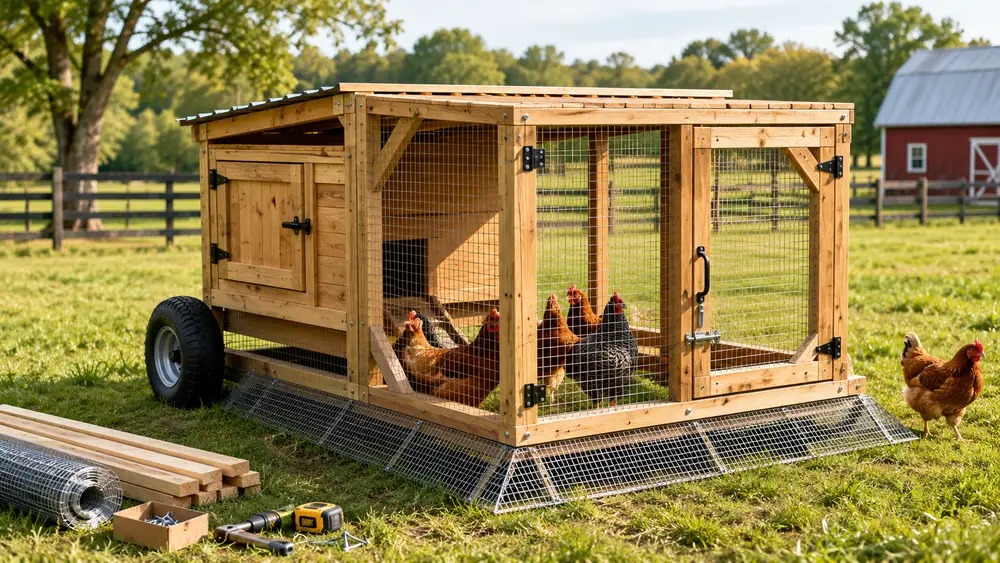
DIY Chicken Tractor Plans must balance four practical requirements: enough space for the birds, strong predator protection, low enough weight for easy movement and a layout that fits your garden or pasture rotation. A chicken tractor that is too heavy will not be moved often enough. A tractor that is too light may fail against predators or wind. A tractor that is too small will damage soil, stress birds and create manure buildup.
A good chicken tractor is not just a box with wire. It is a mobile poultry shelter designed around bird behavior, soil recovery, ventilation, shade, manure distribution and daily handling. The best design is the one you can actually move on schedule without injuring birds, damaging beds or fighting with the structure every morning.
This guide explains how to plan a chicken tractor from the ground up: size, bird capacity, frame materials, roof options, wheels, handles, mesh, doors, feeders, watering systems and predator protection. The goal is a practical design for homesteads, permaculture gardens, small farms and backyard food systems.
Before choosing a design, it helps to understand how chicken tractors work in a real garden system. Read our complete Chicken Tractor Guide to learn how to use poultry for soil preparation, weed control, pest management and natural fertilization.
Quick Answer: What Is the Best DIY Chicken Tractor Plan?
The best DIY chicken tractor plan for most small homesteads is a 4 × 8 ft mobile frame with strong welded wire or hardware cloth, a partial solid roof for shade and rain protection, secure latches, handles and a wheel system that allows one person to move it safely.
For laying hens, plan around 3–5 square feet per bird if they stay in the tractor during the day and are moved frequently. For broilers on short daily rotations, 1.5–2.5 square feet per bird may work, depending on climate, breed, growth stage and ground condition.
A practical beginner design is:
| Feature | Recommended Starting Point |
|---|---|
| Size | 4 × 8 ft |
| Capacity | 6–10 laying hens or 12–18 broilers, depending on rotation |
| Frame | Lightweight wood or metal conduit |
| Mesh | Welded wire or hardware cloth on vulnerable sections |
| Roof | 30–50% covered for shade and rain |
| Movement | Rear wheels plus front handles |
| Rotation | Move every 24 hours in most systems |
| Predator protection | Tight ground contact, strong mesh and secure latches |
This design is large enough to be useful, small enough to move and simple enough for a first build.
What Makes a Good Chicken Tractor Design?
A good chicken tractor must solve several problems at the same time. It needs to protect chickens, support natural behavior, distribute manure, prevent soil damage and fit the way you actually manage your land.
The most important design principles are:
- The tractor must be light enough to move regularly.
- The frame must be strong enough to stay square.
- The mesh must resist local predators.
- The roof must provide shade, rain protection and ventilation.
- Doors must allow easy feeding, watering and bird handling.
- Wheels must lift the frame without creating escape gaps.
- The size must match bird number and rotation speed.
- The base must sit close enough to the ground to block entry points.
A chicken tractor fails when one of these basics is ignored. Many homemade designs look good when empty but become frustrating once birds, feeders, waterers, uneven soil and weather are involved.
The best DIY Chicken Tractor Plans start with the management system, not the materials. Before buying lumber or wire, decide where the tractor will move, how often it will move, what birds it will hold and whether it will be used in garden beds, pasture, orchards or mixed areas.
Chicken Tractor Size: How Big Should It Be?
Size is the first serious design decision. A larger tractor gives birds more space and covers more land, but it becomes harder to move. A smaller tractor is easier to handle, but it can become overcrowded quickly.
For most homestead systems, the best size is between 4 × 6 ft and 8 × 8 ft.
| Tractor Size | Ground Area | Best For |
|---|---|---|
| 4 × 6 ft | 24 sq ft | Small gardens, 4–6 hens, tight spaces |
| 4 × 8 ft | 32 sq ft | Most backyard and homestead systems |
| 6 × 8 ft | 48 sq ft | Larger laying flocks or broiler batches |
| 8 × 8 ft | 64 sq ft | Pasture systems, larger rotations |
| 8 × 12 ft | 96 sq ft | Advanced builds, usually needs better wheels |
A 4 × 8 ft tractor is often the best starting point because it matches common sheet material sizes, fits many garden beds and remains moveable by one person if built carefully.
How Many Chickens Can Fit in a Chicken Tractor?
Bird capacity depends on whether you keep laying hens, broilers or a mixed flock. It also depends on how long the birds stay in one place.
A daily-moved tractor can hold more birds than a tractor moved every three or four days. Hot climates, wet soil and poor forage require lower stocking density.
Practical Space Guidelines
| Bird Type | Minimum Practical Range | Better Range |
|---|---|---|
| Broilers | 1.5–2.5 sq ft per bird | 2.5–3.5 sq ft per bird |
| Laying hens | 3–5 sq ft per bird | 5–8 sq ft per bird |
| Mixed flock | 4–6 sq ft per bird | 6–8 sq ft per bird |
These are working ranges, not fixed laws. The ground tells you whether the density is right. If the area becomes muddy, bare or smelly before the next move, reduce bird numbers, increase tractor size or move more frequently.
Example Capacity for a 4 × 8 ft Tractor
A 4 × 8 ft chicken tractor gives 32 square feet of ground area.
For laying hens:
- 6 hens = 5.3 sq ft per bird
- 8 hens = 4 sq ft per bird
- 10 hens = 3.2 sq ft per bird
For broilers:
- 12 broilers = 2.7 sq ft per bird
- 16 broilers = 2 sq ft per bird
- 20 broilers = 1.6 sq ft per bird
For beginners, it is better to understock the tractor. A lightly stocked tractor is easier to manage, cleaner and more forgiving.
Choosing the Right Shape
Chicken tractors usually fall into four common shapes: rectangular box, A-frame, hoop-style and hybrid roof designs.
Rectangular Box Chicken Tractor
A rectangular box tractor is simple, stable and easy to customize. It has vertical sides, a flat or sloped roof and a square frame.
Advantages
- Easy to build with standard lumber
- Good headroom for birds
- Simple door and roof design
- Works well with wheels and handles
- Fits garden beds and rectangular plots
Disadvantages
- Can become heavy
- Needs diagonal bracing to stay square
- Flat roofs must be built carefully to shed rain
This is the best design for most first-time builders.
A-Frame Chicken Tractor
An A-frame tractor has a triangular profile. It uses less material and sheds rain well.
Advantages
- Strong triangular structure
- Good rain runoff
- Less wall framing needed
- Visually tidy and compact
Disadvantages
- Less usable floor width near the sides
- Harder to access birds inside
- Less vertical space
- Can be awkward for feeders and waterers
A-frame designs are good for small flocks and simple backyard systems, but they can feel cramped for larger birds.
Hoop-Style Chicken Tractor
A hoop tractor uses curved cattle panels, PVC hoops or metal conduit to create a tunnel shape.
Advantages
- Lightweight for its size
- Good airflow
- Fast to build
- Useful for larger pasture systems
- Easy to cover with tarp or shade cloth
Disadvantages
- Needs strong anchoring against wind
- Predator protection depends heavily on mesh quality
- Curved sides can create ground gaps
- Less rigid unless braced properly
Hoop tractors work well for broilers and pasture rotation, especially when movement is frequent.
Hybrid Chicken Tractor
A hybrid design combines a rectangular base with a curved or sloped roof. This gives the stability of a box frame with better roof drainage and lower weight.
For homesteads, this is often the best long-term design: rectangular ground contact, strong corners, good roof runoff and enough interior height.
Frame Materials: Wood, PVC or Metal?
The frame determines weight, strength, lifespan and ease of construction. No material is perfect. Choose based on climate, predator pressure, budget and your building skills.
Wood Frame
Wood is the most common DIY material because it is easy to cut, screw, repair and reinforce.
Best Wood Choices
- 2×2 lumber for lightweight frames
- 2×3 lumber for stronger builds
- 2×4 lumber only where extra strength is needed
- Exterior-grade plywood for sheltered sections
- Cedar or naturally rot-resistant wood if available
Advantages
- Easy to build with basic tools
- Strong and repairable
- Good for attaching mesh and hinges
- Affordable and widely available
Disadvantages
- Heavier than PVC or conduit
- Can rot if untreated
- May warp over time
- Needs sealing in wet climates
A wood frame is ideal for a first build if you keep the structure light. Avoid building the entire tractor from heavy 2×4 lumber unless you plan to use strong wheels.
PVC Frame
PVC is light, cheap and easy to work with, but it has major limitations.
Advantages
- Very lightweight
- Easy to cut and assemble
- Good for temporary or small tractors
- Resistant to rot
Disadvantages
- Weak against predators
- Can become brittle in sun
- Flexes under pressure
- Harder to attach strong mesh securely
- Poor long-term durability
PVC may work for temporary daytime grazing in low-predator areas, but it is not the best choice for a secure long-term chicken tractor.
Metal Conduit Frame
Metal conduit or lightweight steel tubing can create a strong and relatively light tractor.
Advantages
- Stronger than PVC
- Lighter than heavy wood
- Good for hoop and hybrid designs
- More durable in wet conditions
- Resists warping
Disadvantages
- Requires more careful cutting and joining
- May need special brackets or tools
- Can be harder to modify
- Sharp edges must be protected
Metal conduit is excellent for advanced builds, especially larger tractors that need strength without too much weight.
Recommended Frame for Most Homesteads
For most DIY builders, the best option is:
- 2×2 or 2×3 wood base frame
- Lightweight roof rafters
- Diagonal bracing at corners
- Strong mesh on the sides
- A partial plywood or metal roof
- Wheels attached to the strongest frame members
This gives the best balance between cost, strength, repairability and ease of construction.
Best Mesh for Predator Protection
Mesh is not just a covering. It is one of the most important safety features of the tractor.
Many beginners use standard chicken wire because it is cheap and easy to find. Chicken wire can keep chickens inside, but it does not reliably keep predators out. Raccoons, dogs, foxes and other predators can tear, bend or reach through weak wire.
Mesh Options
| Mesh Type | Best Use | Notes |
|---|---|---|
| Chicken wire | Containment only | Weak against many predators |
| Welded wire | General side panels | Stronger than chicken wire |
| Hardware cloth | High-risk predator areas | Best for lower walls, doors and openings |
| Electric poultry netting | Additional perimeter | Useful outside the tractor, not a substitute for strong frame |
| Heavy welded panels | Large hoop tractors | Strong but heavier |
For a secure chicken tractor, use hardware cloth on the lower sections, doors and any area where predators could reach birds. Welded wire can be used on upper sections if predator pressure is moderate.
Ground-Level Protection
The most vulnerable area is the bottom edge. Because a chicken tractor is open-bottomed, predators may try to dig under or squeeze through gaps.
Use these protection methods:
- Keep the frame close to the ground.
- Avoid warped or uneven base rails.
- Use a wire skirt or apron in high-risk areas.
- Move the tractor onto level ground when possible.
- Check for gaps after every move.
- Use secure corner joints that do not twist.
- Add weight or stakes if wind or predators can lift the frame.
A mobile tractor cannot be sealed like a permanent coop, so daily inspection is part of the system.
Roof Design: Shade, Rain and Ventilation
The roof must provide protection without turning the tractor into a heat trap. Chickens need shade and dry shelter, but they also need airflow.
A good roof usually covers 30–50% of the tractor. The remaining area can be open mesh for sunlight and ventilation.
Roof Material Options
| Roof Material | Advantages | Disadvantages |
|---|---|---|
| Corrugated metal | Durable, sheds rain well | Can get hot in full sun |
| Polycarbonate panel | Light, weather resistant | Can create heat if not shaded |
| Plywood with waterproofing | Easy to build | Heavy and needs maintenance |
| Tarp | Cheap and flexible | Wears out and can flap in wind |
| Shade cloth | Good airflow | Does not fully protect from rain |
For most builds, corrugated metal or lightweight exterior plywood works well if the tractor has enough airflow.
Roof Slope
A flat roof collects water and adds weight. Even a small slope improves drainage.
Use a sloped roof when possible:
- Higher side toward prevailing rain
- Lower side away from doors if practical
- Enough overhang to protect feed and bedding areas
- Secure roofing screws or washers to prevent wind damage
If using a tarp, stretch it tightly and secure all edges. Loose tarps are noisy, wear quickly and can frighten birds.
Wheels: The Most Important Usability Feature
A chicken tractor that is hard to move will fail. Wheels make the difference between a design you use daily and a design you abandon after two weeks.
The wheel system should lift the frame just enough to roll, then allow it to sit back down close to the ground.
Best Wheel Options
| Wheel Type | Best For | Notes |
|---|---|---|
| Small fixed wheels | Light tractors on smooth ground | Poor on uneven pasture |
| Pneumatic wheels | Larger tractors, rough ground | Easier rolling, more expensive |
| Wheelbarrow wheels | Heavy builds | Strong and stable |
| Detachable dolly wheels | Advanced systems | Keeps frame tight to ground when parked |
| Lift-lever wheels | Best usability | Raises tractor only during movement |
Avoid tiny hard plastic wheels if the tractor will move over grass, soil, mulch or uneven ground. They sink, jam and make movement frustrating.
Fixed Wheels vs Lift Wheels
Permanent fixed wheels are simple, but they can create a gap under the frame. That gap may allow chicks to escape or predators to enter.
Lift-wheel systems are better. They allow the tractor to sit flat on the ground when parked and lift only when moved.
A simple version uses:
- Two wheels at the back
- A front handle
- The tractor pivots slightly when lifted
- Wheels contact the ground during movement
- The frame returns to the ground after lowering
This design is simple, reliable and suitable for most 4 × 8 ft tractors.
Handles and Movement Safety
Handles should be placed at a comfortable height and attached to strong frame members. Weak handles eventually loosen or break.
When moving the tractor:
- Check that birds are awake and visible.
- Move slowly.
- Pull or push only a short distance.
- Watch the back edge so birds are not trapped.
- Stop if birds crowd the moving edge.
- Set the frame down gently.
- Check for gaps around the base.
Some chickens learn to move with the tractor. Others crowd corners. Slow movement prevents injuries.
Door and Access Design
Poor access makes daily management annoying. Every chicken tractor needs easy access for feed, water, eggs, bedding and emergency handling.
Include at least two access points:
- A large top or side door for reaching inside
- A smaller service door for feeder and waterer access
For laying hens, add a nest box access door if the tractor is used as their main daytime housing.
Door Requirements
Good doors should:
- Open wide enough for both hands
- Have predator-resistant latches
- Close tightly without gaps
- Be positioned away from mud-prone areas
- Allow waterers to be removed easily
- Not sag after repeated use
Use locking carabiners, spring latches or two-step latches in areas with raccoons. Simple hook latches can be opened by some predators.
Feed and Water Placement
Feeders and waterers must be stable during movement. Hanging feeders work well in taller tractors. Low-profile feeders may work in smaller designs but can collect dirt and manure.
Place feed and water:
- Under the covered section when possible
- Away from the moving edge
- High enough to reduce contamination
- Low enough for birds to access comfortably
- In a position that can be reached from a service door
Water is heavy. A large waterer can change how the tractor moves. Remove or partially empty heavy waterers before moving the tractor if needed.
Nest Boxes for Laying Hens
A chicken tractor for laying hens may need nest boxes. A broiler tractor usually does not.
For layers, provide one nest box for every 4–5 hens. Nest boxes should be dry, shaded, easy to access and slightly raised from the ground if possible.
A simple external nest box can be attached to the covered side of the tractor. This makes egg collection easier without entering the tractor.
Nest box design tips:
- Use a sloped lid to shed rain.
- Add a secure latch.
- Keep bedding dry.
- Avoid placing nest boxes in direct afternoon sun.
- Make sure the added box does not make the tractor too heavy on one side.
Balance matters. A heavy external box can make the tractor difficult to move straight.
Building a 4 × 8 ft Chicken Tractor: Practical Plan
A 4 × 8 ft chicken tractor is the best starting design for many homesteads. It uses standard material dimensions, gives useful ground coverage and can be adapted for hens or broilers.
Basic Dimensions
- Length: 8 ft
- Width: 4 ft
- Height: 3–4 ft
- Covered roof area: 3–4 ft of the length
- Open mesh area: remaining 4–5 ft
- Wheel placement: rear corners or rear axle
- Handles: front side
Suggested Material List
| Material | Purpose |
|---|---|
| 2×2 or 2×3 lumber | Base frame and wall frame |
| Exterior screws | Frame assembly |
| Corner brackets | Extra strength |
| Welded wire or hardware cloth | Side protection |
| Corrugated roofing or plywood | Covered shelter |
| Hinges | Access doors |
| Predator-resistant latches | Door security |
| Two wheels | Movement |
| Handles or pull bar | Lifting and steering |
| Staples with screws or washers | Mesh attachment |
| Exterior sealant | Wood protection |
Use screws rather than nails for the main frame. Screws are easier to repair and less likely to loosen under repeated movement.
Step-by-Step Build Sequence
Step 1: Build the Base Frame
Build a rectangular 4 × 8 ft base. Keep it square by measuring diagonally from corner to corner. The diagonal measurements should match.
Use corner brackets or diagonal braces if the frame flexes.
The base is the most important part of the structure because it touches the ground, carries the wheel system and resists twisting during movement.
Step 2: Add Vertical Supports
Add vertical supports at each corner and at least one support in the middle of each long side. For a 4 × 8 ft tractor, a height of 3–4 ft is usually practical.
Broilers do not need as much height as laying hens, but extra height improves ventilation and makes access easier.
Step 3: Add Top Rails
Connect the vertical supports with top rails. This creates a rigid box.
At this stage, test the frame by lifting one end. If it twists badly, add diagonal bracing. A tractor that twists when empty will become worse after mesh, roof and hardware are added.
Step 4: Frame the Roof Section
Cover 30–50% of the tractor with solid roofing. For a 4 × 8 ft design, cover roughly 3–4 ft of the length.
Slope the roof slightly to shed water. Add overhang if possible, but avoid making the roof so large that wind can lift the tractor.
Step 5: Attach Mesh
Attach mesh tightly to the sides and open roof sections.
Use screws with washers or wood strips over the mesh edges. Staples alone can pull loose over time, especially if predators push against the wire.
Pay special attention to:
- Corners
- Door edges
- Bottom rails
- Roof transitions
- Any place where two materials meet
Small gaps become large problems.
Step 6: Build Access Doors
Add at least one large door and one service door. The large door should allow you to reach a bird if needed. The service door should make feeding and watering easy.
Use strong hinges and latches. Test the doors repeatedly before adding birds.
Step 7: Install Wheels
Install wheels at the rear or use a lift-wheel system. The goal is to raise the frame slightly when moving, not permanently lift it off the ground.
Test movement before adding birds. Move the tractor across grass, soil and any surface it will actually use.
Step 8: Add Handles
Attach handles or a pull bar to the front. The handles must connect to the main frame, not just a thin wall member.
Test the tractor with feeders and waterers inside. Weight distribution changes after equipment is added.
Step 9: Check Predator Gaps
Set the tractor on uneven ground and inspect every side. Look for gaps under the base, loose mesh, weak corners and doors that do not close tightly.
A chicken tractor should be inspected like a shelter, not just a garden tool.
Step 10: Test Before Full Use
Start with a short daytime test. Watch bird behavior, temperature, shade, water access and movement.
Do not leave birds overnight in a new tractor until you are confident it is secure against local predators.
Predator Protection: Design Details That Matter
Predator protection must be included from the beginning. It should not be added after the first attack.
Common predators may include dogs, foxes, raccoons, coyotes, weasels, snakes, hawks, rats or local equivalents depending on your region.
Protection Against Digging Predators
Because the bottom is open, digging predators are a serious risk.
Use one or more of these methods:
- Keep the tractor on level ground.
- Add a wire apron around the base.
- Use temporary stakes at corners.
- Add electric poultry netting around the rotation area.
- Move birds to a secure coop at night in high-risk zones.
A wire apron can be made from welded wire or hardware cloth extending outward from the base. It discourages digging but adds weight and can make movement more difficult.
Protection Against Reaching Predators
Raccoons and similar predators may reach through mesh. Hardware cloth is better than wide mesh in lower areas.
Use smaller mesh near the lower 18–24 inches of the tractor, around sleeping zones and around corners where birds may rest.
Protection Against Aerial Predators
A chicken tractor with an open top is not safe in hawk-prone areas. Use mesh or roof coverage over the entire top.
Shade cloth alone is not predator protection. It can reduce sun exposure but does not stop strong birds of prey or climbing predators.
Protection Against Wind
Wind can flip lightweight tractors. This is especially true with tarps, solid roofs and hoop designs.
Reduce wind risk by:
- Keeping the profile low
- Using roof panels securely
- Avoiding loose tarps
- Staking the tractor in exposed areas
- Parking the solid side toward prevailing wind
- Adding weight only if it does not make movement impractical
A tractor that protects against predators but flips in wind is not safe.
Ventilation and Heat Management
Heat stress is one of the most overlooked risks in chicken tractor design. A small mobile structure can become hot quickly if airflow is poor.
Good ventilation requires:
- Open mesh sides
- Shade during hot hours
- A roof that does not trap heat
- Enough height for air movement
- Water available at all times
- Lower stocking density during hot weather
Metal roofing can radiate heat. If using metal, make sure the tractor has strong airflow and enough shade. In very hot climates, a reflective roof or shade cloth over the roof can help.
Signs of heat stress include panting, wings held away from the body, lethargy and crowding in the shaded area. If birds show these signs, move the tractor to shade, reduce density and improve airflow.
Weight: How Heavy Should a Chicken Tractor Be?
There is no perfect weight, but there is a simple rule: the tractor should be easy enough to move every day.
A 4 × 8 ft tractor can often be moved by one adult if built with lightweight wood, partial roofing and good wheels. A heavy tractor may require two people or a better wheel system.
Weight increases quickly from:
- Heavy 2×4 lumber
- Full plywood roof
- Large external nest boxes
- Large waterers
- Thick wire panels
- Overbuilt doors
- Long overhangs
Strength is important, but overbuilding can ruin usability. Build strong at the corners, base, doors and wheel mounts. Save weight where strength is less critical.
Chicken Tractor Rotation Planning
The design should match your rotation plan. A tractor for daily vegetable bed movement can be smaller and more precise. A pasture tractor can be larger and wider.
For a full seasonal movement strategy, see our chicken tractor rotation schedule section in the main guide.
Garden Bed Rotation
For garden beds, rectangular tractors work well. A 4 ft width matches many common bed systems.
Use the tractor:
- Before planting heavy feeders
- After harvest
- Before mulching paths
- Before cover cropping
- Around garden edges with weed pressure
Do not keep birds too long on active vegetable beds. The goal is light disturbance, not destruction.
If your main goal is preparing vegetable beds, read our full guide on using a chicken tractor for soil preparation.
Pasture Rotation
For pasture, larger tractors may be more efficient. Broilers are often managed in wider tractors that move daily across grass.
Pasture tractors need:
- Better wheels
- More airflow
- Larger water capacity
- Strong roof attachment
- Good wind resistance
- Easy daily movement
Pasture ground is not always level, so the base must handle uneven contact without creating escape gaps.
Orchard Rotation
Chicken tractors are useful in orchards because chickens can clean up fallen fruit, insects and larvae.
Design considerations for orchards:
- Protect young tree trunks
- Avoid damaging irrigation lines
- Use lower density around exposed roots
- Move frequently to prevent bare soil
- Provide shade but avoid trapping heat under tree canopy
A tractor can become part of an orchard pest-management cycle when timed after fruit drop or harvest.
Common DIY Chicken Tractor Mistakes
Mistake 1: Building Too Heavy
A heavy tractor may look durable, but if it is hard to move, the system fails. Daily movement must be easy.
Mistake 2: Using Chicken Wire Everywhere
Chicken wire is not strong predator protection. Use stronger mesh where predators can push, tear or reach.
Mistake 3: Not Enough Shade
Birds need shade every day, especially in summer. A fully exposed tractor can become dangerous quickly.
Mistake 4: Poor Door Placement
Doors that are too small or badly placed make feeding, watering and bird handling difficult. Design access before attaching mesh.
Mistake 5: Permanent Wheel Gaps
Fixed wheels that lift the frame too high can create escape points. Use lift wheels or keep the frame close to the ground.
Mistake 6: No Diagonal Bracing
A rectangular frame without bracing may twist during movement. Add diagonal supports where needed.
Mistake 7: Overcrowding
Too many birds cause manure buildup, odor, stress and soil damage. Start with fewer birds and increase only if the system stays clean.
Mistake 8: Ignoring Local Predators
Predator pressure is local. A design that works in one place may fail in another. Build for the strongest realistic threat in your area.
Recommended Designs by Use Case
Best Beginner Chicken Tractor
| Feature | Recommendation |
|---|---|
| Size | 4 × 8 ft |
| Frame | 2×2 or 2×3 wood |
| Roof | 40% covered |
| Mesh | Welded wire plus hardware cloth lower sections |
| Wheels | Two rear pneumatic wheels |
| Capacity | 6–8 laying hens |
| Movement | Daily or every 48 hours |
This is the safest starting design for most small homesteads.
Best Chicken Tractor for Broilers
| Feature | Recommendation |
|---|---|
| Size | 6 × 8 ft or 8 × 8 ft |
| Frame | Lightweight wood or conduit |
| Roof | Partial roof plus shade |
| Mesh | Welded wire |
| Wheels | Strong rear wheels or skid design |
| Capacity | Depends on bird age and rotation |
| Movement | Daily |
Broiler tractors should prioritize airflow, easy movement and quick access to feed and water.
Best Chicken Tractor for Laying Hens
| Feature | Recommendation |
|---|---|
| Size | 4 × 8 ft or 6 × 8 ft |
| Frame | Strong wood or hybrid frame |
| Roof | Covered shelter zone |
| Nest boxes | External or covered access |
| Mesh | Strong predator protection |
| Wheels | Lift-wheel system |
| Movement | 24–48 hours |
Laying hens need more comfort, shade and nest access than broilers.
Best Chicken Tractor for Small Gardens
| Feature | Recommendation |
|---|---|
| Size | 4 × 6 ft or 4 × 8 ft |
| Frame | Lightweight wood |
| Width | Match bed width |
| Roof | Partial cover |
| Wheels | Small pneumatic wheels |
| Capacity | Low density |
| Movement | Frequent, controlled |
Small gardens need precision. The tractor should fit paths and beds without damaging crops.
Maintenance Checklist
A chicken tractor needs regular inspection because it is moved, stressed by weather and exposed to predators.
Check daily:
- Water level
- Feed access
- Shade coverage
- Bird behavior
- Ground condition
- Gaps under the frame
- Door latches
- Predator signs
Check weekly:
- Mesh attachment
- Wheel bolts
- Handle strength
- Roof screws
- Hinges
- Wood cracks
- Sharp edges
- Frame twisting
Check seasonally:
- Reapply wood protection if needed
- Replace worn tarps
- Tighten hardware
- Repair rusted mesh
- Upgrade predator protection
- Review bird density and rotation schedule
Maintenance is not optional. A mobile structure wears faster than a fixed coop.
FAQ About DIY Chicken Tractor Plans
What is the easiest chicken tractor to build?
The easiest chicken tractor to build is a rectangular 4 × 8 ft wood-frame tractor with a partial solid roof, welded wire sides, two rear wheels and front handles. It uses common materials and simple cuts.
What size chicken tractor do I need for 10 chickens?
For 10 laying hens, a 4 × 8 ft tractor is the minimum practical size only if it is moved frequently. A 6 × 8 ft tractor is more comfortable. For 10 broilers, a 4 × 8 ft tractor can work with daily movement, depending on bird age and climate.
Can I build a chicken tractor without wheels?
Yes, but wheels make the system much easier to manage. A small lightweight tractor can be dragged or lifted, but dragging increases the risk of injuring birds and damaging the frame. Wheels are strongly recommended for regular use.
Is PVC strong enough for a chicken tractor?
PVC can work for a temporary lightweight tractor in low-predator areas, but it is not the best material for long-term predator protection. Wood or metal conduit is usually stronger and more durable.
Should a chicken tractor have a floor?
Most chicken tractors are bottomless so birds can access grass, soil, insects and weeds. A floor would prevent the main benefits of the system. Predator protection must come from strong sides, tight ground contact and careful placement.
How often should I move a chicken tractor?
Most chicken tractors should be moved every 24–48 hours. Daily movement is better when bird density is high, weather is hot, soil is wet or vegetation is sparse.
What mesh should I use for a chicken tractor?
Use welded wire or hardware cloth. Chicken wire may contain chickens, but it is weak against many predators. Hardware cloth is best for lower sections, doors and vulnerable openings.
Can a chicken tractor be used as a permanent coop?
A chicken tractor can serve as daytime housing or seasonal mobile housing, but many homesteads still use a secure fixed coop at night in high-predator areas. A tractor used as permanent housing must provide strong protection, shade, ventilation, nest boxes and weather shelter.
Final Notes
The best DIY Chicken Tractor Plans are not the most complicated. They are the designs that fit your birds, your land and your daily routine.
Start with the correct size. Build the frame strong but not heavy. Use secure mesh. Add real predator protection. Make the wheels easy to use. Provide shade, ventilation, water access and safe doors. Then move the tractor before the ground is damaged.
A well-built chicken tractor can support soil preparation, weed control, pest reduction, manure distribution and healthier poultry behavior. A poorly designed one becomes heavy, unsafe and frustrating.
Build for daily use, not just for the first day it looks finished. That is the difference between a chicken tractor that works for one season and one that becomes a reliable part of your homestead system.
1 thought on “DIY Chicken Tractor Plans: Size, Materials, Wheels and Predator Protection”
Comments are closed.