
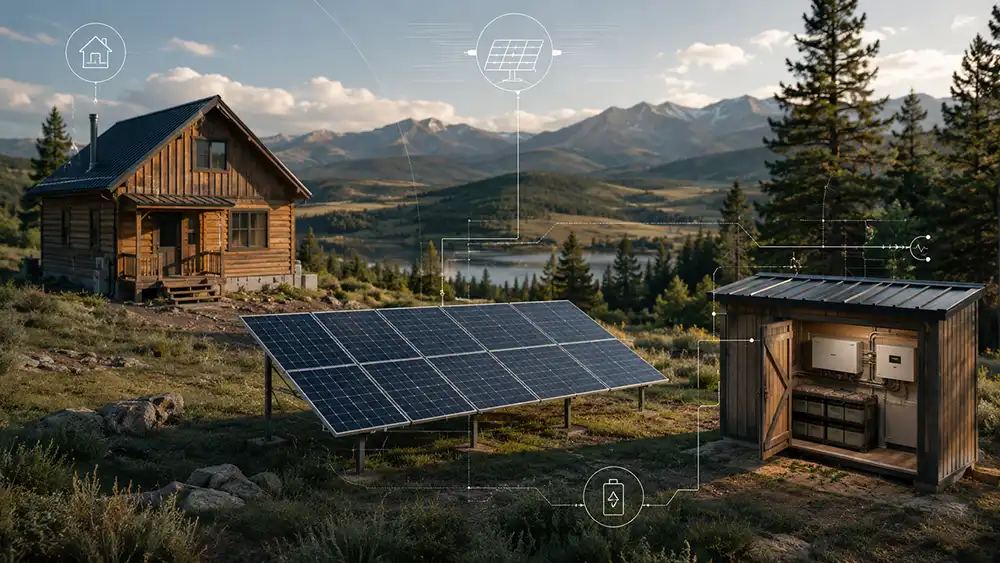
Solar panels in series vs parallel is the first wiring choice every off grid builder faces. Series wiring adds voltage and keeps current the same, while parallel wiring adds current and keeps voltage the same. The right choice depends on your charge controller limits, wire length, shading and panel mix.
This guide explains solar panels in series vs parallel in plain language, with a comparison table, the formulas, MPPT controller limits, shading effects, and a worked example you can copy. It is general guidance. Always check your panel and controller data sheets and local electrical rules.
Quick answer: solar panels in series vs parallel
- Series: voltages add, current stays the same. Good for long wire runs and MPPT controllers. Shading on one panel hurts the whole string.
- Parallel: currents add, voltage stays the same. Better shade tolerance, but needs thicker wire and more fuses.
- Series-parallel: combine both to hit the voltage window of your controller and your power target.
Series vs parallel solar panel calculator
Take the values from the panel label or datasheet (STC).
The safe default factor of 1.25 matches the guidance in this article. Using your record low and the temperature coefficient gives a more precise figure. Always confirm limits in the controller datasheet.
How the numbers add up
| Wiring | Voltage | Current | Example with 4 panels (22 V Voc, 18 V Vmp, 6 A Isc, 5.6 A Imp) |
|---|---|---|---|
| All in series | Sum of voltages | Same as one panel | 88 V Voc, 72 V Vmp, 5.6 A |
| All in parallel | Same as one panel | Sum of currents | 22 V Voc, 18 V Vmp, 22.4 A |
| 2 series x 2 parallel | Two panels in series | Two strings in parallel | 44 V Voc, 36 V Vmp, 11.2 A |
Total power is the same in every layout: voltage times current. Wiring changes the voltage and current balance, not the watts.
MPPT controller limits
An MPPT charge controller has a maximum input voltage and maximum input current. Both limits matter, and the voltage limit is the safety-critical one.
- Maximum PV voltage: the string open-circuit voltage (Voc) must stay below this limit, even in the coldest weather. Voc rises as temperature drops, by roughly 0.3 percent per degree Celsius for silicon panels. In cold climates multiply Voc by 1.25 for a safe estimate.
- Minimum start voltage: the string must exceed the battery voltage plus a margin for the controller to start. Parallel-only arrays with 12 V panels often fall short on cloudy days.
- Maximum input current: the sum of Isc in the string or strings must stay below the controller rating.
Size the controller with our guide on MPPT controller sizing, and check the wire gauge using the wire and fuse size guide.
Worked example: four 100 W panels and a 100 V controller
Four panels, each 22 V Voc, 18 V Vmp, 6 A Isc. Controller maximum input 100 V, 30 A, 12 V battery.
- All in series: Voc is 88 V, cold-corrected 88 x 1.25 = 110 V. That exceeds 100 V, so this layout is unsafe in cold weather.
- All in parallel: Voc is 22 V. Isc is 24 A, within 30 A. The controller starts easily, but the current is high, so wires must be thick and fused.
- Two in series, two strings in parallel: Voc is 44 V, cold-corrected 55 V. Isc is 12 A. This is within limits, and the wire sizing is moderate. This is the best layout.
Shading with solar panels in series vs parallel
- In a series string, shade on one panel reduces the current of the whole string. Bypass diodes help, but losses can be large.
- Parallel layouts lose only the shaded panel output, so they work better with partial shade from trees or chimneys.
- Never mix panels with very different voltage or current in the same series string. Match panels within a string.
- Different panels can sit in parallel if their voltages are close.
Wire runs and losses
Higher voltage means lower current for the same power, and lower current means less wire loss. If the array is far from the controller, series wiring lets you use thinner and cheaper cable. In a parallel layout, short runs and combiner boxes with fuses are important.
Safety notes
- Use DC-rated fuses or breakers for parallel strings, especially with three or more strings in parallel.
- Use a DC disconnect between array and controller.
- Panel voltage is dangerous even at 60 V and above. Cover panels or disconnect them before working.
- Follow the manufacturer instructions and local codes.
If you also want to tune the panel angle for winter, see our guide to the solar panel tilt angle.
Related guides
- MPPT Charge Controller Sizing Calculator
- Solar Panel Tilt Angle
- Off-Grid Solar System Sizing Calculator
- Wire and Fuse Size for Off Grid Solar
Frequently Asked Questions
Are solar panels better in series or parallel?
For MPPT controllers, series or series-parallel is usually better because higher voltage reduces wire losses. Parallel is better in shaded sites and with PWM controllers on 12 V systems.
Can I mix different solar panels?
Mixing is safest in parallel with similar voltage. In series, the weakest panel limits current, so match panel current within a string.
What happens if the string voltage is too high?
Exceeding the controller maximum input voltage can destroy the controller. Always check the cold-weather Voc against the limit.
Do I need a combiner box?
If you have three or more strings in parallel, use fuses or breakers per string and a combiner box. For two strings, check the panel data sheet for fuse requirements.
Sources and further reading
- U.S. Department of Energy: Solar Energy Technologies Office
- NREL PVWatts calculator
- NREL: Solar research
Solar panels in series vs parallel is a trade-off between voltage, current, shade tolerance and wire cost. Calculate the cold-weather voltage, respect the controller limits, and choose a series-parallel layout when you can. When in doubt, ask a qualified installer to review your design.
1 thought on “Solar Panels in Series vs Parallel: Voltage, Current and MPPT Limits”
Comments are closed.